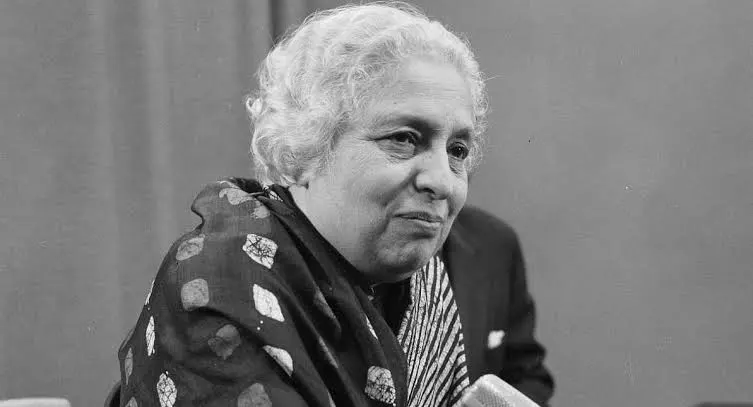
At a Glance
Anand Bhavan: Growing Up in the Heart of the Movement
Vijayalakshmi Pandit was born on 18 August 1900 in Allahabad as Swarup Kumari Nehru — the second child of Motilal Nehru, the most prominent lawyer in northern India and one of the most powerful figures in the Indian National Congress. The household into which she was born — Anand Bhavan, the large Nehru family home in Allahabad — was simultaneously a family residence and one of the principal meeting places of the Congress's national leadership. Gandhi visited; Gokhale visited; the debates that shaped the independence movement's direction were conducted in the drawing rooms and on the lawns of the house where she grew up. This immersion in the movement from childhood was the most important element of her political formation: she did not encounter nationalism as an idea or an ideology at a formative moment in adolescence or early adulthood, as many of her contemporaries did. She absorbed it as the natural atmosphere of her family's life.
Her education was largely private — tutors at home, some time at schools in England — rather than the formal institutional education that her brother Jawaharlal received at Harrow and Cambridge. This difference in educational formation between the Nehru siblings was characteristic of the period's treatment of girls from even the most progressive Indian families: the investment in expensive English education was made for the sons who would become lawyers or administrators, not typically for the daughters who would marry. Motilal Nehru was considerably more progressive than most of his contemporaries in the education and public engagement he encouraged in his daughters, but the formal educational distinction between Jawaharlal and Vijayalakshmi remained, and it shaped, in small ways, the different registers in which they operated throughout their public lives.
She was married in 1921 to Ranjit Sitaram Pandit — a Maharashtrian barrister, a Sanskrit scholar, and a Congress activist — and took the name Vijayalakshmi at that time. The marriage was a partnership of equals in the political as well as the personal sense: Ranjit Pandit shared his wife's nationalist commitments and was himself imprisoned for his political activities. He died in Lucknow Jail in January 1944, while Vijayalakshmi was also imprisoned under the Quit India crackdown — a bereavement that she received while still in detention, unable to be present at his death or at his funeral. The loss was profound and permanent; she did not remarry.
Three Imprisonments: The Independence Struggle's Personal Cost
Vijayalakshmi Pandit was imprisoned by the British three times for her participation in civil disobedience movements. The first imprisonment came in 1932, during the Civil Disobedience Movement — she was arrested in Allahabad and held for several months. The second came in 1940. The third, and longest, came with the Quit India Movement: she was arrested in August 1942 and held until 1943, spending the period in Naini Prison in Allahabad. It was during this third imprisonment that her husband died in Lucknow Jail, and the grief of receiving that news while herself imprisoned — unable to act, unable to mourn in any of the normal ways — was the hardest personal cost that the independence movement extracted from her directly.
The imprisonments were also periods of reflection and of the formation of political conviction that confinement can produce when the person confined has the inner resources to use the time. She read, wrote, and thought during her imprisonments with the same discipline that her brother brought to his far longer periods of imprisonment, though her confinements were shorter and the conditions less severe than those of the Cellular Jail or the most punitive of the colonial prisons. Her imprisonment gave her the independence movement's credential — the willingness to accept personal cost for the cause — that was necessary for credibility in the Congress's internal politics and, after independence, in the Indian public's assessment of its diplomatic representatives.
Ministerial Office: Among the First Women in Indian Government
The provincial elections of 1937 — held under the Government of India Act of 1935, which granted limited self-governance to the provinces — brought the Congress to power in several major provinces including the United Provinces. Vijayalakshmi Pandit was elected to the UP Legislative Assembly and was appointed to the provincial cabinet as Minister of Local Self-Government and Public Health — making her one of the first women, and in some accounts the first woman, to hold a cabinet-level position in India's governmental history. She held the portfolio until the Congress governments resigned from office in 1939 over the British decision to involve India in the Second World War without consulting Indian opinion, and again after independence in 1946–47.
Her ministerial work was practical and focused: improving sanitation and public health infrastructure in the United Provinces, reforming local government, managing the administrative portfolio of a major Indian province during a politically turbulent period. The work was not glamorous; it was the work of governance rather than of the movement, and it demonstrated the Congress's capacity — which it needed constantly to demonstrate against the colonial government's claim that Indians could not administer their own affairs — to manage real institutions with real consequences for ordinary people's lives.
The United Nations: India's First Diplomatic Battles
In 1946, even before formal independence, the interim government of India led by Jawaharlal Nehru sent Vijayalakshmi Pandit to head the Indian delegation to the United Nations General Assembly. The choice was simultaneously personal — she was Nehru's sister and his trusted representative — and professional: she had the political standing, the intelligence, and the English fluency to represent India effectively in the new international institution whose procedures and culture were being established in these founding years.
Her first significant achievement at the UN was the campaign against South Africa's treatment of its Indian minority — specifically, the Asiatic Land Tenure and Indian Representation Act of 1946, which restricted Indian land ownership and offered a form of communal representation that the Indian community and the Indian government rejected. Vijayalakshmi Pandit led India's successful effort to bring a resolution before the General Assembly calling on South Africa to negotiate with the Indian government and with representatives of the Indian community in South Africa. The resolution passed. It was India's first significant multilateral diplomatic success, achieved before independence, and it established both the UN as a forum where colonial and racial injustice could be effectively challenged and India as a country willing to use that forum actively.
She went on to serve as India's Ambassador to the Soviet Union (1947–49) and to the United States (1949–51) — two of the most important bilateral relationships for a newly independent India attempting to navigate the emerging Cold War without being consumed by it. Her period in Washington coincided with the height of early Cold War tension and with the Korean War, and her task was to represent Indian non-alignment — the Nehru government's insistence on maintaining independent relationships with both superpowers — to an American political establishment that viewed non-alignment with considerable suspicion and that tended to interpret it as soft sympathy for communism. She did this with considerable diplomatic skill, building personal relationships across Washington's political landscape and communicating the substance of Indian foreign policy in terms that her American interlocutors could understand even when they disagreed with it.
President of the UN General Assembly: 1953
In 1953, heading India's delegation to the UN General Assembly for the second time, Vijayalakshmi Pandit was elected President of the General Assembly — the presiding officer of the world's principal deliberative international body, responsible for managing its sessions, its procedures, and its increasingly complex agenda at a moment when the Assembly's membership was beginning the expansion that decolonisation would accelerate through the 1950s and 1960s. She was the first woman in history to hold the office.
The significance of the "first" is worth understanding in its context. The United Nations in 1953 was eight years old — a new institution, still defining its procedures and its relationship to the Security Council and to the Secretariat, still establishing its culture and its conventions. The election of a woman as the Assembly's President at that early stage was not inevitable: it reflected both the standing that India had established in the UN's first years and the personal reputation that Vijayalakshmi Pandit had built through her previous service as head of the Indian delegation. She presided over the Assembly's eighth session with the authority and competence that the role required — managing debate, maintaining procedure, representing the Assembly in its relations with other UN bodies — and her year as President established the precedent that the office was not gender-restricted, a precedent that has been followed by many subsequent women presidents of the Assembly.
Her tenure coincided with a moment of considerable UN activity: the Korean War had ended in July 1953 with an armistice, and the Assembly's agenda included the complex questions of Korean unification and the broader architecture of the post-war East Asian settlement. She navigated these issues with the procedural authority of the presidency and with the substantive knowledge that years of UN engagement had given her.
High Commissioner to the United Kingdom and Later Career
Vijayalakshmi Pandit served as India's High Commissioner to the United Kingdom from 1954 to 1961 — the diplomatic representative of independent India to the country that had colonised it for two centuries, stationed in London at a moment when the relationship between Britain and its former Indian empire was being renegotiated in both practical and emotional terms. The posting required both the formal diplomatic skills she had developed across a decade of ambassadorial service and the particular kind of self-possession that the situation demanded: representing a country that had fought for and won its independence to the government and society that had been the object of that fight, maintaining the professional courtesies of diplomatic practice while carrying the full weight of what that relationship had meant and cost.
She served as Governor of Maharashtra from 1962 to 1964 and as a Member of Parliament, and her later career was complicated by her increasingly difficult relationship with Indira Gandhi — her brother's daughter and, after Nehru's death in 1964, the dominant figure in the Congress and eventually in Indian politics. The relationship between Vijayalakshmi Pandit and Indira Gandhi was strained by political disagreements, by the complicated dynamics of a family in which public prominence was both shared and competed for, and by Vijayalakshmi Pandit's willingness to criticise her niece's political methods with a directness that Indira Gandhi did not welcome. She supported the opposition in the 1977 elections, briefly, before returning to the Congress fold. The family politics of the Nehru-Gandhi dynasty are among the most discussed topics in modern Indian political history, and Vijayalakshmi Pandit's place within them is a subject that her memoir — The Scope of Happiness, published in 1979 — addresses with more candour than is common in political autobiography.
Legacy: The Diplomat Who Opened the Door
Vijayalakshmi Pandit died on 1 December 1990 in Dehradun, aged ninety — one of the last surviving major figures of the independence generation, having outlived her brother by twenty-six years, her husband by forty-six, and most of the people with whom she had shared the Anand Bhavan years and the civil disobedience campaigns of the 1930s and 1940s. Her memoir, her papers, and her UN and diplomatic records constitute a primary source for the history of early Indian foreign policy and for the founding years of the United Nations that historians of both subjects continue to draw on.
Her place in Indian women's political history is secured by the UN General Assembly presidency — the first woman, in 1953, to hold the world's most prominent multilateral deliberative office — but its significance extends beyond the record. She demonstrated, across a career that stretched from the Allahabad drawing rooms of Anand Bhavan to the floor of the General Assembly in New York, that the women who had been part of the independence movement had not exhausted their public contribution with independence. The freedom fighters who survived 1947 faced the question of what to do with a freedom that had been achieved, and Vijayalakshmi Pandit's answer — to take the values and the commitments of the independence movement into the international arena, to argue for racial equality and decolonisation in the forums of the new world order, to represent India as a country with something to say and the standing to say it — was one of the most consequential answers that the independence generation gave to that question.