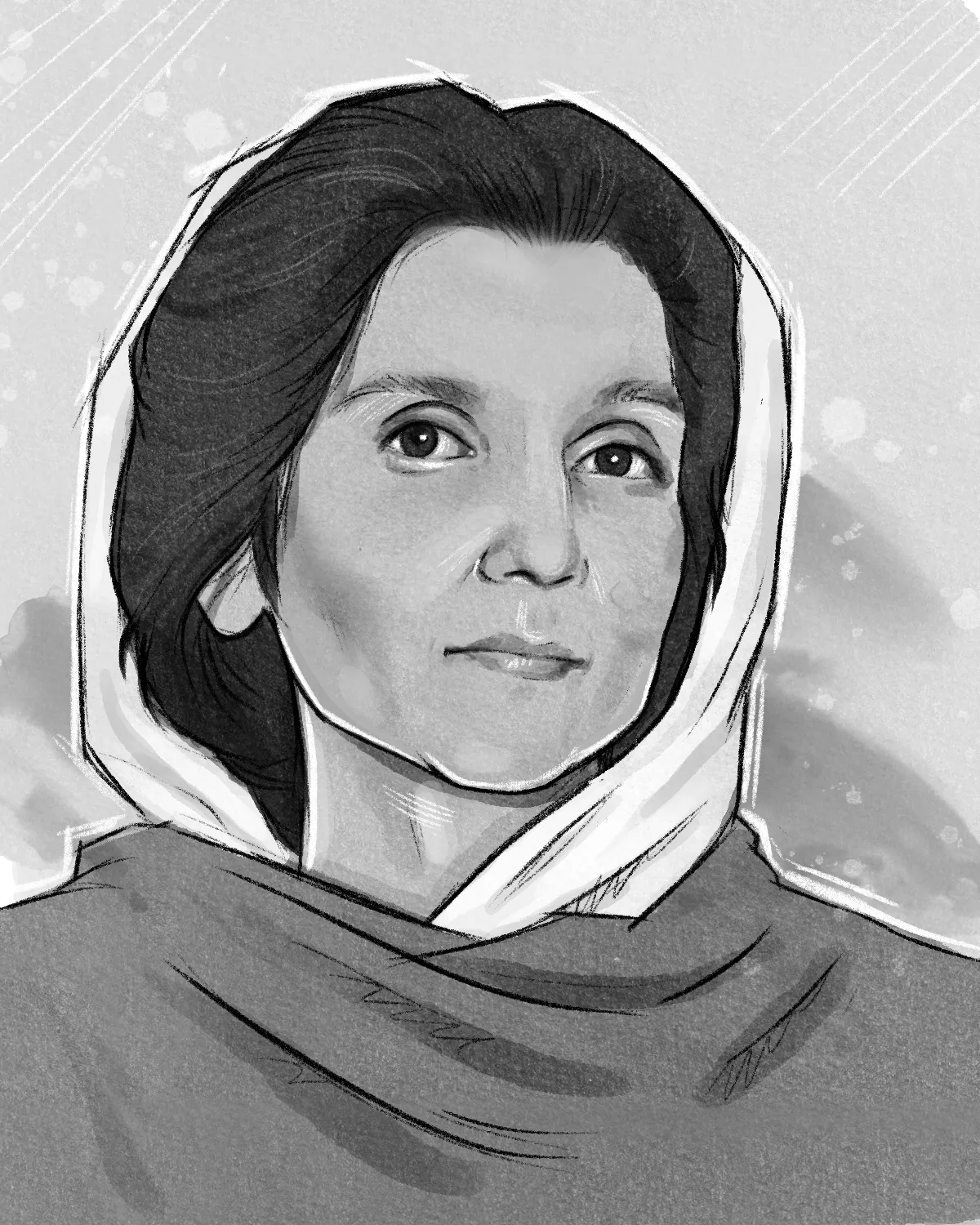
At a Glance
Kalka and Calcutta: A Bengali Brahmin Childhood and a Teacher's Training
Aruna Ganguly was born on 16 July 1909 in Kalka, a small hill town at the foot of the Himalayas in the Punjab, into a Bengali Brahmin family of modest means and strong educational values. Her father, Upendranath Ganguly, ran a restaurant and later a hotel; her mother came from a family that valued learning for daughters as well as sons, which was by no means universal among upper-caste Bengali families in the first decade of the twentieth century. Aruna was sent to Sacred Heart Convent in Nainital — a Catholic school run by European nuns, where the medium of instruction was English and the model of education was deliberately anglicised — and subsequently to Bethune College in Calcutta, which was by the 1920s one of the most prestigious institutions for women's education in India and had produced generations of Bengali women who entered public life.
She completed her studies and began teaching at a school in Allahabad, which was then one of the centres of Indian nationalist politics — the city of the Nehru family, a Congress stronghold, and a place where the question of independence was not abstract but immediate. It was through the Congress networks in Allahabad that she met Asaf Ali, a senior Muslim Congress leader and barrister who was twenty years her senior. They fell in love and decided to marry. Both families objected, for the obvious reasons: she was a young Hindu Brahmin woman, he was a Muslim, and the age gap was conspicuous. They married anyway in 1928, and the marriage — which lasted until Asaf Ali's death in 1953 — was, by all accounts, a genuine partnership of political commitment and personal affection. The opposition it overcame was not incidental to Aruna's character: she had demonstrated, at nineteen, that she would not allow family pressure to determine choices she had made on her own terms.
The Salt March and Tihar Jail: First Imprisonment
She joined the Indian National Congress the year after her marriage, in 1930, which was the year of Gandhi's Salt March — arguably the single most effective act of civil disobedience in the entire independence movement. The march to Dandi, where Gandhi and his followers made salt from the sea in deliberate violation of the salt tax, ignited a wave of civil disobedience across India that the colonial government struggled to contain. Aruna Asaf Ali joined the movement, participated in the protests, and was arrested. She was sent to Tihar Jail in Delhi, where she spent fourteen months — a period she later described not as a hardship to be minimised but as a formative education in the realities of colonial governance.
The conditions in Tihar were wretched for political prisoners who refused to accept the lower-class treatment the colonial authorities applied to Indians. Aruna refused to accept it. She was kept in conditions considerably inferior to those offered European prisoners and fought, from inside the jail, for political prisoner status. When the government granted an amnesty in 1931 as part of the Gandhi-Irwin Pact, Aruna was initially excluded from the amnesty order — she had apparently made enough trouble inside prison to be individually noted. She refused to accept release on unequal terms and remained in jail until the full amnesty was extended. This was characteristic: she consistently chose the harder option when the easier one involved accepting an inequality she regarded as unjust.
The Congress Years: Building Toward 1942
Through the 1930s Aruna Asaf Ali was an active Congress organiser, attending sessions, participating in civil disobedience campaigns, and building the networks of local political organisation that the Congress depended on to function as a mass movement rather than an elite debating society. She was not yet at the front rank of Congress leadership — that was still a world dominated by men of an older generation — but she was known, respected, and effective. Her husband Asaf Ali's seniority in Congress gave her access to the movement's inner discussions; her own abilities and willingness to do the unglamorous work of organising kept her inside those discussions in her own right.
The Second World War changed the political calculus entirely. Britain declared India a belligerent in the war without consulting any Indian political body, a decision that outraged even the most moderate Congress leaders. Subhas Chandra Bose had already broken with the Congress and was moving toward collaboration with the Axis powers as a strategy for forcing Britain out. The Congress Working Committee was moving toward the confrontational position that became the Quit India resolution. By July 1942, when Gandhi articulated "Do or Die" as the movement's slogan, the Congress had committed to open mass defiance of colonial rule on a scale not attempted since 1857.
9 August 1942: Gowalia Tank and the Flag
The British government in India had been watching the Congress preparations and decided to act first. In the pre-dawn hours of 9 August 1942, police and soldiers moved simultaneously across India to arrest every senior Congress leader they could find. Gandhi was taken from Birla House in Bombay. Nehru was arrested in Allahabad. Patel, Maulana Azad, and dozens of other Working Committee members were taken in a coordinated sweep. The government's calculation was clear: without leadership, the movement would stall.
A large crowd had gathered at Gowalia Tank Maidan in Bombay, expecting to hear the Congress leaders speak after the passage of the Quit India resolution. They arrived to find the leaders gone and police barricading the ground. The Congress flag — the symbol of the movement — had not been hoisted. The crowd was confused and uncertain. Aruna Asaf Ali walked to the platform, climbed up, and raised the flag. The police moved in immediately; the crowd surged; in the chaos Aruna escaped. The photograph of that moment — the flag being raised at Gowalia Tank on the morning the Quit India Movement began — became one of the most reproduced images of the independence struggle.
The colonial government issued an arrest warrant and declared her an absconder. A reward of five thousand rupees — a very substantial sum in 1942 — was offered for information leading to her capture. She went underground.
Three Years Underground: The Hidden Network
The underground period from 1942 to 1945 tested everything Aruna Asaf Ali had. She moved constantly, staying with sympathisers, using different names, maintaining communication with Congress networks across India at a time when those networks were being systematically dismantled by the colonial authorities. She helped coordinate the clandestine Congress Radio, which broadcast from shifting locations and kept the underground movement's communications alive at a time when all official Congress activity was banned. She helped distribute funds — collected by sympathisers and channelled through networks that the government was trying to identify and shut down — to resistance cells across the country.
Gandhi, from his own confinement at the Aga Khan Palace in Pune, wrote to Aruna urging her to surrender. He was concerned about her health and about the risk she was running, and he argued that voluntary surrender would be a morally consistent act for a satyagrahi. She wrote back respectfully declining. She believed the underground work she was doing was too valuable to surrender it for a gesture of compliance, however principled. The correspondence between them is one of the more interesting exchanges in the independence movement's documentary record — two people who respected each other deeply, disagreeing with perfect clarity about tactics, neither bullying the other into agreement.
By 1945, with the war ending and the political situation shifting, the government quietly dropped the charges against her. She returned to public life in 1946, attending the Congress sessions that would shape the negotiations over partition and independence. She had spent three years as one of the most wanted people in India. She had not been caught.
Independence and Political Life in a Free India
The independence that came in August 1947 brought Asaf Ali an ambassadorship — he was appointed India's first ambassador to the United States — and Aruna had to decide what she wanted to do with a public life now freed from the constraints of colonial repression. She moved toward the left of Indian politics, joining the Socialist Party and subsequently the Communist Party of India, positions that put her at odds with the Nehru government on economic policy and with the Congress mainstream on the Cold War. She edited Patriot, a left-leaning English-language newspaper she founded in 1962 that she ran with the same directness she had brought to everything else she did.
In 1958 she was elected the first Mayor of Delhi, a position that brought her back into the administrative mainstream and demonstrated that her political reach extended beyond ideology into the practical business of city governance. She served in that role with the attention to concrete problems — housing, sanitation, education — that she had always brought to political work, and the position is historically significant as one of the first major elected administrative offices held by a woman in independent India.
Later Honours and the Long View
Aruna Asaf Ali lived to see much of the India she had fought for built, contested, reformed, and disputed. She received the Jawaharlal Nehru Award for International Understanding in 1991 and the Padma Vibhushan — India's second-highest civilian honour — in 1992. She died on 29 July 1996 in New Delhi, aged eighty-seven. The following year, in 1997 — fifty years after independence — the government of India awarded her the Bharat Ratna, the country's highest civilian honour. A commemorative postage stamp bearing her image was issued in 1998. Aruna Asaf Ali Marg, one of the significant roads in central New Delhi, carries her name.
What she had done on 9 August 1942 at Gowalia Tank took perhaps sixty seconds. The consequences of those sixty seconds — the image that spread across India of the flag still being raised despite the arrests, the signal that the movement would not be decapitated by removing its visible leaders — reverberated through three years of resistance. Acts of that kind require a particular combination: the knowledge of what is at stake, the physical courage to act when the police are present and the crowd is uncertain, and the clarity of mind to understand that a symbolic act at the right moment is not less but more consequential than a hundred acts of careful planning. Aruna Asaf Ali had all three, at thirty-two, on a monsoon morning in Bombay, with a crowd watching and a warrant about to be issued.