At a Glance
Hogla to Aligram: A Life Shaped by Loss and Labour
Matangini Hazra was born on 19 October 1870 in Hogla, a village in the Tamluk subdivision of Midnapore District, one of the most politically charged districts in Bengal — a region that produced a disproportionate number of revolutionary and civil disobedience activists throughout the independence movement, and that would, in the early 1940s, become one of the centres of the Quit India uprising. She was born into a poor Hindu family, without land or resources of significance, and the life she was given by the circumstances of her birth and early marriage was defined by labour, bereavement, and the narrow material horizons that poverty and widowhood imposed on women in rural Bengal in the late nineteenth century.
She was married at twelve — child marriage being the norm in the community into which she was born — to a man considerably older than herself. He died when she was approximately eighteen, leaving her a childless widow with no property of her own. Under the social codes of the time, a Hindu widow's options were severely constrained: remarriage was stigmatised in most communities, property rights were limited, and the social status of widowhood carried its own forms of deprivation and marginalisation. Matangini Hazra eventually remarried — itself an act of some social defiance — but her second husband also died, leaving her again a widow, in a village called Aligram, with no children, no property, and no resources beyond her own labour and the social networks of the village community.
She worked as a day labourer and in domestic agriculture — the difficult, low-paid physical work of the landless poor in rural Bengal. The conditions of her life gave her no particular reason, by any conventional calculation, to become a political activist. She was poor, illiterate, elderly, and female — four categories each of which, separately, carried significant barriers to political participation in early twentieth-century India, and which in combination formed what might have seemed an insuperable obstacle to public life. The story of how she became Gandhi Buri is therefore not the story of a woman with resources and education finding her way to activism. It is the story of a woman with nothing but conviction finding that conviction was enough.
The Gandhian Turn: Civil Disobedience in Midnapore
Matangini Hazra's encounter with the independence movement came through the Congress's civil disobedience campaigns of the early 1930s — specifically, through the Salt Satyagraha that Gandhi launched in March 1930 by marching to the sea at Dandi to make salt in defiance of the colonial salt monopoly. The Dandi March and the mass civil disobedience it triggered spread across India with extraordinary speed, and in Midnapore District it found a particularly receptive population: the district had a tradition of resistance to British taxation and authority dating back to the Chuar rebellions of the eighteenth century, and it had active Congress networks that could organise the grassroots participation the campaign required.
Matangini Hazra joined one of the salt satyagraha actions in Midnapore — a procession to a salt pan or a symbolic salt-making exercise — and was arrested. The arrest, far from deterring her, appears to have confirmed her commitment. Being arrested for defying the colonial government was, in the Gandhian framework, not a punishment but a demonstration of moral seriousness: the willingness to accept legal consequences for civil disobedience was the proof of the satyagrahi's sincerity. Matangini Hazra accepted her arrest, paid her fine or served her brief detention, and came back into the movement.
Through the 1930s she became a familiar presence in the local Congress activities of the Tamluk area — attending meetings, participating in processions, and becoming known in her village and the surrounding area as a woman of unusual determination and courage. The nickname "Gandhi Buri" — Gandhi's old woman — was given to her by the people of the area, initially perhaps with some of the affectionate condescension that attaches to the unexpected commitment of an elderly woman, but increasingly with genuine respect for the constancy of her engagement. She was arrested more than once during the decade, fined, briefly imprisoned, and returned each time to the same activities. She was not building a political career or seeking recognition. She was doing what she believed needed to be done.
1942: The Quit India Movement Reaches Midnapore
On 8 August 1942, the All India Congress Committee, meeting in Bombay at the Gowalia Tank Maidan, passed the Quit India Resolution and authorised Gandhi to lead a mass civil disobedience movement demanding immediate British withdrawal from India. Gandhi's speech that evening — in which he said "Do or Die," calling on every Indian to give everything they had to the movement or to die in the attempt — was broadcast and transmitted across India. The British response was immediate: in the early hours of 9 August, Gandhi, Nehru, and virtually the entire Congress leadership were arrested and imprisoned. The movement was left without its national leadership from its very first day.
What happened next was one of the most remarkable episodes of the independence movement: leaderless, lacking central coordination, and sustained by the energy of millions of ordinary people who had understood Gandhi's call as a personal instruction rather than a programme to be implemented by a hierarchy, the Quit India Movement broke out across India in forms that were often violent, localised, and beyond any organisation's control. In Bengal — particularly in Midnapore District — the movement was especially intense. Government buildings were attacked, police stations targeted, railway lines disrupted, and local administrations paralysed in many areas. In parts of Midnapore, a parallel national government — the Jatiya Sarkar — was eventually established, operating outside British authority and administering justice and public services for approximately two years.
It was into this context that Matangini Hazra stepped on 29 September 1942. She was seventy-two years old.
29 September 1942: The March to Tamluk
The procession that Matangini Hazra led to the Tamluk police station on 29 September 1942 was one of many similar processions organised across Midnapore District in the weeks after the Quit India Resolution. The targets were typically police stations and government offices — the physical sites of British administrative authority — and the tactic was the Gandhian one: a large peaceful march, the demonstrators advancing unarmed, intending to take symbolic or actual possession of the building as a statement that the British administration had lost its legitimacy and that Indian self-governance was beginning.
The procession that day numbered approximately six thousand people, many of them women from the villages of the area who had responded to the call and come in groups to Tamluk. Matangini Hazra was at the front, carrying the Indian National Congress tricolour flag. She was not the formal organiser of the march — the Congress structures of Tamluk had planned it — but she was its visible leader, its front rank, the oldest person present and the one who walked at the head.
As the procession approached the police station, the police opened fire. The first bullet hit Matangini Hazra in the hand — the hand that held the Congress flag. She transferred the flag to her other hand and continued advancing. The police fired again; she was hit a second time. She kept walking. A third shot struck her — this one fatal. She fell, still holding the flag. Witnesses reported that her last words were "Vande Mataram." The procession behind her did not immediately disperse — the sight of the elderly woman falling while still holding the flag, still advancing, still crying the nationalist salutation, had fixed itself into the memory of everyone present in a way that did not dissolve into panic. It crystallised into legend almost immediately.
The Meaning of Her Courage
What makes Matangini Hazra's death so powerful as a story — and what explains the place it has held in Indian nationalist and Bengali cultural memory ever since — is not primarily the fact of her dying. Many people died in the Quit India Movement, in the colonial repression of 1942 that killed hundreds across India. It is the specific character of how she died: the two intermediate moments, when she transferred the flag from her wounded hand and kept walking, and when she continued advancing after the second wound. These are not the actions of someone who did not understand what was happening. They are the actions of someone who understood exactly what was happening and chose to continue. At seventy-two, illiterate, poor, without status or power or resources, she made a decision in the moment of maximum danger that was also the clearest possible expression of what she had believed for the preceding twelve years of her political life.
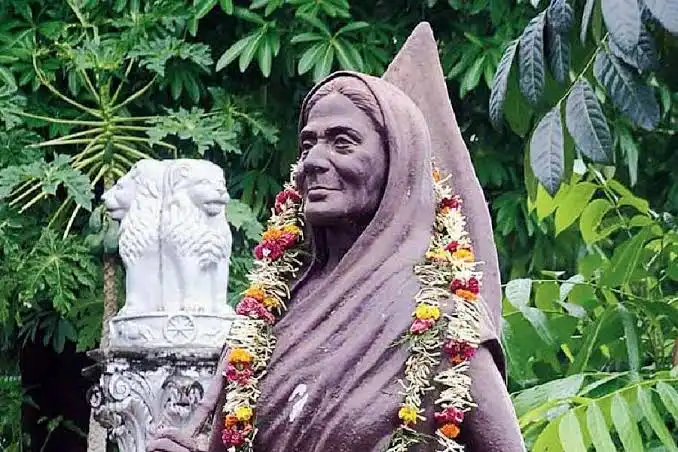
The social dimensions of her martyrdom also deserve attention. She was a woman in a society that severely limited women's public roles; she was elderly in a political culture that often equated leadership with physical vigour; she was poor and illiterate in a movement whose most famous figures were educated lawyers and intellectuals. Her presence at the front of a procession of six thousand people was already an assertion against these limitations. Her death at the front of that procession, flag in hand, is a statement that freedom struggles are not the exclusive property of the young, the educated, the male, or the privileged. It is this universalising force that has kept her story alive and that has made her statue, at the base of the Victoria Memorial in Kolkata, such a charged presence in the landscape of Bengali public memory.
Commemoration and Legacy
The Tamluk Mahakuma — Tamluk subdivision — established a Jatiya Sarkar (National Government) in December 1942, partly in the spirit of those who had died in the September marches, and this parallel government operated for approximately two years in effective defiance of the British administration, administering justice, maintaining public services, and governing the area as if independence had already arrived. It was one of the most sustained experiments in self-governance during the independence struggle and stands as a practical legacy of the movement in which Matangini Hazra gave her life.
The Government of India issued a commemorative postage stamp in Matangini Hazra's honour in 1977. Her statue stands prominently in Tamluk, the town where she died. Most significantly, a full-figure statue of Matangini Hazra stands at the base of the Victoria Memorial in Kolkata — alongside statues of Mahatma Gandhi and Subhas Chandra Bose — making her one of very few freedom fighters, and the most prominent woman, commemorated at that central site of Kolkata's public space. The statue shows her as she fell: an elderly woman, flag in hand, advancing. It is one of the most powerful images of the independence movement in the public spaces of independent India.
In 2002, the Government of India launched INS Matangini, a coastal patrol vessel, named in her honour. Schools, roads, and public institutions in West Bengal bear her name. The annual commemorations at Tamluk on 29 September draw crowds that include politicians, students, and villagers from across Midnapore — people who understand that what she did on that day was not simply brave but paradigmatic: a demonstration that the independence struggle belonged to everyone, that its cost could be asked of everyone, and that everyone could choose to pay it.