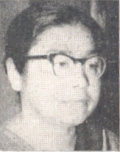
At a Glance
Ambala to Delhi: Education and the Path to Congress
Sucheta Majumdar was born on 25 June 1908 in Ambala in Punjab — now in Haryana — into a Bengali family whose circumstances were comfortable rather than affluent. Her father was a government officer, and the family's mobility through different postings gave her an education that was broader geographically than most of her contemporaries. She studied at Lahore and then at Banaras Hindu University, where she took an MA in History — the degree that qualified her for the academic position she initially pursued as a lecturer at Indraprastha College in Delhi.
Delhi in the 1930s was the capital of the colonial government and a city with a significant nationalist presence — Congress organisations, women's associations, student groups, and trade unions all active in the political life of the city and all connected to the wider national movement. Sucheta Majumdar came into Congress politics through the women's and students' organisations that operated alongside the formal party structures, and she developed into an organiser of considerable ability — practical, disciplined, willing to do the less glamorous work of building and maintaining networks that the movement's spectacular actions depended upon.
She married Jivatram Bhagwandas Kripalani in 1936 — better known as J. B. Kripalani or Acharya Kripalani, who would serve as President of the Indian National Congress in 1946–47 during the critical period of the transfer of power negotiations. The marriage connected her to the innermost circles of the Congress leadership and gave her a vantage point from which the independence movement's internal dynamics were visible in unusual detail. She retained her own political identity and her own political record throughout, and the significance of her career does not derive from her husband's position.
Quit India 1942: Underground in the Capital
When Gandhi launched the Quit India Movement on 8 August 1942 and the British arrested virtually the entire Congress leadership in the early hours of 9 August, the movement found itself without its national leadership from its first day. In Delhi — the seat of the colonial government, the city most directly under the eyes of the Viceroy's administration and its intelligence apparatus — maintaining any kind of organised Congress presence was particularly difficult and particularly dangerous. The police were alert, the government's intelligence networks were extensive, and the consequences of arrest were certain and severe.
Sucheta Kriplani organised the Congress underground in Delhi during this period — maintaining communications between activists, coordinating with the Congress networks in other cities, helping to sustain the movement's presence in the capital while its formal leadership was imprisoned. This was work that required not the public courage of the demonstration but the sustained, patient, dangerous courage of the clandestine organiser: the ability to manage information carefully, to maintain secure communications, to make decisions under pressure without the guidance of the leaders who were no longer available, and to keep the networks functioning month after month without the drama of a public confrontation to sustain morale.
She was arrested. The accounts of her imprisonment include a hunger strike — the satyagrahi's assertion of moral authority in conditions of physical constraint — and her eventual release. The arrest and the hunger strike did not end her underground activities; she resumed them after her release and continued through the remaining years of the war. The Quit India period was the crucible in which her political character was fully formed, and the qualities it revealed — the combination of organisational ability with personal courage and the willingness to endure hardship without complaint — defined her political reputation for the rest of her career.
The Constituent Assembly: Midnight and Vande Mataram
Sucheta Kriplani was elected to the Constituent Assembly of India in 1946 and served throughout its deliberations as it drafted the constitution of independent India. The Constituent Assembly was not a rubber stamp: its debates were genuine, its members engaged seriously with the questions of rights, governance, federalism, and social justice that the constitution had to resolve, and women members — including Sucheta Kriplani, Sarojini Naidu, Vijayalakshmi Pandit, Hansa Mehta, and Ammu Swaminathan — participated actively in those debates and shaped several of the constitution's provisions on women's rights and social equality.
The moment for which she is most immediately remembered in the Constituent Assembly is the midnight session of 14–15 August 1947, when India's independence took formal effect. The session opened with Jawaharlal Nehru's "Tryst with Destiny" speech — one of the most celebrated addresses in modern political oratory. Sucheta Kriplani sang "Vande Mataram" — the nationalist hymn that had been the movement's anthem for half a century — as the transfer of power became complete. The moment has been preserved in photographs and in the memory of those present: the woman who had organised the underground in Delhi during the darkest years of the movement, singing the song that the movement had made sacred, at the moment that the movement had been made for. It was not a performance. It was a conclusion.
Parliament and the Path to Uttar Pradesh
Sucheta Kriplani was elected to the Lok Sabha in the first general elections of 1952 and served multiple terms as a Member of Parliament — a constituency representative and a party figure of increasing seniority in the Congress organisation. She served as General Secretary of the Indian National Congress and was known within the party as a woman of exceptional organisational ability and personal integrity, qualities that were not always the most politically advantageous combination in the Congress of the 1950s and early 1960s but that gave her a particular kind of moral authority.
Uttar Pradesh — the largest and most politically consequential state in India, with a population approaching eighty million by the early 1960s — had been governed by Congress since independence, and its internal Congress politics were among the most complex in the country: factionalism, caste politics, the competing interests of the state's various regional and religious communities, and the administrative challenges of governing a state the size of France with the resources available to post-independence India all made UP's Chief Ministership one of the most demanding positions in Indian politics. When Sucheta Kriplani was elected Chief Minister of Uttar Pradesh in October 1963, she became the first woman ever to hold that office in any Indian state.
Chief Minister of Uttar Pradesh: Austerity and Principle
Sucheta Kriplani took office as Chief Minister of Uttar Pradesh in a state in severe fiscal difficulty. The state government's finances were strained; the wage bill for state employees was consuming resources that were needed for development; and the political culture of the Congress organisation in UP was not conducive to the kind of firm fiscal management that the situation required. She imposed an austerity programme — reducing government expenditure, refusing to accede to demands for wage increases that the state could not afford, and demonstrating in her own conduct the personal simplicity that she had always practiced and that she expected of the administration she led.
The most difficult episode of her tenure was the state government employees' strike of 1966–67, in which government workers struck over pay demands that Sucheta Kriplani refused to meet on the grounds that the state could not afford them. The strike was long and bitter; the government employees were a significant constituency; and the political pressure on her to settle on terms that would have added substantially to the state's financial burden was enormous. She refused. She broke the strike. The decision was unpopular with the strikers and with the sections of the Congress organisation that represented their interests, and it contributed to the erosion of her political base within the party. She declined to seek re-election as Chief Minister in 1967 and withdrew from active politics.
Her tenure was not only about austerity. She worked on agricultural development in a state that was heavily dependent on farming, pursued rural electrification and road-building programmes, and attempted to address the caste and communal tensions that were chronic features of Uttar Pradesh's political life. The fiscal crisis constrained what she could accomplish, and her four years as Chief Minister are not generally counted among the most administratively transformative in UP's history. But they demonstrated something important: that a woman could govern India's largest and most complex state with the same combination of competence and principle that male Chief Ministers brought to the office, and that the first to do so would not be remembered as a novelty but as a Chief Minister who did her job.
Retirement and Legacy
Sucheta Kriplani left active politics in 1971, in declining health, and died in New Delhi on 1 December 1974 at the age of sixty-six. She had been in public life for nearly forty years — from the Congress underground of the Quit India period through the Constituent Assembly, through Parliament, through the Chief Ministership of Uttar Pradesh. Sucheta Kriplani Hospital in New Delhi was named in her honour, and she is commemorated in Indian women's political history as a founding figure: the first woman to govern an Indian state, the woman who sang Vande Mataram at the midnight of independence, the organiser who kept the movement alive in Delhi when the leaders were in prison.
Her significance in the longer arc of Indian women's political participation is easily understated because it was followed so quickly — Indira Gandhi became Prime Minister in 1966, only three years after Sucheta Kriplani became Chief Minister of UP — by a figure whose prominence has inevitably overshadowed almost everyone else. But Sucheta Kriplani got there first, without dynastic connection or family legacy, on the strength of her own record in the independence movement and her own political ability. The midnight song and the Chief Ministership of Uttar Pradesh are two points on the same line — the life of a woman who understood that freedom, once achieved, had to be governed as seriously as it had been fought for.