At a Glance
Bhagur to London: The Education of a Revolutionary
Vinayak Damodar Savarkar was born on 28 May 1883 in Bhagur, a village in Nashik District in Maharashtra, into a Chitpavan Brahmin family — the subcaste that had provided the intellectual and administrative elite of the Maratha Empire and that was, in the late nineteenth century, disproportionately represented among Maharashtra's educated professional class and revolutionary nationalists. His father was a village landowner; his early life was shaped by the violence that marked the Maharashtra of his childhood, including the bubonic plague epidemic of the 1890s and the colonial government's aggressive, sometimes brutal plague-control measures that contributed to the political radicalisation of a generation of Maharashtrians.
He was educated at Fergusson College in Pune — one of the premier nationalist educational institutions in western India, where the intellectual influence of Bal Gangadhar Tilak was pervasive — and founded the Abhinav Bharat Society (Young India Society) in 1904, modelling it consciously on the Italian revolutionary Mazzini's Young Italy. The Abhinav Bharat was a secret society committed to revolutionary nationalism, and its foundation while Savarkar was still a college student reflects both his precocity and the intensity of the political atmosphere in Pune in the years following the partition of Bengal and the Swadeshi agitation of 1905.
He went to London in 1906 on a scholarship to study law at Gray's Inn, and in London he became the dominant figure at India House — the hostel and meeting place of Indian students in London that became, under his influence, a centre of revolutionary nationalist activity. India House hosted lectures, discussions, and the planning of more direct actions; it attracted Indian students who were being radicalised by the experience of living in the empire's capital while reading about the empire's treatment of India, and Savarkar channelled that radicalisation into organised activity. He arranged for pistols to be smuggled from London to the Abhinav Bharat network in Nashik, and one of those pistols was used in the 1909 assassination of the District Magistrate A. M. T. Jackson in Nashik — the killing for which Savarkar was eventually prosecuted.
The 1857 Book: Reframing the Rebellion
While in London, Savarkar wrote The Indian War of Independence, 1857 — a systematic historical argument that the 1857 Rebellion was not a mutiny, as British historiography insisted, but the first war of Indian independence: a coherent national uprising against colonial rule, deserving celebration rather than condemnation. The book was completed in 1908, banned by the British government before it could be published in India, and eventually published in 1909 through a Dutch press and circulated clandestinely. It was a serious work of historical argument — not merely political propaganda, though it was certainly that too — that reframed the entire narrative of 1857 in terms that nationalist historians and political thinkers across the spectrum, including many who would later reject Savarkar's Hindu nationalist politics, drew on for decades.
The argument that 1857 was a national war rather than a military mutiny had been made in various forms before Savarkar, but he made it with a comprehensiveness and a polemical force that no earlier treatment had achieved. He gave the nationalist movement a usable history of its own resistance — a founding moment of armed struggle against colonial rule that preceded the constitutional-moderate tradition and that sat alongside and implicitly challenged it. The 1857 book is one of the most consequential single acts of historical writing in Indian nationalist history, regardless of how one assesses the political direction Savarkar subsequently took.
Arrest, the Marseilles Escape, and Two Life Sentences
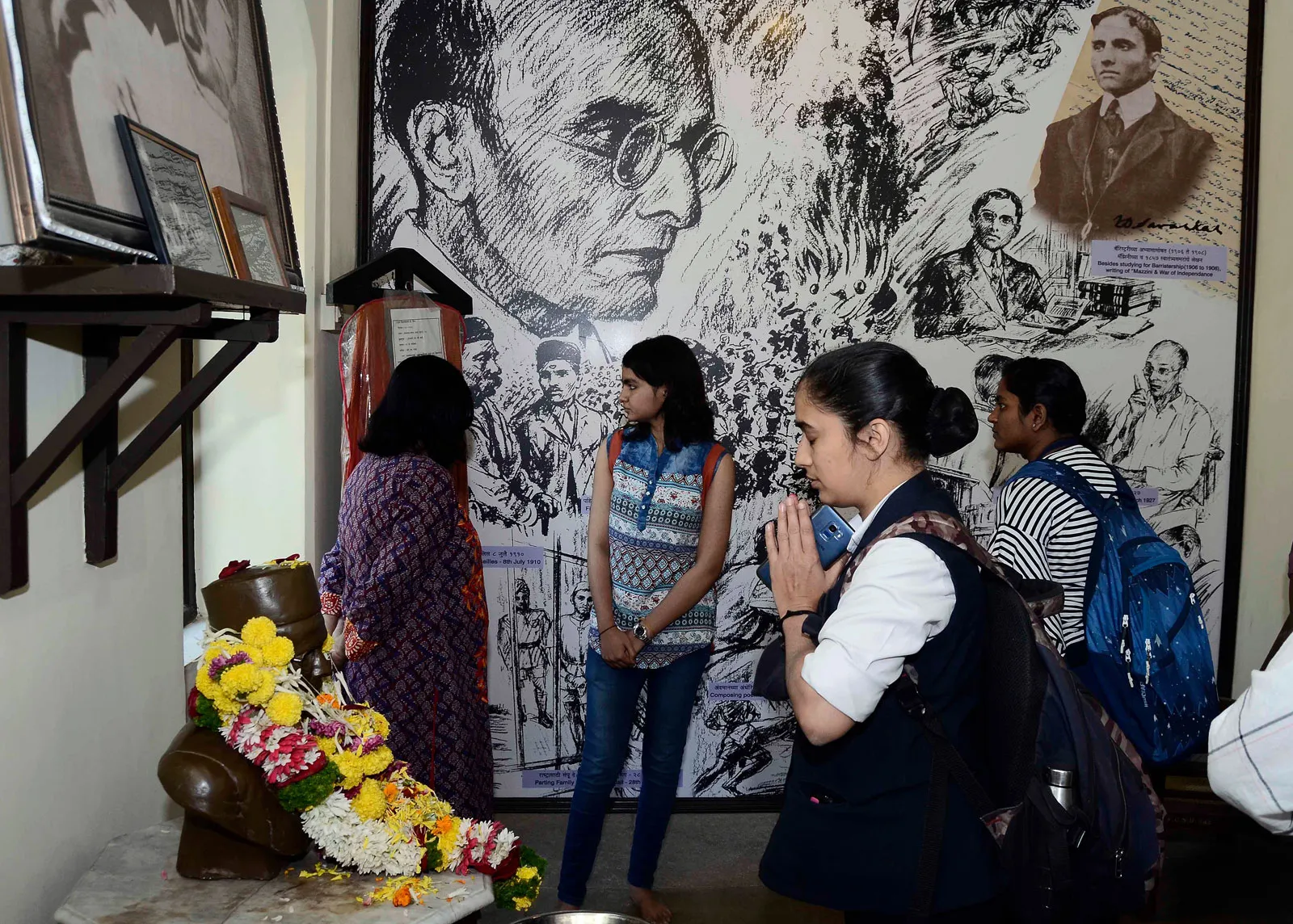
Savarkar was arrested in London in 1910 on charges arising from the Nashik pistol smuggling. He was being transported from England to India aboard the SS Morea when, as the ship docked at Marseilles on 8 July 1910, he escaped through a porthole, swam to the harbour, and ran along the quay appealing to bystanders for asylum. French police, responding to a call from British officers aboard the ship, caught him and handed him back to the British — an act that violated the applicable rules of international extradition law and that was subsequently challenged at the Permanent Court of Arbitration at The Hague, which ultimately ruled in Britain's favour on procedural grounds. The Marseilles escape attempt became one of the most celebrated episodes in the popular narrative of Savarkar's revolutionary career — the image of the young man swimming from the prison ship toward a quay where freedom was momentarily visible before being snatched away.
He was tried in the Nasik Conspiracy Case — charged with conspiracy in the Nashik assassination and with waging war against the King — and sentenced to two consecutive terms of transportation for life: fifty years in total, the most severe sentence imposed on any Indian political prisoner of the independence movement. He arrived at the Andaman Cellular Jail in 1911, aged twenty-seven, and was there until 1921.
The Andaman Years and the Petitions
Savarkar's eleven years in the Andaman Cellular Jail are the most complex and most contested element of his biography. The complexity arises from two parallel facts: that he endured the hardships of the Cellular Jail with considerable courage — writing poetry on the cell walls with thorns when he had no pen or paper, maintaining his intellectual life under conditions designed to destroy it, producing written work of substance during his imprisonment — and that he petitioned the British colonial government for release and for clemency multiple times between 1913 and 1920, in terms that his critics have characterised as supplicatory and that his defenders have characterised as strategic.
The petitions are a matter of historical record. They exist; they can be read; their language is not defiant. The most cited is the 1913 petition, in which Savarkar asked for release or transfer on the grounds of his poor health and expressed willingness to support the government's constitutional efforts and to work within the law. His defenders argue that the petitions were a tactical necessity — that a man facing fifty years of transportation had no realistic alternative to attempting to negotiate an earlier release, and that the language of submission was the price of making the petitions legible to their audience. His critics argue that the contrast between the petitions' tone and the revolutionary defiance that Savarkar claimed for himself is a fundamental inconsistency that reveals something about his character that his admirers prefer not to examine.
What is not disputed is that he was transferred to Ratnagiri prison on the mainland in 1921 and released in 1924 — subject to the restriction that he could not leave Ratnagiri District and could not engage in political activity for five years. He observed the territorial restriction, at least formally, and used the period to write and to think — including to develop the ideological framework that he published as Hindutva: Who is a Hindu? in 1923, under a pseudonym, while still imprisoned.
Hindutva: The Ideology and Its Consequences
The 1923 pamphlet Hindutva: Who is a Hindu? is Savarkar's most consequential and most disputed intellectual contribution. It articulated a definition of Hindu identity that was not primarily religious but cultural and territorial: a Hindu, in Savarkar's definition, was anyone who regarded India as both their fatherland (pitribhumi) and their holy land (punyabhumi). This definition was explicitly designed to include Sikhs, Buddhists, and Jains within Hindu identity while excluding Muslims and Christians — whose holy lands, in Savarkar's framework, lay in Arabia and Palestine respectively, making them partially foreign in their primary loyalties regardless of where they had been born or how many generations their families had lived in India.
The distinction between religious practice and cultural identity that Savarkar drew was presented as a secular or at least non-theistic nationalism: you did not have to be a practising Hindu to be a Hindu in his sense. But the effect of the definition was to make the religious identity of Muslims and Christians a permanent political disqualification from full Indian nationality — to build minority exclusion into the conceptual foundation of the nation rather than treating it as a political problem to be managed. This is the core of the sustained critique of Hindutva that has been made from the Congress tradition, from the Muslim League tradition, and from the secular and socialist left in India: that Savarkar's definition of the nation made the two-nation theory inevitable by conceding its premise.
The RSS (Rashtriya Swayamsevak Sangh), founded in 1925 by K. B. Hedgewar, drew heavily on Savarkar's ideological framework. The Hindu Mahasabha, which Savarkar led as President from 1937 to 1943, was the principal political vehicle of Hindu nationalism in the Congress era. The Bharatiya Jana Sangh (founded 1951) and its successor the BJP (founded 1980) are the electoral expressions of the tradition that Savarkar's ideology shaped. The question of whether Savarkar bears responsibility for the political uses to which his ideology was put is one of the central questions in the contemporary argument about his legacy.
Gandhi's Assassination and the Acquittal
Mahatma Gandhi was assassinated on 30 January 1948 by Nathuram Godse, a former member of the RSS and an admirer of Savarkar's ideology. Savarkar was arrested and tried as a co-conspirator in the assassination. The prosecution alleged that Savarkar had approved or encouraged the killing; Godse, in his own testimony, praised Savarkar's ideological influence. Savarkar denied direct involvement. The Special Court acquitted him for lack of corroborative evidence, accepting the argument that the prosecution had not produced sufficient direct evidence connecting him to the specific conspiracy.
The acquittal settled the legal question. It did not settle the political and moral question, which has been argued ever since. The Justice Jivanlal Kapur Commission, which investigated Gandhi's assassination in 1965–69, found evidence that Savarkar's personal secretary and bodyguard had been in contact with the conspirators and expressed the view that the conspiracy was hatched with Savarkar's knowledge. The Commission's finding was not a criminal judgment — it was an inquiry's assessment of the balance of evidence — and Savarkar's supporters dispute it. The dispute continues.
Later Life, Atmaarpan, and the Argument That Has Not Ended
Savarkar continued writing and engaging in political commentary through the 1950s and early 1960s, increasingly marginal to the mainstream of Indian politics under Nehru but deeply influential within the Hindu nationalist movement that would eventually, through the BJP's rise, become the dominant force in Indian politics after his death. He argued against the Congress's secular framework, against the special status of Jammu and Kashmir, against what he saw as the Congress government's appeasement of Muslim communalism, and for a muscular Hindu nationalism that he believed the independence struggle had been betrayed in not achieving.
In February 1966, at the age of eighty-two and in declining health, he stopped eating, drinking, and taking medication — a decision he described in a written statement as atmaarpan, the deliberate offering of the self in conscious preparation for death. He died on 26 February 1966. The manner of his death was consistent with the philosophical framework he had articulated in his later writings about the appropriate end of a life that had served its purpose, and his admirers have honoured it as a final act of self-determination. His critics have viewed it as a theatrical exit consistent with the performance of heroism that they see running through his entire public life.
The argument about Vinayak Damodar Savarkar — about whether he was Veer Savarkar, the brave, or a more complicated and less honourable figure — is one of the most actively contested in contemporary Indian public life. His portrait hangs in the Indian Parliament; his name is on airports and institutions; the political party that governs India at the time of writing regards him as a foundational national hero. His critics, no less serious and no less informed, regard his ideological legacy as one of the most damaging contributions to Indian political culture in the twentieth century. The historical record does not resolve this argument. It provides the material from which the argument is made, and the argument belongs to the living.