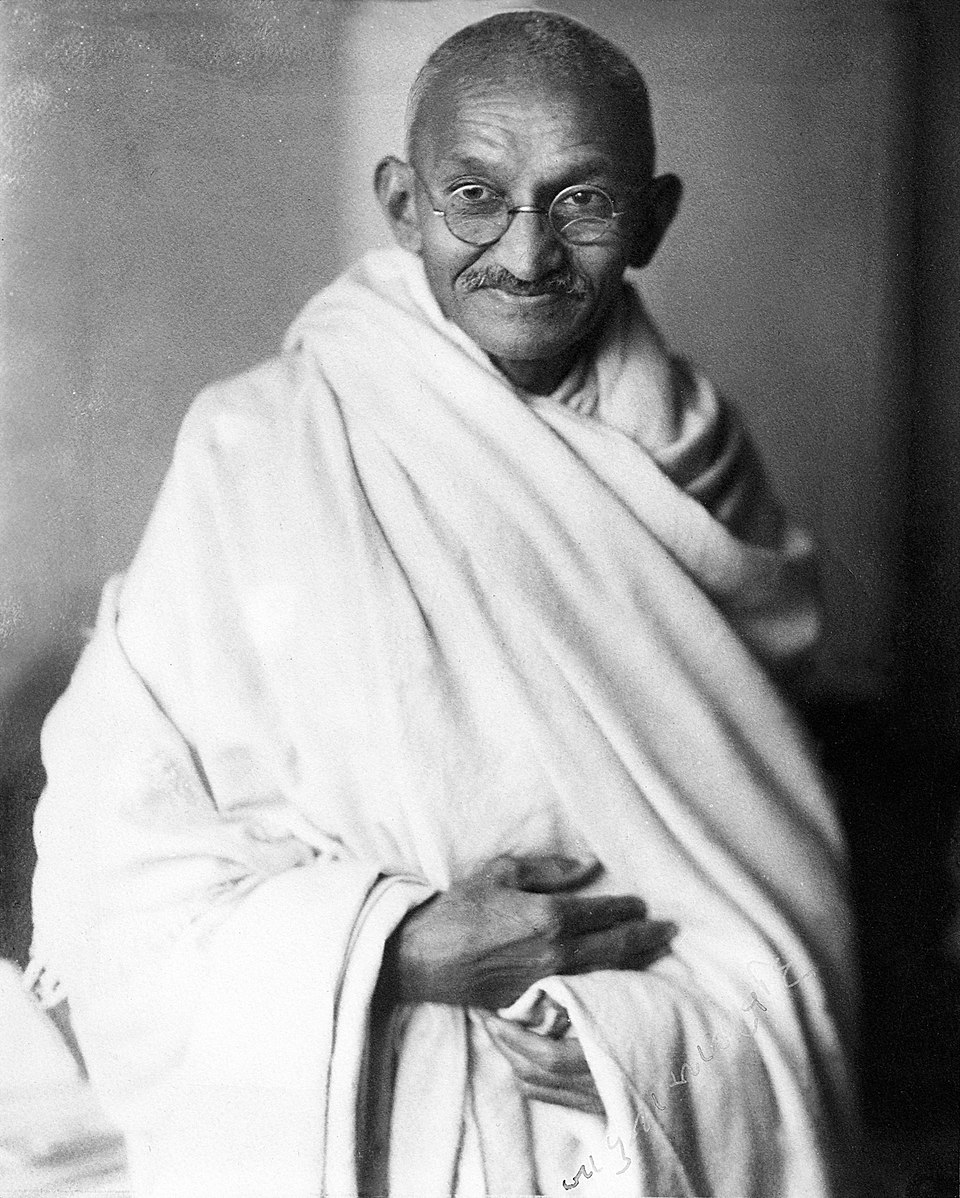
At a Glance
Porbandar and London: A Barrister's Formation
Mohandas Karamchand Gandhi was born on 2 October 1869 in Porbandar, a small princely state on the Kathiawar Peninsula of Gujarat, into a Bania (merchant caste) Hindu family with a tradition of service in the local administration. His father Karamchand Gandhi was the diwan — chief minister — of Porbandar, a position of real local authority if limited external power. The family was devout in the Vaishnava Hindu tradition, with the household shaped by the practices of non-violence toward all living creatures, dietary restraint, and fasting that were central to Vaishnava observance and that Gandhi absorbed before he could articulate them as philosophy.
He was married at thirteen to Kasturba Kapadia, an arranged marriage in the fashion of their community. He was sent to England in 1888 to study law at the Inner Temple — a journey that required him to take a vow before his community not to touch wine, women, or meat while abroad, vows he kept with the literalism of a young man who had already begun to understand that keeping difficult commitments was itself a form of power. He was called to the bar in 1891, returned briefly to India, and found that establishing a legal practice was difficult. In 1893 he accepted a contract offer from an Indian Muslim merchant in South Africa and sailed for Natal, intending a one-year stay that became twenty-one years and the making of everything that followed.
South Africa and the Development of Satyagraha
The transformation that turned a hesitant young barrister into the twentieth century's most significant practitioner of political non-violence began with a train journey. In 1893, a week after arriving in South Africa, Gandhi was travelling first class to Pretoria when a white passenger complained about his presence and the railway official told Gandhi to move to the third-class "van" designated for non-whites. Gandhi had a valid first-class ticket. He refused to move. He was thrown off the train at Pietermaritzburg station at night. He sat in the cold station waiting room through the night, shivering, deciding whether to go back to India or to stay and fight the injustice. He stayed.
The twenty-one years in South Africa were the laboratory in which satyagraha was developed — not as a theory first and then a practice, but as a practice that was theorised retrospectively. The specific campaigns — the resistance to the Asiatic Registration Act in the Transvaal, the various protests against the colonial government's treatment of the Indian community, the Phoenix Settlement that Gandhi founded as a communal experiment in simple living — developed through iteration what the method was and what it required of its practitioners. The essential insight was that injustice maintained through force required the cooperation of those on whom it was inflicted, and that withdrawing that cooperation while accepting the legal consequences of doing so — going to prison without resisting, accepting beatings without retaliating — placed a moral burden on the perpetrator of the injustice that physical resistance did not. Violence against violent resistance was, from the colonial state's perspective, normal governance. Violence against non-violent resistance was, from any audience's perspective, the exposure of what the governance was.
The South Africa campaigns were partially successful — the colonial government made some concessions on the treatment of Indians, though discrimination was not eliminated. More importantly, they produced Gandhi himself: a man who had tested the method under conditions of real danger, who had been beaten and imprisoned and emerged without abandoning the method, and who had the moral credibility of someone who had paid personally for the politics he was advocating.
Return to India: The Year of Silence and Three Peasant Campaigns
Gandhi returned to India in January 1915, having been told by Gokhale — whom he had acknowledged as his political guru — to spend a year travelling India in third class before he presumed to speak about it. He did exactly that. The year of travel gave him what his English education and his South Africa experience had not: direct knowledge of what India was — its poverty, its diversity, the lives of its hundreds of millions of rural inhabitants who had no connection to the Congress sessions and the English-language newspapers through which the independence movement conducted its visible politics.
The three campaigns that established Gandhi's method in India — Champaran in Bihar in 1917, where indigo plantation labourers were being forced to cultivate indigo at below-cost prices; Kheda in Gujarat in 1918, where farmers were being required to pay land revenue during a crop failure; and Ahmedabad in 1918, where mill workers were striking for a wage increase — were all local, specific, and grounded in the concrete conditions of the rural and industrial poor. Each was also a test of whether satyagraha worked in India as it had worked in South Africa. The answer in all three cases was yes, with appropriate modifications for context. The Champaran inquiry that Gandhi organised forced the colonial government to accept an investigation of the indigo system that eventually led to its abolition. The Kheda campaign produced a revenue concession. The Ahmedabad strike produced a wage settlement through Gandhi's own fast.
The Non-Cooperation Movement: Bringing India Into Politics
The Jallianwala Bagh massacre of 13 April 1919 — when British Brigadier-General Reginald Dyer ordered his troops to fire without warning into a crowd of unarmed civilians in Amritsar, killing somewhere between 379 and over a thousand people — converted Gandhi from a constructive worker within the colonial system into the leader of mass resistance to it. The massacre and the colonial government's refusal to hold Dyer adequately accountable demonstrated that the system was incapable of reforming itself from within, and Gandhi accepted the logic of that demonstration.
The Non-Cooperation Movement of 1920–1922 was the first mass political campaign Gandhi led at national scale — a call to Indians to withdraw from colonial institutions, return British honours, boycott British goods, leave colonial schools and courts, and refuse to participate in the elections and councils through which the colonial government maintained the appearance of Indian participation. The movement mobilised millions, disrupted the colonial administration's functioning, and demonstrated that Indian nationalism could be a genuinely mass politics rather than an elite minority. It was also suspended abruptly in February 1922, when a crowd in Chauri Chaura in the United Provinces attacked and burned a police station, killing twenty-two constables. Gandhi called off the movement on the grounds that it had produced violence and that he could not lead a movement whose practitioners had not mastered non-violence. The decision outraged many in the Congress — including Nehru — but Gandhi held to it, and the movement ended.
The Salt March: Satyagraha at its Most Perfect
The Salt March of 12 March to 5 April 1930 is the act that most perfectly embodied what satyagraha was and what it could accomplish. Salt was taxed under the British colonial monopoly, and Indians were forbidden from making their own — a prohibition that affected every Indian regardless of class, since salt was a necessity of daily life that even the poorest households required. Gandhi announced that he would walk 241 miles from his Sabarmati Ashram to the coastal village of Dandi, where he would make salt from the sea in direct violation of the salt laws, and he invited people to follow him and do the same.
The march began with seventy-eight volunteers and arrived at Dandi on 5 April with tens of thousands. Gandhi picked up a lump of natural salt from the beach. The act was technically trivial and symbolically total: it was a visible, photographable, undeniable defiance of a specific colonial law by the most prominent person in India, in full public view, in front of the world's press. The colonial government could arrest him — and it did, six weeks later — or it could ignore him and demonstrate that its laws could be defied with impunity. Either option served Gandhi's purpose. The Civil Disobedience Movement that followed the march spread across India, generating over sixty thousand arrests including Gandhi's own, and forcing the colonial government into the Gandhi-Irwin Pact of 1931 — the first negotiated agreement between the colonial power and its subjects as relative equals.
The Quit India Movement and the Final Imprisonment
Gandhi launched the Quit India Movement on 9 August 1942 with the words "Do or Die" — India would either achieve independence or the people would die trying. The colonial government arrested him and the entire Congress Working Committee within hours. Gandhi was held at the Aga Khan Palace in Pune with Kasturba, who died there in February 1944. He was released in May 1944, his health diminished and his personal grief immense. The Quit India underground continued through the war years without its leadership, demonstrating both the movement's resilience and the limits of what a leaderless resistance could achieve.
Partition, Independence, and Assassination
The negotiations that led to independence in August 1947 also produced partition — the division of the subcontinent into India and Pakistan along religious lines, at the cost of hundreds of thousands of lives and the displacement of fifteen million people. Gandhi had opposed partition throughout the negotiations, had proposed instead that Muhammad Ali Jinnah be invited to form a government of undivided India, and had been outmanoeuvred by the political realities of the moment — the Congress leadership's exhaustion, Jinnah's intransigence, the British government's urgency to be done. He accepted partition as the only available path to independence while making clear that he considered it a tragedy. The comment attributed to him — that partition was his "vivisection" — captures the personal weight of the acceptance.
In the months after independence, while India and Pakistan burned in communal violence, Gandhi walked through the affected areas of Bengal and Delhi, fasting against the violence, meeting with both Hindu and Muslim leaders, using his physical presence and his fast as instruments of moral pressure on people who were killing each other. His fast-unto-death in January 1948 — demanding that the Indian government pay Pakistan the £55 million it owed under the partition financial settlement, which the Indian cabinet had withheld — produced a pledge from Hindu nationalist leaders to stop the violence in Delhi. It was his last fast. It worked. It also confirmed Nathuram Godse's decision that Gandhi needed to be removed.
On 30 January 1948, at Birla House in New Delhi, Gandhi was walking to his evening prayer meeting when Godse stepped forward, bowed to him, and fired three shots. Gandhi died within minutes. His last words, by most accounts, were "Hey Ram" — O God. He was seventy-eight years old. He had been one of the most photographed people in the world for thirty years, had been imprisoned by the most powerful empire on earth and outlived it, had achieved independence for the largest colonial subject population in history, and died at the hands of a fellow Indian in the garden of a friend's house. The independent India he had made began, six months after his death, to be something other than what he had imagined. That is the condition of all foundational acts: they produce consequences their authors did not foresee and would not endorse. Gandhi's act was independence. Its consequences are still unfolding.