At a Glance
Madras and a Family That Produced Fighters
Lakshmi Swaminathan was born on 24 October 1914 in Madras into a Tamil Brahmin family that was already, by the time of her birth, engaged in the nationalist movement at its active edge. Her mother, Ammu Swaminathan, was a lawyer, social reformer, and politician who became one of the few women elected to the Central Legislative Assembly in the colonial period and who participated in the drafting of the Indian Constitution after independence. The household Lakshmi grew up in was one where women's education was not merely accepted but expected, where political engagement was normal rather than exceptional, and where the question of India's independence was a matter of daily discussion rather than distant aspiration.
She attended Madras Medical College — one of the oldest and most prestigious medical institutions in India, which had been admitting women since the nineteenth century — and graduated with an MBBS in 1938, training subsequently in surgery and gynaecology. The medical career she was building was serious and skilled; she was not a woman who entered medicine as a genteel alternative to politics but one who pursued the technical mastery of a demanding discipline with the same intensity that she later brought to military organisation. In 1940 she moved to Singapore, then at the height of its importance as the principal British naval base in Southeast Asia, to work as a doctor serving the large Indian migrant worker community on the Malayan Peninsula.
Singapore, the Fall, and the Choice to Join
The Indian community in Malaya and Singapore in 1940–1941 was among the largest in the British imperial world — Tamil labourers on rubber plantations, merchants and traders from across India, professionals like Lakshmi who had come for work and opportunity. When Japan attacked Malaya in December 1941 and advanced rapidly down the peninsula, the British military's defensive failure was comprehensive and devastating: Singapore, defended by over eighty thousand troops and considered an impregnable fortress, fell to a Japanese force of under thirty thousand on 15 February 1942 — one of the most humiliating defeats in British military history and the event that, more than any other, demonstrated to Asian populations that European imperial power was not invincible.
Among the prisoners taken were around forty-five thousand Indian soldiers of the British Indian Army. It was from these men — and from the Indian civilian population of Malaya and Singapore — that Subhas Chandra Bose built the Indian National Army. Bose arrived in Singapore in July 1943, having made his extraordinary journey from India through Afghanistan, the Soviet Union, Germany, and Japanese submarine to reach Southeast Asia, and immediately began transforming the existing INA network — which had been started by Captain Mohan Singh in 1942 — into the organised armed force that would attempt to liberate India from the east.
Lakshmi Sahgal joined the INA when Bose arrived and was appointed captain with responsibility for organising the women's wing of the organisation. The appointment was not ceremonial: Bose was serious about women's participation in the armed struggle — both for its practical military value and for its symbolic significance, the statement that India's liberation was the business of all Indians regardless of gender. Lakshmi's medical qualifications made her the obvious choice for a command role that combined military organisation with the medical support that any fighting force required.
The Rani of Jhansi Regiment: Training Women for Combat
The Rani of Jhansi Regiment — named after Rani Lakshmibai of Jhansi, the queen who had fought the British in the 1857 uprising and died in battle at twenty-nine, and whose image in the independence movement's iconography was of a woman on horseback with a sword — was the INA's women's unit and, when Lakshmi Sahgal took command of it in 1943, the first organised women's combat regiment in South Asian history. The regiment recruited from among the Indian women in Singapore and Malaya, trained its members in weapons use, drill, and military discipline, and prepared them for the role they would play in the INA's operations.
The regiment's role was primarily in the areas of medical support and communications, but it was armed, trained to fight, and its members understood themselves as soldiers rather than auxiliaries. The naming after Rani Lakshmibai was deliberate and precise: it invoked the tradition of Indian women who had taken up arms against the colonial power and framed the regiment's existence as a continuation of that tradition rather than a novelty. Bose's public speeches about the regiment emphasised this framing — the women of the Rani of Jhansi Regiment were, in his presentation, the heirs of the queen who had died fighting rather than surrender.
Lakshmi Sahgal organised and commanded approximately fifteen hundred women, training them through 1943 and into 1944 as the INA prepared for the Imphal Campaign — the operation that Bose and the Japanese high command had conceived as the decisive military push that would carry the INA into India on the wave of a Japanese advance through Assam.
Imphal and Kohima: The Campaign That Failed
The Imphal and Kohima campaigns of 1944 were the largest battles of the Burma theatre in the Second World War and represented both the INA's most significant military action and its effective destruction as a fighting force. The Japanese Fifteenth Army, with INA units attached, crossed the Chindwin River in March 1944 intending to advance into Assam, cut the supply lines to China, and create the conditions for Bose's INA to enter India in the wake of Japanese military success. The plan failed at Imphal and Kohima — the British and Indian Army defenders held the sieges despite enormous pressure, and the Japanese supply lines proved catastrophically inadequate for a sustained offensive in the Naga Hills terrain.
The Rani of Jhansi Regiment was present in the campaign's support operations, with Lakshmi Sahgal directing medical services and maintaining the regiment's cohesion under conditions of extreme difficulty. The defeat, when it came, was total: the Japanese retreat through Burma from May 1944 onward became one of history's most gruelling military withdrawals, with soldiers dying of disease — cholera, malaria, dysentery — in the jungle in far greater numbers than from British fire. The INA's losses were catastrophic. Lakshmi Sahgal kept the regiment's survivors together through the retreat as long as she was able, treating the sick and wounded with whatever supplies remained.
She was captured by British forces in Burma in 1945 as the Japanese position collapsed entirely. She was a Japanese-allied officer who had fought against the British Indian Army. By the laws of war as the British applied them, she was a traitor — an Indian subject who had taken up arms for an enemy power. She was taken to India for trial.
The Red Fort Trials and the Political Reversal
The decision to try senior INA officers at the Red Fort in Delhi in late 1945 was one of the colonial government's most serious political miscalculations of the independence movement's final phase. The men and women who had joined the INA — whatever their specific motivations, which ranged from genuine nationalist conviction to the practical calculation that the Japanese were going to win anyway — were experienced by the Indian public not as traitors but as people who had fought for India's freedom by different means. Prosecuting them for that at the Red Fort, in full public view, with the Congress providing defence counsel and the Indian press covering every session, converted the trials into a platform for exactly the nationalist argument the colonial government was trying to suppress.
The defence team included Nehru, who had rejoined the bar specifically to appear in these cases, and Bhulabhai Desai, whose closing argument is regarded as one of the finest pieces of Indian legal advocacy. The three principal defendants — Prem Kumar Sahgal (whom Lakshmi would later marry), G. S. Dhillon, and Shah Nawaz Khan — were convicted but the colonial government, unable to withstand the political storm the trials had generated, commuted the sentences and eventually released all the INA prisoners. Charges against Lakshmi Sahgal, who had not been prosecuted in the first batch, were dropped. The Red Fort trials ended the colonial government's credibility on the question of who in India was loyal and who was not — the men and women who had fought for India's freedom in the INA came home to a public reception that made the colonial government's legal categories irrelevant.
Kanpur, Medicine, and the Sixty-Five-Year Practice
Lakshmi Sahgal returned to India, married Prem Kumar Sahgal — the INA officer who had been one of the three principal Red Fort defendants — and settled in Kanpur, where she established a medical practice that she maintained for over sixty years. The practice was organised explicitly as a service to the poor: she treated patients regardless of their ability to pay, ran a gynaecology and obstetrics practice in a city where affordable specialist medical care for women was chronically scarce, and built the kind of local reputation that is different from national political fame but is in its own way more significant — the doctor who would see you when you had nothing, in the city where you lived.
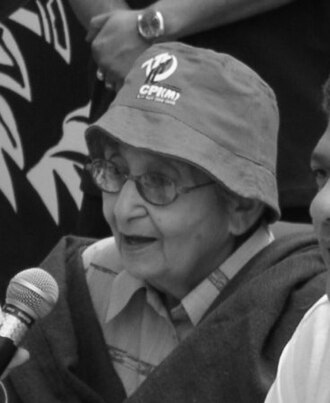
She joined the Communist Party of India (Marxist) and was active in its Kanpur organisation, combining the medical practice with the political work in the way that the independence generation's most committed members often did — treating politics and professional service as expressions of the same underlying commitment rather than alternatives to each other. She remained active in public life well into her eighties, speaking at meetings, giving interviews, providing the kind of first-hand testimony about the INA period that was becoming irreplaceable as her generation aged.
Presidential Candidate at Eighty-Seven
In 2002, when the Left parties — the Communist Party of India (Marxist) and its allies — needed a presidential candidate to stand against the ruling National Democratic Alliance's nominee A. P. J. Abdul Kalam, they nominated Lakshmi Sahgal. She was eighty-seven years old. The nomination was a statement of political values as much as an electoral calculation: the Left was presenting a woman who had fought for India's independence in the INA, had spent sixty years serving the poor as a doctor, and had maintained consistent socialist and secular political commitments throughout, as its vision of what the Indian Republic's highest office should represent.
She received approximately 107,000 votes in the electoral college — roughly twenty-three percent of the total — against Kalam's approximately 922,000. She was not going to win, and everyone knew it, but the candidacy gave her positions, her history, and the tradition she represented a national platform at a moment when the political climate was moving in directions that the independence generation found troubling. She accepted the candidacy in the same spirit: not as a bid for power but as an act of political witness.
Death at Ninety-Seven and a Life's Accounting
Lakshmi Sahgal died on 23 July 2012 in Kanpur, aged ninety-seven. She had been practising medicine until she was in her early nineties. The obituaries across India and internationally noted what her life had been: the Madras medical graduate who had become a commander of women soldiers in the jungle of Burma, who had been tried for treason and acquitted by public pressure, who had spent sixty years treating women and children in a mid-sized Indian city, who had stood for President at eighty-seven because her party asked her to and she said yes. The span of it — from colonial Madras in 1914 to independent India in 2012, from the Rani of Jhansi Regiment to the Kanpur clinic — is unusual in the independence movement's biographical record, where so many lives were cut short by the colonial state's violence or by the ordinary mortality that came for people who had spent years in the Andaman Cellular Jail.
She received the Padma Vibhushan — India's second-highest civilian honour — in 1998. The award was not the measure of her life, but it was India's acknowledgement that what she had done — fighting for independence in the INA, then spending a lifetime in service — constituted something the republic owed recognition to. She would, one suspects, have continued seeing patients regardless of whether the recognition came. That is what the record suggests about her: a woman for whom the work was the point, and who did it for ninety-seven years because it needed doing.