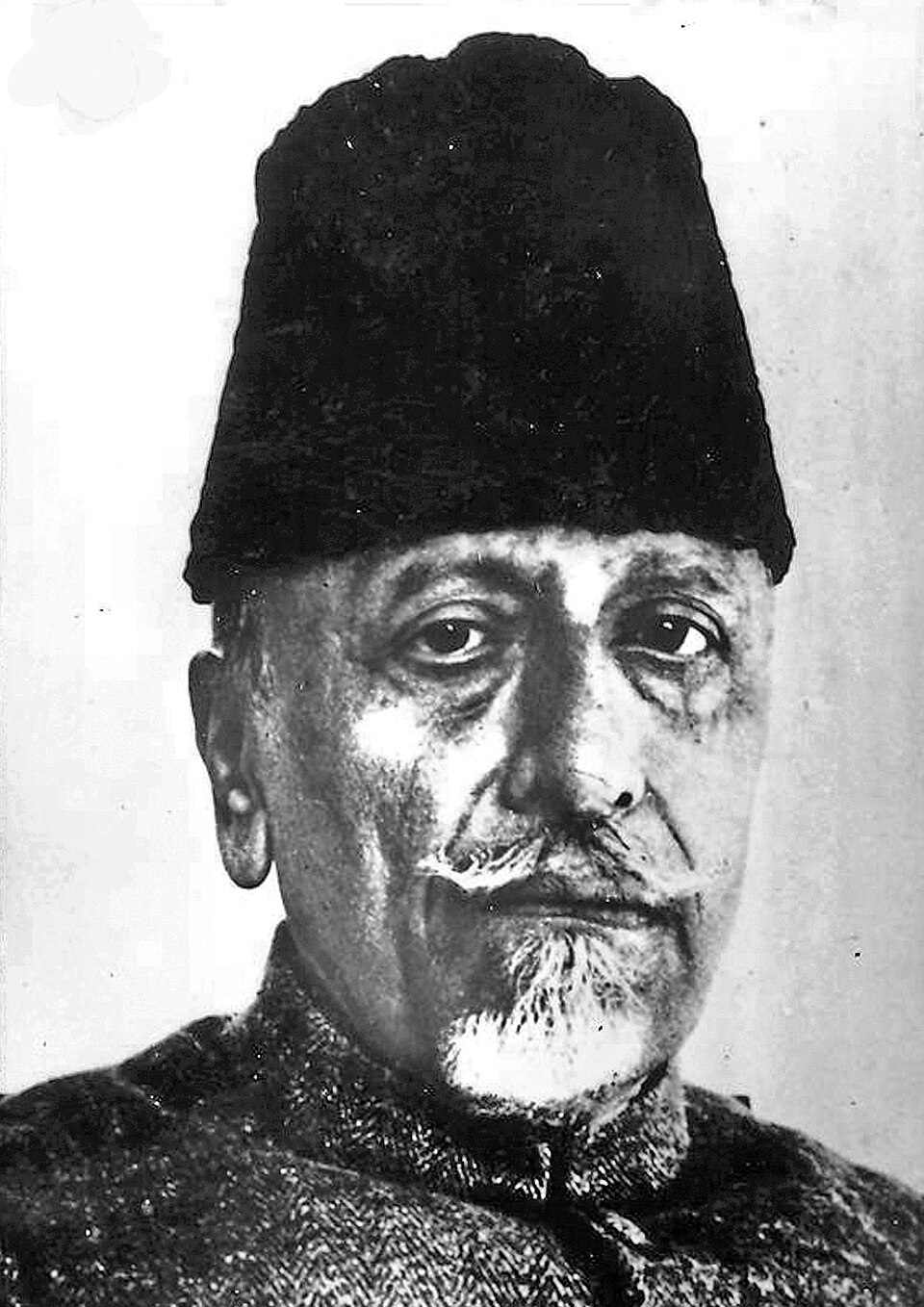
At a Glance
Mecca to Calcutta: The Formation of a Polymath
Maulana Abul Kalam Azad was born on 11 November 1888 in Mecca — in the Ottoman Hijaz — where his father, Maulana Khairuddin, a Bengali Muslim scholar of considerable reputation, had gone to live after the upheavals of 1857. His mother was an Arab woman from a scholarly family in Medina. The family returned to Calcutta around 1890, when Azad was still an infant, and it was in Calcutta that he received his education and came of age as an intellectual and a public figure.
His education was traditional in its framework — the Dars-i-Nizami, the classical curriculum of Islamic religious learning that covered Quranic studies, hadith, fiqh (Islamic jurisprudence), logic, philosophy, and rhetoric — and his father was his primary teacher. By his mid-teens he had mastered the curriculum and was recognised in the Muslim scholarly community of Calcutta as a young scholar of exceptional ability. But he did not confine himself to the classical tradition: largely self-taught in English, he read extensively in Western philosophy, history, and political thought, and encountered the works of modernist Islamic thinkers — Jamal ad-Din al-Afghani, Muhammad Abduh — who were attempting to reconcile Islamic scholarship with modern political and scientific thought. The combination of deep classical Islamic learning and wide modern reading produced the intellectual independence that his pen name "Azad" — "free" — announced to the world.
Al-Hilal and the Birth of a Political Voice
Azad was barely twenty-four years old when he launched Al-Hilal — "The Crescent" — in Calcutta in July 1912. The weekly Urdu journal was unlike anything in the existing Muslim press of India. It was written in a prose style of unusual power and clarity, addressed to ordinary educated Muslims rather than to scholars, and argued with great urgency that Indian Muslims had to engage with the independence movement, that loyalty to the British Empire was incompatible with the Islamic obligation to resist oppression, and that the proper response to colonial rule was resistance rather than accommodation.
Al-Hilal drew on Quranic texts, on Islamic history, on the contemporary politics of the Ottoman Empire and the pan-Islamic world, and on the particular situation of Indian Muslims under British rule to construct an argument for nationalist engagement that was rooted in Islamic values rather than in opposition to them. This was a crucial intervention: the dominant strain of Muslim political thought associated with Syed Ahmad Khan had argued that Muslims should cooperate with the British and avoid the Congress, which was seen as a predominantly Hindu organisation pursuing Hindu interests. Azad attacked this position directly and at length, arguing that it was both politically mistaken and theologically unjustifiable.
Al-Hilal reached a circulation of approximately 26,000 within two years — an extraordinary figure for a weekly Urdu journal — and was read across the Muslim communities of India and in the wider Urdu-reading world. The British authorities recognised its impact and suppressed it in 1914 under wartime emergency powers. Azad founded a successor journal, Al-Balagh, in 1915; it was also suppressed, in 1916, and Azad himself was interned under the Defence of India Act and sent to Ranchi, where he remained until 1920. He was thirty-two when he was released.
Congress, Gandhi, and the Architecture of Composite Nationalism
Azad's encounter with Gandhi and the Congress after his release from internment was one of the formative relationships of the independence movement. He had been moving toward Congress engagement before his internment — his nationalism was always Indian rather than merely Muslim, his target always colonial rule rather than Hindu dominance — and Gandhi's non-cooperation movement of 1920–22 gave him the political vehicle he needed. He participated actively in the movement, was elected to the Congress's central leadership, and became one of the most important figures in the effort to build and sustain the Congress's cross-communal character.
The political theology that Azad developed over the following decades was a distinctive and sophisticated contribution to Indian nationalist thought. He argued from within Islamic scholarship — from the Quran, from the hadith, from the tradition of Islamic jurisprudence — that Islam required Muslims to honour their covenants with their neighbours, that the concept of the umma (the worldwide community of Muslims) did not override the obligations of citizenship and shared political life with non-Muslims, and that the two-nation theory — the argument that Hindus and Muslims were separate nations who could not share a political future — was not only politically dangerous but theologically wrong. For Azad, Indian Muslims were as authentically Indian as Indian Hindus; their religious identity and their national identity were not in competition; and the demand for a separate Muslim state was a counsel of despair that would weaken rather than protect Indian Muslims.
This position put him in direct conflict with Muhammad Ali Jinnah and the Muslim League through the 1930s and 1940s — a conflict that was not merely political but personal and theological, carried on in speeches, articles, and negotiations that reveal the depth and irreconcilability of the two visions for the Muslim future in South Asia. Azad lost that argument, ultimately: Pakistan was created in August 1947. But the argument he made — and the consistency and courage with which he made it — remains one of the most important intellectual contributions to the question of how a religiously plural society can govern itself, and it has not lost its relevance.
INC President 1940–1946: Leading Through the Crisis
Azad was elected President of the Indian National Congress in 1940, succeeding Subhas Chandra Bose. He was elected at a moment of acute political crisis: the Second World War was in its early phase, the British had declared India a belligerent without consulting Indian opinion, the Congress was split over how to respond, and Gandhi was navigating between his absolute commitment to non-violence, his sympathy for Britain's democratic allies in the war against fascism, and his determination to use the war crisis to extract genuine constitutional concessions from the colonial government. Azad's election as President — a Muslim scholar leading a Congress that was widely characterised internationally as a Hindu organisation — was itself a political statement about the nature of Indian nationalism.
He served as President through the most turbulent period in the Congress's history. In August 1942, Gandhi launched the Quit India Movement — the most dramatic mass civil disobedience campaign of the independence struggle — with the demand that the British leave India immediately. The British response was swift and comprehensive: Gandhi, Azad, Nehru, and virtually the entire Congress leadership were arrested on 9 August 1942 and imprisoned without trial for the duration of the war. Azad spent the following three years in detention at the Ahmednagar Fort in Maharashtra, along with most of the Congress's central leadership — a confinement that was physically trying but intellectually productive. He worked on his Quranic commentary, Tarjuman al-Quran, during these years and deepened the theological work that would be his most enduring scholarly contribution.
Released in June 1945, Azad immediately re-engaged with the transfer-of-power process, participating in the Simla Conference and in the negotiations that followed the 1945–46 elections and the arrival of the Cabinet Mission in 1946. He negotiated on behalf of the Congress with both the British and the League, and his accounts of those negotiations — set out in India Wins Freedom, which was written in 1957 and published in a full version only in 1988, thirty years after his death as he had specified — remain indispensable primary sources for understanding the decisions and miscalculations that produced Partition.
Opposing Partition: The Argument He Knew He Was Losing
Throughout the mid-1940s, as the momentum toward Partition became increasingly difficult to resist, Azad continued to argue against it. His argument was not merely political — that Partition would be administratively chaotic and would leave Muslim minorities in a Hindu-majority India without the protection they needed — though he made that argument too, and with considerable foresight: the condition of Muslims in post-Partition India was indeed deeply affected by the political logic of Partition, by the communal violence that accompanied it, and by the polarising legacy that the two-nation theory left on both sides of the new border.
His argument was also, and more fundamentally, moral and theological: that the demand for Pakistan was a failure of nerve, a retreat from the difficulty of building a genuinely plural society into the false security of a communal state. He believed — and said — that a Pakistan created on the basis of communal identity would not actually protect Indian Muslims, because it could not protect the Muslims who would remain in India once the subcontinent was divided, and because a state built on religious exclusivity would have difficulty sustaining the plural, open culture that Islamic civilisation had historically produced on the Indian subcontinent. These arguments were not persuasive to the majority of Muslim League voters in 1945–46. Pakistan was created. Azad stayed in India.
Education Minister: Building Independent India's Institutions
Jawaharlal Nehru appointed Azad as India's first Minister of Education in August 1947, and Azad held that portfolio until his death in February 1958 — eleven years in which he shaped the institutional framework of independent India's educational and cultural life with a thoroughness that no subsequent minister has matched. His vision for Indian education was rooted in the conviction that science, technology, and modern learning were not in conflict with India's civilisational heritage but were its natural development — that a country that had produced the mathematics of Aryabhata, the grammar of Panini, and the philosophy of the Upanishads was also the country that should lead in scientific and technical education in the twentieth century.
The Indian Institutes of Technology — the IITs, established beginning in 1951 — were the most consequential single institutional initiative of his tenure. The IITs were conceived as world-class institutions for technical education, designed to produce the engineers and scientists that a newly industrialising country required and to anchor India's technical capacity in genuinely rigorous, internationally competitive institutions. The first IIT was established at Kharagpur in West Bengal in 1951; subsequent institutes followed at Bombay, Madras, Kanpur, and Delhi during the 1950s and 1960s. The IITs have become, over the decades since their founding, among the most celebrated engineering schools in the world — their alumni populate technology companies and research institutions across the globe — and their creation is Azad's most tangible institutional legacy.
He also established the University Grants Commission (1956), the body that coordinates and funds higher education across India and sets academic standards for universities. The Sangeet Natak Akademi (for performing arts), the Sahitya Akademi (for literature), and the Lalit Kala Akademi (for visual arts) — the three national academies that support and recognise achievement in India's artistic and literary traditions — were all founded during his tenure, reflecting a vision of national development that encompassed culture alongside technology and science. The Indian Council for Cultural Relations, which manages India's cultural diplomacy, was also established under his direction.
Scholar, Writer, and the Tarjuman al-Quran
Alongside his political career, Azad produced a body of Urdu writing — scholarly, journalistic, and autobiographical — that places him among the major figures of twentieth-century Urdu literature. His prose style in Urdu is considered remarkable for its combination of classical Islamic rhetorical tradition and modern lucidity: difficult, demanding, allusive, but capable of extraordinary clarity when clarity is needed. His early journalistic writing in Al-Hilal and Al-Balagh established his voice as one of the most distinctive in the Indian Muslim public sphere of the early twentieth century.
His most important scholarly work is Tarjuman al-Quran — a translation and extended commentary on the Quran that he worked on across decades, producing the first volume while imprisoned at Ranchi and continuing through his subsequent incarcerations and public life. The Tarjuman is not a conventional exegetical commentary but an engaged, philosophical interpretation of the Quran as a text for living — an argument that the Quran's core teaching is the unity of God (tawhid) and the unity of humanity, and that these two unities have profound implications for how Muslims relate to non-Muslims, to political life, and to the contemporary world. It is a work that reflects the breadth of his learning and the consistency of the intellectual vision he brought to both his scholarship and his politics.
India Wins Freedom — his political autobiography, completed in 1957 and left to be published with a delay — is one of the most important documents of the partition period, candid about the failures of judgment that he believed had produced Partition and about his own role in the negotiations that preceded it. The thirty-year delay in full publication, which he specified in his will, was itself a political act: he understood that what he had to say about the conduct of the Congress leadership, and specifically about Nehru and Patel's acceptance of Partition, could not safely be said while the principals were alive and governing India.
Death and the Bharat Ratna
Maulana Abul Kalam Azad suffered a stroke in January 1958 and died on 22 February 1958 in New Delhi, aged sixty-nine, while still serving as Education Minister. He was buried at the Jama Masjid in Delhi, one of the great mosques of Mughal India, in a grave that has become a site of pilgrimage and commemoration. The Bharat Ratna — India's highest civilian honour — was awarded to him posthumously in 1992. National Education Day is observed in India on 11 November, his birth anniversary, a recognition that has grown in observance in recent decades.
The institutions he built — the IITs above all — are his most visible legacy, but they are not his most important one. His most important legacy is the argument he made, over four decades of public life, that Indian identity is plural and that its plurality is its strength: that a devout Muslim and an Indian patriot are not two people but one, that the civilisation of the Indian subcontinent belongs to all who live in it and have been formed by it, and that the state that governs this civilisation must be answerable to all of them equally. He lost the argument that was most urgently put to him — the argument over Partition — but he lived, and died, demonstrating by his own example that the thing he argued for was possible.