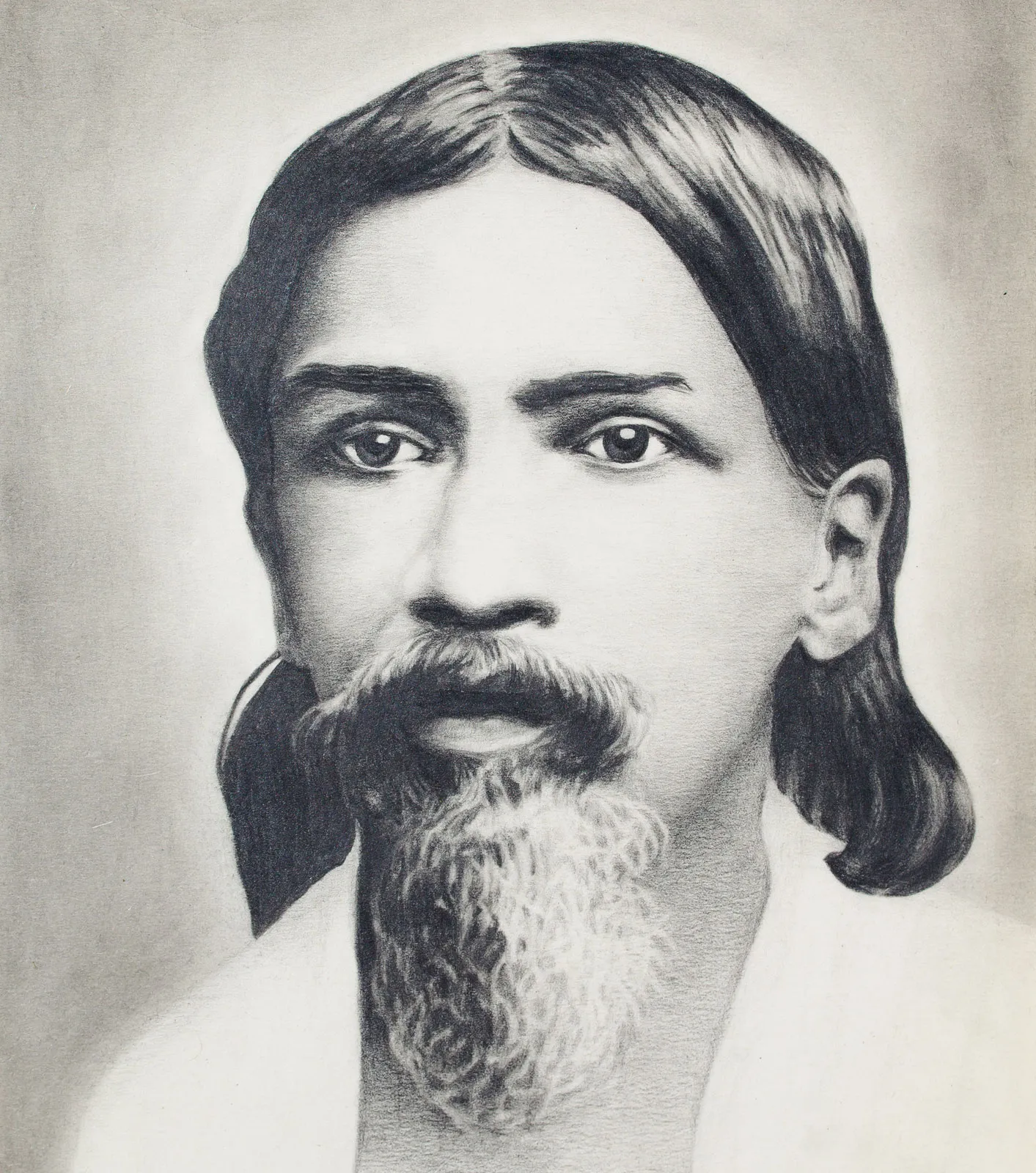
At a Glance
An English Education Designed to Produce a Servant of Empire
Aurobindo Ghose was born on 15 August 1872 in Calcutta — a date that would acquire retrospective significance when India achieved independence on 15 August 1947, seventy-five years later almost to the day. His father, Dr. Krishna Dhun Ghose, was a Bengali physician who had been educated in England and had returned to India with an unambiguous conviction: the future belonged to Indians who were indistinguishable from Englishmen in their education, their manners, and their professional competence. He wanted his sons to enter the Indian Civil Service, which was at that time the highest administrative body in the empire, staffed overwhelmingly by Englishmen and requiring passage through examinations set in England, based on the Oxford and Cambridge curriculum. In 1879, when Aurobindo was seven years old, Dr. Ghose sent him to England with two of his brothers and placed them with an English family in Manchester, with instructions that the children were to have no contact with Indians and no exposure to Indian culture or language.
The instruction was followed. Aurobindo spent his childhood and adolescence in England knowing almost no Bengali, reading Latin and Greek, studying at St Paul's School in London on a scholarship, and winning a further scholarship to King's College Cambridge. He read classics — Greek and Latin literature, philosophy, history — with an intensity that went well beyond what the curriculum required, and he added French, Italian, and German on his own initiative. At Cambridge he passed the ICS examinations with high marks. He was, by his father's design, exactly the kind of Indian the empire needed. He was also, by the time he finished his studies, clear that he would not serve the empire at all.
The mechanism he chose was quiet and technically deniable: he appeared for the mandatory horse-riding examination required for ICS candidates three times, failed it three times — the failing was deliberate, as he was by several accounts a capable enough rider — and eventually let the deadline for qualification pass. He was disqualified from the ICS on procedural grounds. His father, whose health had been deteriorating, died in 1893 believing a telegram that incorrectly reported the ship carrying Aurobindo had sunk. Aurobindo arrived in India as an orphan, estranged from the country of his birth by fifteen years of English education, speaking almost no Bengali, reading no Sanskrit, knowing the Upanishads and the Mahabharata only through Victorian translations. He had fourteen years before the Alipore arrest to rebuild what had been taken from him.
Baroda and the Reconstruction: Sanskrit, Bengali, and the Making of a Revolutionary
The Gaekwad of Baroda — a princely state in western India — had been looking for educated Indians to staff his administration, and Aurobindo was employed there from 1893, working in a variety of administrative and educational roles and eventually becoming a professor of English at Baroda College. He stayed in Baroda for thirteen years, and the period was one of systematic self-reconstruction. He learned Bengali from scratch, working through texts with the concentrated discipline his classical training had given him. He learned Sanskrit and read the Upanishads, the Bhagavad Gita, the Vedas, and the Puranas in the original — not as religious documents but as philosophical and literary works that represented the accumulated intellectual tradition of the civilisation his father had tried to cut him off from.
He also began writing political essays. These were not the polite petitions and reasoned arguments for incremental reform that characterised the Congress moderates of the period — men like Dadabhai Naoroji and Gopal Krishna Gokhale, who believed that demonstrating Indian political maturity would eventually persuade the British to extend greater self-governance. Aurobindo's position was simpler and harder: India needed complete independence, not more council seats; armed resistance was a legitimate response to colonial occupation; and the spiritual and cultural resources of Indian civilisation were not inferior to those of Europe but different and in certain respects deeper. He wrote these arguments in English prose of unusual quality — spare, precise, with the classical training visible in the sentence construction — and they circulated in nationalist networks across Bengal and beyond.
He was also, during this period, building or helping to build the secret revolutionary organisations that operated beneath the surface of the legitimate nationalist movement. The Anushilan Samiti, founded in Calcutta in 1902, was the most significant of these — a network of gymnasiums and physical culture clubs that provided cover for the training of young men in the methods of armed resistance. Aurobindo was connected to these networks, and his younger brother Barindra Kumar Ghose was one of their most active organisers. The connection between the public intellectual and nationalist writer and the underground revolutionary was not coincidental; it was the same man working at two registers simultaneously.
Calcutta, Yugantar, and the Swadeshi Years
In 1905 Lord Curzon partitioned Bengal — dividing the province along religious lines into a Hindu-majority west and a Muslim-majority east, ostensibly for administrative efficiency but transparently as a strategy to weaken Bengali nationalism by dividing its Hindu and Muslim populations. The partition was the most galvanising act of colonial policy in India since the annexation of Awadh in 1856. The Swadeshi Movement — the boycott of British goods and the promotion of Indian manufactures — erupted across Bengal and spread to other provinces. Aurobindo moved to Calcutta in 1906 to place himself at the centre of it.
He edited the English-language newspaper Yugantar (meaning "New Era" or "New Age") and was connected to the Bengali-language newspaper of the same name that Barindra ran. The newspapers were among the most explicitly revolutionary publications in colonial India — they argued not for reform but for insurrection, not for concession but for independence, and they named the methods that would be required without the evasions and qualifications that other nationalist publications used. The colonial government considered them seditious, which they were, in the technical sense that they called for the overthrow of colonial rule. Aurobindo also helped found the Bengal National College in 1906, which was set up as an explicitly nationalist alternative to the colonial university system, and was appointed its principal.
He was also, simultaneously, one of the most important voices in the national Congress debate. At the Surat Congress of 1907 — one of the most acrimonious in the party's history — the split between the Extremists, led by Tilak and Aurobindo, and the Moderates, led by Gokhale, became irreconcilable. The Moderates wanted gradualism and constitutional methods; the Extremists wanted mass action, non-cooperation, and an explicit demand for swaraj. The Surat session broke up in disorder. The Moderate faction retained control of the Congress machinery. Tilak was subsequently prosecuted and sentenced to six years' transportation to Mandalay. Aurobindo was arrested the following year.
Muzaffarpur, the Alipore Bomb Case, and a Year in Jail
On 30 April 1908, two young men connected to Barindra Kumar Ghose's revolutionary group — Khudiram Bose and Prafulla Chaki — threw a bomb at the carriage of Douglas Kingsford, a magistrate who had ordered the flogging of nationalist demonstrators and whom the revolutionaries had marked for assassination. The bomb hit the wrong carriage. Kingsford was not in it. Two English women — Pringle Kennedy and her daughter — were killed. Prafulla Chaki shot himself rather than be captured. Khudiram Bose was arrested, tried, and hanged — he was eighteen years old and became one of the most celebrated martyrs of the Bengal revolutionary movement.
The colonial government used the Muzaffarpur bombing to move against the entire revolutionary network. Barindra Kumar Ghose and dozens of others were arrested. Aurobindo was arrested on 2 May 1908 and charged with sedition and conspiracy to wage war against the King Emperor — charges that carried the death penalty. He was sent to Alipore Jail, where he spent approximately a year in solitary confinement and in the general jail population awaiting trial. The period is described in his own later writings as one of intense spiritual experience — a year of reading the Gita, of meditation, of a psychological transformation that he characterised as a complete reorientation of his sense of what his life was for.
The defence was conducted by Chittaranjan Das, one of the most skilled barristers in Bengal, who argued that the evidence against Aurobindo was circumstantial, that the prosecution's case rested heavily on approver testimony, and that no direct participation in the Muzaffarpur conspiracy could be proved. He was right on all counts. Aurobindo was acquitted on 6 May 1909. The acquittal speech Das gave — arguing that Aurobindo was not merely a political defendant but a man whose vision of India's freedom would outlast any trial — is itself a celebrated document of the independence movement. Aurobindo emerged from prison to a reception in Uttarpara where he delivered a speech that signalled the changed direction of his interior life even as it reaffirmed his commitment to Indian independence in the most absolute terms.
Pondicherry: The Withdrawal That Was Also a Continuation
In February 1910, receiving what he described as an inner instruction — later interpreted by him as a directive from a higher consciousness — Aurobindo left British India for Pondicherry, the small French colonial enclave on the Coromandel Coast that lay outside British jurisdiction. He never returned. The colonial government continued to watch him and to consider whether grounds existed for extraditing him from French territory; they concluded they did not. He was free in Pondicherry in a way he had not been in Calcutta, and he used that freedom to write.
The withdrawal has been read, by critics, as a retreat from political responsibility at the moment the independence movement needed its most capable minds. It has been read, by his followers, as a continuation of his commitment to India's liberation at a level deeper than the political — a conviction that the transformation of human consciousness was the precondition for any lasting political transformation. Both readings contain something true. Aurobindo himself was unambiguous about his view: he had concluded that the work he needed to do could not be done in the conditions of active political struggle, and that the philosophical and spiritual work he undertook in Pondicherry was not separate from the independence movement but its deeper foundation.
In 1914 he was joined in Pondicherry by Mirra Alfassa, a French woman of Turkish-Egyptian Jewish descent who had come to India after years of spiritual seeking and who immediately recognised in Aurobindo the teacher she had been looking for. She became his closest collaborator, eventually known simply as "the Mother," and after his death she administered the Sri Aurobindo Ashram — the community that had grown around him — until her own death in 1973. Together they built not only the Ashram but the intellectual and practical framework for Auroville, the international township founded in 1968 on the principle that human beings of different nationalities and cultures could live and work together on the basis of shared spiritual and humanist values rather than national or religious identity.
The Pondicherry Writings: Philosophy on an Enormous Scale
The Pondicherry years produced an extraordinary body of work. The Life Divine, his central philosophical text, argued that matter and spirit are not opposed but continuous — that the evolution of consciousness is the central fact of the universe, that human beings are not the final form of that evolution but an intermediate one, and that what the Indian tradition called the Supermind was an emergent possibility toward which evolution was moving. The argument drew extensively on the Vedanta and the Upanishads while engaging seriously with Bergson, Hegel, and the contemporary philosophy of science. Whether one accepts its conclusions or not, it is a work of sustained and serious thought, not mystical impressionism dressed in philosophical language.
Savitri, the epic poem he worked on for much of his Pondicherry life and which runs to approximately twenty-four thousand lines, takes the story of Savitri and Satyavan from the Mahabharata and transforms it into a vast symbolic narrative about consciousness, death, and the possibility of human transformation. It is by any measure one of the most ambitious works of English-language poetry produced in the twentieth century — whether it achieves its ambitions is a question that serious readers disagree about, but the scale and seriousness of the attempt are not in question.
He also wrote extensively on the Bhagavad Gita (Essays on the Gita), on yoga (The Synthesis of Yoga), on Indian culture and civilisation, and on the politics of Indian independence — though the political writing became less frequent after the first years in Pondicherry. He broke his near-silence on political matters in 1940, when the fall of France and the advance of Nazi Germany prompted him to make public statements supporting the Allied cause and arguing that Hitler's victory would be a catastrophe for the human project he believed in. He sent financial contributions to the Indian war effort. His position that the Nazis represented something categorically different from the ordinary evils of colonial exploitation, and that resisting them was not a contradiction of anti-imperialism, was controversial among Indian nationalists and remains historically interesting.
Independence Day and Death
When India achieved independence on 15 August 1947 — his seventy-fifth birthday — the Sri Aurobindo Ashram celebrated. He issued a statement noting the coincidence and expressing his conviction that India's freedom was not only a political event but a spiritual one, the first step in a larger transformation. He had lived to see the thing he had argued for in the most uncompromising language available to an Indian journalist in 1906, the thing he had been tried for in 1908, the thing that had driven him from British India to Pondicherry in 1910. He did not return to India to celebrate it. Pondicherry was still French territory in 1947 and did not merge with India until 1954. By then he was dead.
He died on 5 December 1950, aged seventy-eight, at the Ashram in Pondicherry. He had spent forty years there — longer than he had spent in England and in British India combined. His body lay in state for five days, drawing thousands of visitors, before being interred in the courtyard of the Ashram where it remains. The Ashram continues to function. Auroville continues to function. The works he wrote in those forty years continue to be read, debated, and in some quarters practiced. The man who had been designed by his father to serve the British Empire and had spent his life dismantling it — first in the newspapers of Calcutta, then in the courts of Alipore, then in the philosophical volumes of Pondicherry — left behind a body of work that was impossible to dismiss and difficult to categorise, which may be the most he could have hoped for.