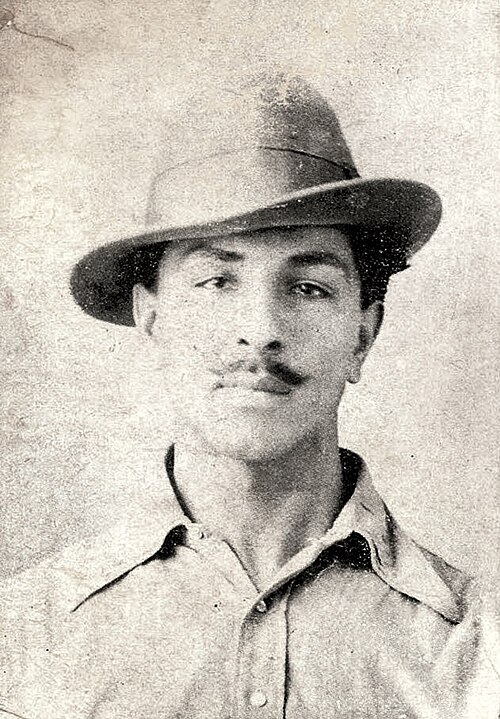
At a Glance
Banga, Lyallpur: A Family Already in the Revolution
Bhagat Singh was born on 28 September 1907 in Banga, a village in Lyallpur District in the Punjab — the province that the British had developed as the granary of empire, crisscrossed with irrigation canals, heavily settled by military veterans given land grants, and producing a Jat Sikh peasant class that was simultaneously the backbone of the Indian Army and a source of fierce, independent political consciousness. The Singh family was Sandhu Jat Sikh, and their nationalist politics were not adopted but inherited. Bhagat's father Kishan Singh had been involved in the Ghadar Party networks. His uncle Ajit Singh — who had organised the peasant resistance to the colonial government's land tenure legislation in 1907 and been deported — was one of the most celebrated nationalist figures in Punjab. Bhagat Singh was born into a household where opposition to colonial rule was not a political position but a family tradition, absorbed before he could read.
The event that seems to have crystallised that inheritance into something active and personal was the Jallianwala Bagh massacre of 13 April 1919, when British Brigadier-General Reginald Dyer ordered his troops to fire without warning into a crowd of unarmed civilians gathered at an enclosed garden in Amritsar — killing somewhere between 379 and over a thousand people depending on which count one accepts, wounding more than a thousand more. Bhagat Singh was eleven years old. He reportedly went to Jallianwala Bagh the following day and collected soil from the site of the massacre, keeping it as a relic. Whether the story is precisely accurate in its details or not, the Jallianwala Bagh massacre was the formative political event for an entire generation of Punjab's young people, and Bhagat Singh was at the age when such events leave permanent marks.
National College and the Making of a Socialist
Bhagat Singh joined Gandhi's Non-Cooperation Movement when it was launched in 1920, left school as the movement required, and then was left without a direction when Gandhi suspended the movement in February 1922 following the Chauri Chaura incident — a police station in the United Provinces had been attacked and burned by a mob, killing twenty-two constables, and Gandhi halted the movement on the grounds that mass disobedience had produced violence. Bhagat Singh, then fourteen, was among the thousands of young nationalists who found Gandhi's suspension of the movement incomprehensible. He had given up his education for the movement. He had not been consulted about ending it.
He entered Lahore's National College — founded as part of the Swadeshi nationalist alternative education system — and began the reading that would build his political philosophy. The college's library contained European revolutionary literature alongside Indian nationalist texts, and Bhagat Singh read both with concentrated appetite: Marx, Engels, Lenin, Trotsky, Bakunin, the history of the Irish Republican Army, the theory of the Russian revolution, the writings of the Bengal revolutionaries and the American radical tradition. He was teaching himself the intellectual framework for a politics that went beyond what the Congress offered — a politics that understood colonialism as an economic system as well as a political one, and that therefore understood independence as requiring economic transformation, not just the departure of British administrators.
He joined the Naujawan Bharat Sabha — the Young Men's Association of India — which he helped found in 1926 as a mass youth organisation for socialist nationalist politics, and connected with the surviving networks of the Hindustan Republican Association after the Kakori executions of December 1927. The hangings of Bismil, Ashfaqullah Khan, Roshan Singh, and Rajendra Lahiri were the radicalising event for Bhagat Singh in the same way that Jallianwala Bagh had been a decade earlier: a demonstration of what the colonial state was willing to do, and of the inadequacy of political responses that did not match that willingness with equivalent commitment.
The HSRA: Reorganising the Revolutionary Underground
In 1928, Bhagat Singh and Chandrashekhar Azad restructured the remnants of the HRA into the Hindustan Socialist Republican Association — the addition of "Socialist" was Bhagat Singh's insistence, reflecting his conviction that the organisation needed to be explicit about its economic programme rather than merely nationalist. The HSRA's political positions were articulated in documents and pamphlets that Bhagat Singh wrote or edited: opposition to British colonialism, opposition to the landlord and capitalist class that benefited from colonial rule, demand for a socialist republic with equal rights regardless of religion, caste, or class, and solidarity with workers and peasants rather than the educated bourgeoisie that dominated the Congress.
The HSRA was a small, tightly disciplined organisation. Azad was its military commander — a man of extraordinary physical courage who had survived multiple confrontations with colonial police. Sukhdev Thapar was the organisation's principal administrator in Punjab, responsible for communications, safe houses, and the logistics of the underground network. Bhagat Singh was the theorist, the writer, and increasingly the public face — though the HSRA's activities required him to maintain the kind of anonymity that eventually became impossible once the colonial government identified him as the central figure.
Lala Lajpat Rai, John Saunders, and the Logic of Reprisal
On 30 October 1928, a procession led by Lala Lajpat Rai — the veteran Punjab nationalist, one of the Lal-Bal-Pal triumvirate — was marching in Lahore against the Simon Commission, the all-British parliamentary committee examining Indian constitutional reform that had excluded Indians from its membership entirely. The superintendent of police, James Scott, ordered a baton charge. Lala Lajpat Rai was struck directly on the chest by police blows. He died of a heart attack on 17 November 1928, approximately three weeks later. Whether the baton blows caused the heart attack was medically disputed; in the political consciousness of Punjab it was not disputed at all — he had been beaten by the colonial police, and he had died. The HSRA decided that Scott would be killed in retaliation.
The operation went wrong in its targeting. On 17 December 1928, Bhagat Singh, Azad, and Rajguru stationed themselves near the District Police Office in Lahore intending to shoot Scott. John Saunders, a deputy superintendent of police who was not Scott, left the building and was shot instead. Chanan Singh, a constable who gave chase, was also killed. Bhagat Singh, Azad, and Rajguru escaped Lahore the following day with the help of the HSRA network — Bhagat Singh disguised in a Western suit with Durga Bhabhi, a comrade's wife, posing as a European couple. Posters distributed across Lahore the day after the shooting named the HSRA as responsible and explained the political reasoning: the killing of Saunders was retaliation for Lajpat Rai's death, a statement that colonial violence would not go unanswered.
The Assembly Bombing and the Deliberate Arrest
The Central Legislative Assembly action of 8 April 1929 has been described in the Batukeshwar Dutt profile. From Bhagat Singh's perspective, it was a calculated communicative act — the selection of the method and the target were both deliberate: smoke rather than fragmentation bombs, to produce maximum noise and press coverage with minimum casualties; the Assembly rather than a police station or government building, to force the colonial legislature itself to become the site of the HSRA's political statement; the refusal to flee, to ensure a public trial where the organisation's arguments could be made before the largest possible audience.
The trial provided exactly what he had planned for. His defence statements — which he wrote himself, in clear and forceful English — were published in Congress newspapers and read across India. He used the courtroom as a platform to argue not simply for Indian independence but for the socialist transformation that he believed independence required: the abolition of the economic system that produced poverty alongside colonial rule, not merely the replacement of British administrators with Indian ones. These arguments reached audiences that the HSRA's clandestine pamphlets never could, and they reached those audiences at a moment when the Indian nationalist movement was debating, more seriously than ever before, what kind of India it was trying to build.
The 116-Day Hunger Strike and Jatindra Nath Das
The hunger strike that Bhagat Singh and other HSRA prisoners launched in June 1929, demanding political prisoner status, was one of the most effective acts of political communication in the independence movement's history — not because it achieved its immediate objective (it did not; the colonial government made no meaningful concessions) but because the publicity it generated, and the death of Jatindra Nath Das on its sixty-third day, made the suffering of political prisoners impossible for Indian public opinion to ignore.
Jatindra Nath Das was a HSRA member and a trained bomb-maker who had been arrested in the post-Assembly bombing sweeps. He died on 13 September 1929 after sixty-three days of hunger striking, having refused to end his fast despite appeals from his family and from Congress leaders. His funeral procession in Lahore drew hundreds of thousands of people. The procession moved from Lahore to Calcutta by train, stopping at stations along the route where crowds gathered, and arrived in Calcutta to a reception of unprecedented scale. The colonial government's attempt to manage the publicity of a man dying slowly in jail while demanding to be treated as a political prisoner rather than a criminal was a failure of the most basic kind — it could not be managed because it was happening in public view and its moral logic was inescapable.
Bhagat Singh continued his own fast for 116 days before ending it, under considerable pressure from his family and from Congress leaders including Nehru, who visited him in jail and whose published accounts of the visit added substantially to Bhagat Singh's political stature. The fast damaged his health but did not kill him. The colonial government had that reserved for a different occasion.
The Lahore Conspiracy Case and the Death Sentence
The trial for the John Saunders killing proceeded alongside the Assembly Bomb Case, eventually consolidated as the Lahore Conspiracy Case. The prosecution relied substantially on approver testimony — members of the HSRA's peripheral networks who agreed to testify for the government in exchange for reduced sentences — and on the physical and documentary evidence gathered in the extensive raids on the HSRA's safe houses and networks across Punjab and the United Provinces. Bhagat Singh, Sukhdev, and Rajguru were the principal accused.
The defence arguments were irrelevant in any practical legal sense — the evidence of participation in the Saunders killing was sufficient for conviction under the charges brought, and no defence argument would have changed the outcome. Bhagat Singh used the trial proceedings as he had used the Assembly trial: as a platform, writing statements that were published outside, conducting himself before the court with a combination of dignity and deliberate political provocation that kept him in the press and before the public. He and his co-accused shouted revolutionary slogans in the courtroom. They rejected the court's authority without rejecting the opportunity the trial gave them to make arguments.
He was convicted and sentenced to death. Gandhi negotiated with Viceroy Irwin in the Gandhi-Irwin Pact of March 1931, which produced Congress's agreement to end the Civil Disobedience Movement in exchange for a set of concessions. The commutation of Bhagat Singh's death sentence was widely expected to be among those concessions. It was not. Gandhi did appeal to Irwin for commutation. Irwin declined. The hanging was set for 24 March 1931.
23 March 1931: The Execution and Its Aftermath
The colonial government moved the execution forward by one day — from 24 to 23 March 1931 — and changed the time from morning to evening, apparently in an attempt to reduce the opportunity for public demonstrations. Bhagat Singh, Rajguru, and Sukhdev were hanged at Lahore Central Jail at approximately 7:30 in the evening of 23 March 1931. Bhagat Singh was twenty-three years, five months, and twenty-three days old. His last request, reportedly, was to finish reading the book he was reading — Lenin's biography. The request was granted.
The bodies were taken secretly to Hussainiwala on the Sutlej River, cremated, and the ashes thrown in the river — the colonial government's attempt to prevent the creation of a grave site that would become a pilgrimage destination and a sustained focal point for nationalist protest. The attempt failed. When local people found the site of the cremation, Hussainiwala became exactly what the colonial government had been trying to prevent. A memorial was eventually built there after independence, and it is where Batukeshwar Dutt was later buried.
The reaction to the executions was immediate and severe. Demonstrations erupted across India. The Congress session at Karachi, meeting days after the hanging, passed a resolution expressing its admiration for the courage of the three men and dissociating from their methods — a carefully calibrated political response that acknowledged the popular feeling without endorsing armed violence. Gandhi, who had not secured the commutation, was met at Karachi station by demonstrators with black flags. The relationship between the Congress leadership and the revolutionary left was not simply one of disagreement about tactics; it was coloured by the perception, which Bhagat Singh's execution made acute, that the Congress had been unable or unwilling to save him when it might have tried harder.
The Prison Writings: "Why I Am an Atheist" and the Letters
The philosophical writings that Bhagat Singh produced in Lahore Central Jail while awaiting execution are the part of his legacy that has proved most durable in intellectual rather than purely political terms. "Why I Am an Atheist," written in October 1930 and smuggled out for publication, is a sustained argument against religious belief that draws on the European freethought tradition — Voltaire, Russell, Ingersoll — while addressing directly the argument that a man facing death will inevitably turn to religion for comfort. He did not. He was an atheist, he argued, not because atheism was comfortable — it was considerably less comfortable than the belief in a God who was watching and would reward suffering — but because the evidence for God's existence was insufficient, and accepting insufficient evidence was an intellectual failure he was not willing to commit regardless of the consequences.
The letters he wrote from prison to his family, to Sukhdev, to other comrades, and to the court record constitute a document of unusual psychological clarity — a young man who knew he would be killed, writing about politics, philosophy, love, and the nature of the revolution he believed in, with a composure that was not resignation but conviction. He was not afraid of dying, he wrote, because he did not believe in a soul that died — he believed in the causes he had served, and those would continue. The circularity is deliberate: he had staked everything on the proposition that the causes mattered more than the individual, and he was about to demonstrate it.
Legacy: What Twenty-Three Years Built
The question that Bhagat Singh's life poses to any serious political analysis is not why he became a martyr — that is easily explained by the colonial government's decision to hang him — but why, ninety-five years after his death, his face remains one of the most recognisable in the subcontinent's political iconography, appearing on murals in Lahore, on t-shirts in Amritsar, on posters in Delhi, in contexts ranging from left-wing trade union campaigns to Hindu nationalist platforms that would have horrified him. The answer is partially that he died at twenty-three, which fixes him in youth and potential forever; partially that he was genuinely charismatic in the documentary record in a way that is rare; and partially that his insistence that political freedom and economic justice were inseparable has remained relevant to every subsequent generation that found formal independence insufficient.
He was hanged before he was old enough to be compromised by the accommodations that governance requires. He never had to choose between his principles and the practical demands of running a state. He never had to disappoint the people who had believed in him. He was given instead the cleanest possible legacy — the record of what he thought and did before the world got complicated — and India has been arguing about that legacy ever since, each generation finding in it what it needs and leaving behind what it cannot use. That is what it means to become a symbol. He became one at twenty-three, and nothing has undone it.