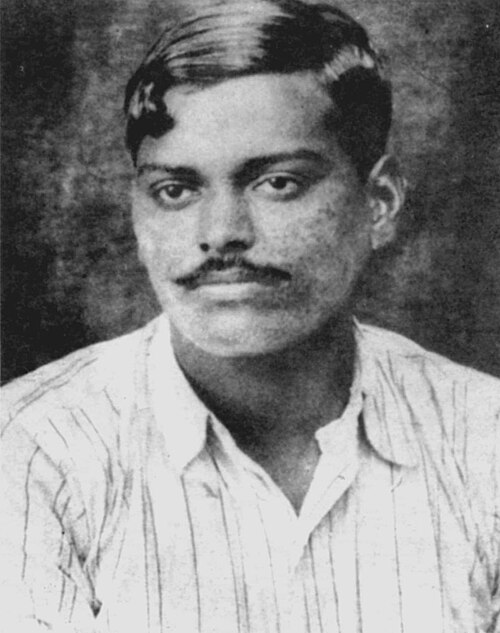
At a Glance
Bhavra and Varanasi: From a Poor Brahmin Family to the Sanskrit Pathshala
Chandrashekhar Tiwari was born on 23 July 1906 in Bhavra, a small village in the Alirajpur region of Central India — the princely state territories in what is now Madhya Pradesh, a region far from the major centres of nationalist politics but not insulated from them. His family were Brahmin, which in the social geography of Central India carried cultural prestige but not necessarily economic security; his father Sitaram Tiwari worked as a minor government servant of the kind that colonial administration produced by the thousands — educated enough for low-level administrative work, paid barely enough to maintain the middle-class respectability that Brahmin social status demanded. The family was poor in the material sense while occupying a social position that carried obligations of education and conduct.
Chandrashekhar was sent to Varanasi — Benares, the sacred city on the Ganges that was the centre of Sanskrit scholarship and Hindu religious learning — for education at a Sanskrit pathshala, a traditional school. He was there when Gandhi launched the Non-Cooperation Movement in 1920 and its call for Indians to withdraw from colonial institutions and participate in civil disobedience reached the students and young men of Varanasi as it reached young people across India. He was fourteen when he joined, fifteen when he was arrested at a protest march in Varanasi, and fifteen when he stood before the magistrate in the court that would define the name he carried for the rest of his life.
The Magistrate, the Name, and the Flogging
The courtroom scene at Varanasi in 1921 is one of the most frequently retold moments in the Indian revolutionary tradition, and its retelling has probably smoothed some of its details over time. What the documentary record establishes is this: a fifteen-year-old boy arrested for participating in civil disobedience was asked by the magistrate to state his name, his father's name, and his home address. He replied that his name was "Azad" (free), his father's name was "Swatantra" (independent), and his home address was "Jail." He was sentenced to fifteen strokes of the cane for this impertinence — the corporal punishment that the colonial courts applied to young offenders — and bore the flogging in silence, reportedly without showing pain or distress, which turned the punishment into its opposite: a demonstration of the boy's refusal to be broken by the state's violence rather than a humiliation of him.
The story entered the nationalist press and circulated across India, which was itself a statement about what the independence movement found meaningful: the young man who named himself "free" and was beaten for it and remained free in the only sense that mattered. Whether every detail of the retelling is precisely accurate is impossible to verify at this distance; that the essential facts are correct — the name, the defiance, the flogging borne without surrender — is established by contemporaries who knew him. He took the name Azad from that day and never answered to Tiwari again in political contexts.
Joining the HRA and the Kakori Operation
When Gandhi suspended the Non-Cooperation Movement in February 1922 following the Chauri Chaura police station burning, Chandrashekhar Azad was among the thousands of young Indians who found the suspension incomprehensible and who began looking for other political frameworks. The Hindustan Republican Association, founded in 1924 by Ram Prasad Bismil and others on the foundations of the existing revolutionary networks, provided that framework. Azad joined and quickly distinguished himself as a man of exceptional physical courage, practical capability, and absolute reliability — qualities that the HRA's military work required and that were rarer than ideological commitment.
He participated in the Kakori train robbery of 9 August 1925 — the operation that Bismil and Ashfaqullah Khan had planned to seize colonial government treasury funds. When the colonial government swept through the HRA networks after Kakori, arresting nearly every participant they could identify, Azad escaped. He remained at large throughout the entire post-Kakori period — the one senior HRA figure who was neither arrested nor killed, surviving through a combination of physical agility, constant movement, use of disguises, and a network of trusted contacts who sheltered him. While Bismil and Ashfaqullah Khan were tried, convicted, and hanged in December 1927, Azad continued operating — the continuity link between the old HRA and what would become the HSRA.
The HSRA and the Partnership with Bhagat Singh
The partnership between Chandrashekhar Azad and Bhagat Singh is the defining relationship of the HSRA period, and it was a partnership between two men who were in many respects entirely unlike each other. Bhagat Singh was a theorist and writer, deeply read in Marxist and European revolutionary literature, convinced that the revolution required a socialist economic programme as well as political independence. Azad was a man of action first — less interested in theoretical frameworks than in the practical questions of weapons, safe houses, escape routes, and the reliability of individual comrades under pressure. He had read relatively little compared to Bhagat Singh; he had survived considerably more. Together they complemented each other almost perfectly: Bhagat Singh providing the ideological direction and the public political voice, Azad providing the military organisation and the operational continuity that kept the underground network functional.
The reorganisation of the HRA into the Hindustan Socialist Republican Association in 1928 — adding "Socialist" to reflect Bhagat Singh's insistence on an explicit economic programme — was a joint project. Azad was formally the HSRA's military commander, responsible for the training of recruits, the acquisition and storage of weapons, the planning of operations, and the management of the network's security. He was not the organisation's political face; that role belonged to Bhagat Singh. But without Azad's organisational and military capabilities, the HSRA could not have functioned as an armed organisation at all.
The John Saunders Shooting and the Escape from Lahore
The killing of John Saunders on 17 December 1928 — the operation intended to avenge Lala Lajpat Rai's death, that killed the wrong officer because Saunders was mistaken for Superintendent Scott — was planned and executed with Azad in a central operational role. While Bhagat Singh and Rajguru carried out the shooting, Azad provided armed cover — positioned to intervene if police interference required a response. Constable Chanan Singh, who gave chase, was shot during the operation. The three principal operatives escaped the scene. The escape from Lahore the following day — the most operationally dangerous moment, with the city under alert — was managed partly through Azad's coordination of the network that provided the disguises and the route out.
After Bhagat Singh's arrest in April 1929 following the Central Legislative Assembly bombing, Azad was the most senior HSRA figure still at liberty. He took on the full burden of keeping the network operational: maintaining safe houses across the United Provinces and Punjab, managing the finances that the HSRA perpetually lacked, planning further operations, and continuing to recruit and train. He organised activities connected with the Delhi Conspiracy Case and maintained contact with Bhagat Singh in prison through intermediaries. The organisation he was running was depleted — the arrests of 1929 and the executions and transportations that followed had taken most of its experienced people — but he kept it alive.
27 February 1931: Alfred Park, Allahabad
By early 1931, Azad was based primarily in the Allahabad area, using the network of contacts he had built there over years of underground existence. On 27 February 1931, he went to Alfred Park — a large public garden in the centre of Allahabad — to meet Sukhdev Raj, a comrade, to discuss the HSRA's next moves in the days following news that Bhagat Singh, Rajguru, and Sukhdev were likely to be executed imminently. An informer — subsequently identified as Virbhadra Tiwari — had told the colonial police of Azad's presence and location. Armed police surrounded Alfred Park in large numbers while Azad and Sukhdev Raj were still in conversation.
What followed was a gun battle that lasted, by contemporary accounts, for a significant period of time. Azad fought back. He used the cover available in the park — trees, a raised mound — to hold off the police while Sukhdev Raj escaped. He was wounded during the exchange. He continued fighting. When he had expended all but one of his rounds, he placed his pistol against his temple and fired. He was twenty-four years old. The colonial police found him dead. They had not captured him. He was, as he had given his word to be, Azad — free — until the moment he died.
The British never took Chandrashekhar Azad alive. In a movement that had watched the colonial courts process and hang Bismil, Ashfaqullah Khan, Bhagat Singh, Rajguru, and Sukhdev, in which the public trial and execution had become the colonial government's principal instrument for destroying the revolutionary underground and humiliating the movement that produced it, Azad's death by his own hand was a refusal of that instrument. The colonial government got a body. It did not get a trial, a conviction, a public performance of state power over a captured revolutionary. It got a man who had kept his word.
The Pistol in the Allahabad Museum
The pistol that Chandrashekhar Azad used in his final stand at Alfred Park is preserved in the Allahabad Museum — or was, at various points, before questions about its precise provenance and condition entered the historical record. Whether the specific weapon currently displayed is definitively the weapon he carried that day is a matter for historians to assess; what the museum's preservation of it represents is the independent Indian state's decision that the instrument of the oath he kept was a relic worth preserving. The park was renamed Azad Park. A statue was erected. The pistol was kept. These are the forms in which the Indian state has tried to honour what he did, which is never a fully adequate form but is the available one.
What Azad Was
Chandrashekhar Azad is not primarily a figure for historical analysis in the way that Bhagat Singh's prison writings or Aurobindo Ghose's philosophical work invite analysis. He left almost nothing in writing. His legacy is biographical rather than textual: the record of what he did and how he died, the account of a man who made a specific promise at fifteen and kept it at twenty-four. The promise was to be free — to refuse, regardless of the cost, to become the colonial state's prisoner. He kept it for nine years of continuous fugitive existence, through the Kakori aftermath when most of his comrades were captured, through the HSRA years when Bhagat Singh was arrested and then hanged, until the last bullet in Alfred Park made the keeping of it final.
The partnership with Bhagat Singh is the frame within which he is usually discussed, and it is the right frame because the two men together were the HSRA in any meaningful sense. But Azad's significance is not reducible to his role as Bhagat Singh's military commander. He was the man the revolutionary underground could not function without — the organiser, the trainer, the person who kept the network alive in the years when everyone else had been caught. That he did this while living as a fugitive, without a fixed address, constantly moving, knowing that the colonial police were looking for him with everything they had, is the fact about him that is hardest to absorb. He kept going. He kept others going. He did it for nine years. And then he kept his word.