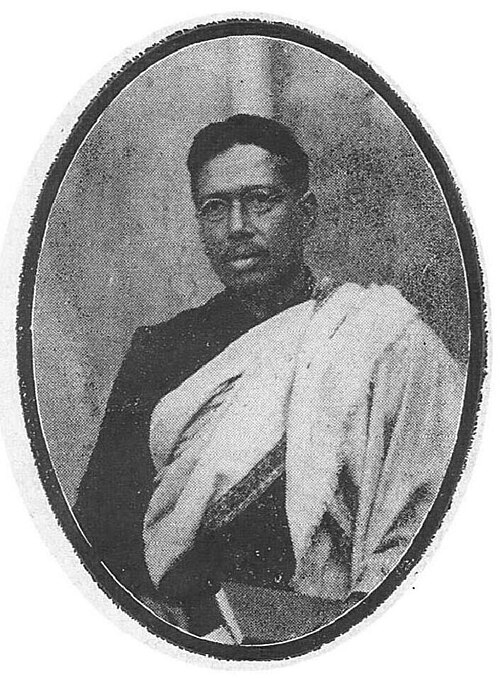
At a Glance
Sylhet and Calcutta: A Vaishnava Upbringing and a Presidency College Education
Bipin Chandra Pal was born on 7 November 1858 in Poil, a village in the Sylhet District of Bengal — a region in the northeast of the province, now part of Bangladesh, with a predominantly Muslim population and a significant Hindu minority community to which Pal's family belonged. His father was a local zamindar of modest standing, a Vaishnava Hindu with the devotional and philosophical orientation that characterised that tradition: an emphasis on bhakti, on the personal relationship between the devotee and the divine, on poetry and song as modes of spiritual expression. This early religious formation left permanent marks on Pal's political philosophy — his nationalism was always deeply entangled with Indian spiritual traditions in ways that distinguished him from the secular rationalists among his contemporaries and connected him to the cultural politics of the Swadeshi years.
He was educated at a Church Mission Society school — the irony of a future anti-colonial revolutionary receiving his early education from Anglican missionaries was not lost on him in later life — and then moved to Calcutta for Presidency College, the premier institution of Bengali higher education and the intellectual crucible from which a disproportionate share of Bengal's political and cultural leadership emerged. He did not complete his degree — a pattern common enough among the politically engaged students of the period, for whom the formal curriculum was often less compelling than the debates and networks available outside the lecture hall — but the years at Presidency College gave him the intellectual formation and the personal connections that shaped the rest of his life.
Early Journalism, the Brahmo Samaj, and the Search for a Framework
Through the 1880s and into the 1890s, Bipin Chandra Pal moved through a series of religious and political positions with a restlessness that reflected both personal intellectual honesty and the genuine difficulty of finding a framework adequate to the political situation of colonial India. He joined the Brahmo Samaj — the reformist Hindu movement founded by Ram Mohan Roy that sought to purge Hinduism of what it considered superstition and idolatry and to build a rational, monotheistic religious practice compatible with modern science and liberal ethics. He was deeply influenced by the Brahmo tradition's emphasis on personal moral responsibility and social reform, and he wrote and spoke within that tradition for years.
He also joined the Indian National Congress in 1886, attending its early sessions and beginning to develop the political positions that would eventually place him at the Extremist end of the Congress spectrum. The Congress of the 1880s and 1890s was dominated by men who believed that India's path to self-governance ran through the demonstration of political maturity — that if Indians could show the British that they were capable of governing themselves by constitutional and rational argument, the British would eventually extend greater self-governance. Dadabhai Naoroji's "drain theory" — the economic argument that colonialism was systematically impoverishing India by draining its resources to Britain — was the intellectual foundation of this moderate politics, and it was powerful as an analysis even if its political prescription of patient petition was increasingly inadequate as a strategy.
Pal's journalism through this period built his reputation as a writer and thinker of unusual range — he wrote on religious philosophy, on social reform, on economic policy, on the theory of nationalism, on the history of Indian civilisation, with a fluency in both Bengali and English that gave him access to audiences the vernacular-only or English-only writers could not reach. He founded and edited a succession of newspapers and journals — New India, Swaraj, Kal, the Hindu Review — each attempting to build the audience for a nationalism that was more assertive than the Congress mainstream would countenance.
The Partition of Bengal and the Swadeshi Moment
The partition of Bengal in 1905 was the event that converted Bipin Chandra Pal from an influential journalist and theorist into one of the most important mass political figures in India. Lord Curzon's decision to divide the province along religious lines — creating a Muslim-majority eastern Bengal and a Hindu-majority western Bengal — was understood by Bengali nationalists as a deliberate strategy to weaken the province's political coherence, and the response was volcanic. The Swadeshi Movement that erupted in Bengal within weeks of the partition announcement was the most significant mass political mobilisation in India since the 1857 uprising: the boycott of British goods, the promotion of Indian manufactures, the street demonstrations and mass meetings that brought together people across caste and class lines in a shared expression of political anger.
Pal was among the movement's most effective organisers and its most compelling voice. He toured Bengal delivering speeches at mass meetings that drew thousands — his oratory combining the cadences of Vaishnava devotional literature, the argument of political economy, and the anger of a man who had spent twenty years watching his country governed against its will. He articulated the demand for complete swaraj — full self-rule, not the partial autonomy and advisory council seats that the Congress moderates were asking for — in language that connected it to the Hindu philosophical tradition of self-knowledge and self-determination, giving the political demand a cultural resonance that the secular constitutional argument of the moderates could not match.
The Swadeshi years were the peak of the Lal-Bal-Pal triumvirate's influence. The three men — Lala Lajpat Rai from the Punjab, Bal Gangadhar Tilak from Maharashtra, and Bipin Chandra Pal from Bengal — represented the Extremist position across three major provinces simultaneously, giving it a national reach that no single-province leadership could have achieved. They were not always in full agreement on tactics or emphasis; Tilak's use of Hindu religious festivals as political organising tools sat somewhat uneasily with Pal's more universalist nationalist philosophy. But on the central question — that the Congress needed to demand complete swaraj, not incremental reform, and that mass agitation rather than polite petitioning was the method required — they were united, and their united voice shifted the Congress debate permanently.
Six Months in Jail: Refusing to Testify Against Aurobindo
In 1907, following the Surat Congress split, the colonial government prosecuted Aurobindo Ghose for seditious articles in Yugantar. Bipin Chandra Pal was called as a witness for the prosecution — a position he had done nothing to deserve except to have had connections to Aurobindo's political circles. He refused to testify. The refusal was not based on a technical legal argument about privilege or relevance; it was a straightforward statement that he would not assist the colonial government's prosecution of a man he considered a comrade in the nationalist cause regardless of whether Aurobindo had written what the government alleged. For this refusal he was convicted of contempt and sentenced to six months' imprisonment.
The imprisonment enhanced his reputation in the nationalist movement substantially. It demonstrated, at a moment when the Surat split had left the Extremists in a politically difficult position, that the principles the Extremists had articulated — solidarity against the colonial state, refusal to cooperate with colonial legal processes directed at nationalists — could be maintained at personal cost. The six months in jail were uncomfortable but not devastating, and Pal emerged from them with his standing in the movement strengthened. He subsequently went to England, where he lectured on Indian nationalism and Indian civilisation to British audiences for approximately three years, building the case for Indian self-rule in the metropolitan centre that governed the country he was trying to free.
The Theory of Nationalism: What Pal Actually Argued
Bipin Chandra Pal's importance to the intellectual history of Indian nationalism rests substantially on a body of theoretical writing that is less read today than it deserves to be. His central argument — developed across dozens of books, pamphlets, and newspaper articles — was that Indian nationalism could not be built on the foundation of European liberal political theory alone, because that theory emerged from a specifically European historical experience and contained assumptions that did not map onto Indian conditions. A nationalism adequate to India needed to be rooted in Indian civilisational traditions: in the philosophy of the Upanishads, in the ethics of the Bhagavad Gita, in the Vedantic concept of the self that transcended individual identity and connected each person to the whole.
This was not a retreat from politics into mysticism — it was an argument about the cultural foundations of political solidarity. Pal's contention was that a nationalism that could mobilise the Indian masses needed to speak a language those masses understood, and that language was religious and philosophical rather than constitutional and legalistic. The Congress moderates were talking to the educated English-speaking elite; the Extremists, and Pal in particular, were trying to build a nationalism that could reach the Bengal peasant and the Punjab agriculturalist and the Tamil weaver. Whether the religious idiom of that nationalism carried within it the seeds of the communal divisions that eventually produced partition is a question that Indian political thought has not finished answering.
The Gandhi Decade and a Different Kind of Marginalisation
When Gandhi returned from South Africa in 1915 and began building the mass political movement that would eventually produce independence, Bipin Chandra Pal found himself in a position that was psychologically complicated. Gandhi's methods — mass non-cooperation, the mobilisation of the Indian peasantry, the use of Hindu religious symbolism in political organisation — drew on much of what Pal had been arguing for twenty years. Gandhi had read Pal, had been influenced by the Extremist tradition, and was in many ways implementing the mass politics that Pal had theorised. But Gandhi's specific methods — the emphasis on non-violence as an absolute principle, the deliberate cultivation of personal austerity as political statement, the willingness to negotiate with the British that the Extremists had always refused — were not Pal's methods.
Pal had reservations about Gandhi's Non-Cooperation Movement, similar to the reservations that Annie Besant expressed and that Tilak might have expressed had he lived to see it launched. He was not opposed to mass action; he was uncertain about the specific form Gandhi was giving it. The practical consequence of these reservations was that Pal became increasingly peripheral to the movement's mainstream through the 1920s — still writing, still arguing, still demanding swaraj, but no longer the voice that tens of thousands gathered to hear. The Swadeshi oratory that had made him the most electrifying speaker in Bengal was a tool adapted to the specific political moment of 1905–1908; the movement of the 1920s had found other tools and other voices.
Last Years and Death in Poverty
Bipin Chandra Pal spent his last years in Calcutta, writing and publishing with the productivity that had characterised his entire career but without the political centrality he had known during the Swadeshi decade. He was not entirely forgotten — the Congress paid him formal respect, his birthday was noted, his writings were cited by those building the theoretical framework for independence — but the day-to-day reality of his life was one of financial difficulty. He had never been a man who accumulated money; his income had always come from journalism and lecturing, and the journalism of an elder statesman of a movement that had moved on from his specific positions did not command the audience that the Swadeshi years had provided.
He died on 20 May 1932 in Calcutta, aged seventy-three, fifteen years before the independence he had spent the most politically significant decades of his life arguing for. Gandhi was alive. Nehru was in prison. The Civil Disobedience Movement had been suspended and relaunched and was being negotiated over in ways that Pal, had he lived longer, would probably have found frustrating. The Swaraj he had demanded in 1905 was seventeen years away.
The India Post stamp issued in 1958 — twenty-six years after his death, eleven years after independence — acknowledged what he had been: one of the architects of the argument that India had the right to govern itself and the will to insist on that right, whose particular contribution was to give that argument a language and a platform that reached beyond the English-educated elite to the mass of Indians who were the movement's ultimate constituency. That the language he found was Hindu in its cultural references, and that this carried complications that the subsequent decades made visible, does not diminish what he built. It makes it more interesting, more complex, and more worth understanding on its own terms.