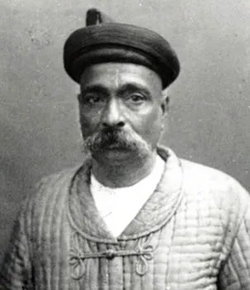
At a Glance
Ratnagiri and Pune: Sanskrit Scholarship and the Decision Against the ICS
Bal Gangadhar Tilak was born on 23 July 1856 in Chikhali, a village in Ratnagiri District on the Konkan coast of the Bombay Presidency — the same coastal region of Maharashtra that had produced the Chitpavan Brahmin community, a caste with a particularly strong tradition of scholarship, administrative competence, and, in the nineteenth century, a fierce ambivalence about British rule. His father, Gangadhar Tilak, was a schoolteacher and a competent Sanskrit scholar, and Aurobindo received his early education under his father's supervision before moving to Pune, where he attended government schools and eventually entered Deccan College.
He graduated in 1877 with a degree in mathematics, one of the best students of his year, and had every conventional credential for a career in the Indian Civil Service or in the legal profession — the two routes through which educated Indians in the 1870s could achieve financial security and social status within the colonial system. He chose neither. He had concluded, while still a student, that the fundamental problem with educated Indians of his generation was not that they lacked ability but that their education had been designed to make them servants of the empire rather than thinkers capable of imagining India's independence. He decided to build an alternative.
The New English School and Kesari: Building Institutions and an Audience
In 1880, with his friend and college contemporary Gopal Ganesh Agarkar, Tilak co-founded the New English School in Pune — a secondary school that would teach English and modern subjects while remaining connected to Indian cultural traditions, run by Indians for Indians without the anglicising ideology that pervaded the government schools. In 1881 he co-founded two newspapers simultaneously: Kesari (meaning "Lion") in Marathi, aimed at the mass Marathi-reading public, and Mahratta in English, aimed at the educated Indian and the colonial administration that he intended to make uncomfortable. In 1884 he co-founded the Deccan Education Society, which took over the running of the New English School and later established Fergusson College — which continues to function in Pune today.
The two newspapers were the instruments through which Tilak built his political influence, and they are inseparable from his biography. Kesari in particular reached an audience that Congress politicians could not reach — the Marathi-speaking peasants, artisans, traders, and lower-middle-class Hindus of the Deccan who were not represented at Congress sessions and had never been consulted by the English-educated professionals who ran the nationalist movement. Tilak wrote for this audience with a directness and cultural fluency that was unusual for a man of his class and education. He was willing to use the language of Hindu religious tradition — the Bhagavad Gita, the example of the Maratha warrior-king Shivaji — as political arguments, which the more secularised moderate nationalists found unsophisticated but which connected with the audiences Tilak was reaching in ways that the moderates' constitutional language never could.
The Ganesh Chaturthi Revival: Festival as Political Mobilisation
One of Tilak's most consequential innovations was the transformation of Ganesh Chaturthi — the festival celebrating the elephant-headed deity Ganesha, widely observed in Maharashtra as a household and community celebration — into a large-scale public political event. From 1893 onwards, Tilak organised Ganesh Chaturthi as a ten-day public festival with street processions, public singing, lectures, and cultural performances. The explicit stated purpose was to create a public gathering that would bring together Hindus of different castes and social classes — the orthodox and the reformers, the Brahmins and the lower castes, the educated and the illiterate — in a shared celebration that would build communal solidarity and political consciousness simultaneously.
The revival was controversial from the start. Reformers like Gopal Krishna Gokhale argued that using religious ritual as a vehicle for political mobilisation was intellectually dishonest and socially backward. Tilak responded that the reformers' preference for secular English-language political organisation was a preference for a form of politics that excluded most Indians from participation. The argument has continued in Indian political analysis ever since, because it touches questions that have not been resolved: whether a nationalism built on religious cultural identity can be genuinely inclusive, and whether a nationalism that avoids religious cultural identity can mobilise the mass of people for whom that identity is fundamental. Tilak's answer was the one that reached more people. Whether it was the right answer in the longer term is a question that the subsequent history of Hindu nationalism makes genuinely difficult.
First Imprisonment: 1897 and the Plague Committees
In 1896–97 a severe plague epidemic struck Pune and the surrounding region, killing tens of thousands of people. The colonial government's response included measures that were experienced by the local population as brutal: military officers conducting house searches, quarantine enforced by soldiers, separation of the sick from their families by force. The Plague Committees that administered these measures were empowered to enter homes, inspect and remove inhabitants, and destroy property deemed infectious. Tilak wrote in Kesari with controlled fury about the conduct of these committees and about the colonial government's treatment of the population it was supposed to be protecting. The articles were inflammatory by any measure, deliberately so.
In June 1897, a British officer named Rand who headed the Plague Committee in Pune, and another British officer, were shot by members of the Chapekar brothers' revolutionary group. The colonial government used the murders as an occasion to prosecute Tilak for sedition — arguing that his articles in Kesari had "excited disaffection" against the government and thereby created the atmosphere that made the killings possible. He was convicted and sentenced to eighteen months' rigorous imprisonment. The prosecution was widely seen as politically motivated — as an attempt to silence the most effective nationalist critic the colonial government faced in the Bombay Presidency — and it made Tilak a martyr figure whose popularity increased substantially as a result of the imprisonment.
The Lal-Bal-Pal Triumvirate and the Surat Split
By the early 1900s, Tilak was the dominant figure in the Congress Extremist faction — the group of nationalists who argued that the Congress moderates' strategy of petitioning for incremental reform was achieving nothing and that the movement needed to adopt mass agitation, economic boycott, and an explicit demand for swaraj. His two principal allies in this argument were Lala Lajpat Rai from the Punjab and Bipin Chandra Pal from Bengal — the three men became known collectively as Lal-Bal-Pal, the initials of their first names, a formulation that circulated in the nationalist press and in popular consciousness as shorthand for the militant nationalist position. The three men were linked not only by political alignment but by the shared experience of prosecution: all three were at various points charged with sedition or incitement by the colonial authorities.
The Swadeshi Movement, launched in response to the 1905 partition of Bengal, gave the Extremists the mass agitation they had been arguing for. The boycott of British goods, the promotion of Indian manufactures, the street demonstrations and public meetings that spread across Bengal and into other provinces — these were the politics Tilak had been advocating for two decades, and they demonstrated that his analysis had been correct: Indian politics could be a mass movement if it was conducted in language and forms that the mass of Indians could participate in. The Congress moderates, led by Gokhale, were alarmed by the scale and the tone of the agitation and increasingly at odds with the Extremists over strategy and methods.
The split came at the Surat Congress session of December 1907. The session descended into open disorder — there are accounts of chairs being thrown — after the Moderates used procedural manoeuvres to prevent Tilak's candidate from being elected Congress president. The Extremists were effectively expelled from the Congress organisation, and the Moderates retained control of the party machinery. It was a tactical victory for the Moderates and a strategic disaster: the Congress lost its most effective mobilisers at exactly the moment when the colonial government, emboldened by the split, moved to suppress the Extremist networks entirely.
Mandalay: Six Years in a Burmese Prison
In 1908, following the Muzaffarpur bombing for which Khudiram Bose was hanged, Tilak wrote articles in Kesari that the colonial government considered seditious — they argued that the bombing was the natural and predictable consequence of colonial repression, and that the government that ordered floggings of demonstrators bore moral responsibility for the violence that followed. He was prosecuted for sedition, tried before a jury that included seven Indians and two Europeans, and convicted by a majority verdict — the seven Indian jurors voted for acquittal, the two Europeans voted for conviction, and the judge accepted the majority finding in the government's favour. He was sentenced to six years' transportation to Mandalay, Burma.
The verdict caused outrage across India. Gandhi, then working in South Africa, wrote that the verdict was an affront to justice. Mass protests erupted in Bombay and other cities. The conviction was widely understood, then and since, as a political prosecution — an attempt to remove the most effective nationalist agitator in India from the political arena for as long as possible. Tilak served the full six years in the Mandalay prison, from 1908 to 1914, and spent much of the time writing. Gita Rahasya — his commentary on the Bhagavad Gita, arguing that the Gita's central teaching was not renunciation but action in the world — was written during the imprisonment and became one of the most widely read religious and philosophical texts in Marathi. The Arctic Home in the Vedas, his scholarly argument that the Vedas described an Arctic homeland of the proto-Indo-European people, was also substantially developed during this period.
Return and the Home Rule League
Tilak returned to India in June 1914, as the First World War was about to begin, and found the political landscape transformed. The Congress had been dominated by Moderates since the Surat split, and the colonial government, distracted by the war and hoping for Indian cooperation, had made some conciliatory gestures. Tilak, characteristically, saw the war as an opportunity rather than an occasion for loyalty: Britain needed Indian cooperation, which meant India had leverage that it should use.
In April 1916, he founded the All India Home Rule League — the first organisation to make home rule for India its explicit and sole objective, modelled on the Irish Home Rule movement and designed to take the demand for self-governance out of Congress resolutions and into a mass membership organisation with branches across India. Annie Besant founded a second Home Rule League in September 1916. The two organisations agreed to operate in complementary geographical territories and effectively ran as a coordinated national campaign. Within eighteen months they had enrolled tens of thousands of members and permanently altered the terms of the Congress debate about what the movement was actually asking for.
The Lucknow Pact of 1916 — in which Tilak played a significant role — reunited the Congress and the Muslim League on a joint platform for constitutional reform, a remarkable achievement at a moment when Hindu-Muslim relations across India were under significant strain. The Pact offered the Muslim League reserved seats in provincial legislatures in exchange for joint demands for constitutional advance — an arrangement that was later criticised as having conceded too much to communal representation, but that in 1916 represented the most significant joint Hindu-Muslim political action since the formation of the Congress itself.
The Last Years: Gandhi's Arrival and a Handover of History
In 1918 and 1919, Tilak travelled to London to press India's case for constitutional reform before the British Parliament and at the Montagu-Chelmsford reform discussions. He was received but not conceded to: the Montagu-Chelmsford reforms introduced in 1919 offered a limited system of dyarchy — partial Indian control of some provincial departments — that fell far short of home rule. Tilak considered it inadequate and said so. He returned to India in late 1919, ill with diabetes but still working, still writing, still editing Kesari.
Gandhi had returned from South Africa in 1915 and was building the political movement that would eventually overshadow everyone who had come before him. The two men had a complicated relationship — Tilak respected Gandhi's ability to reach the masses but was uncertain about the non-cooperation strategy that Gandhi was developing, which proposed a complete withdrawal from British institutions rather than the confrontational engagement that Tilak had always favoured. They met and corresponded; there was mutual respect and some disagreement about tactics. Tilak died on 1 August 1920, just as Gandhi's Non-Cooperation Movement was being formally launched — too early to see whether the movement he had spent forty years building would succeed in the form Gandhi was giving it, and too early to offer his own verdict on whether it would.
His funeral in Bombay drew an estimated two hundred thousand people — at that date one of the largest political funerals in Indian history. Gandhi delivered the eulogy: "Lokamanya Tilak was the Maker of Modern India." The phrase has remained the standard formulation. What Tilak made was the conditions for the possibility of what Gandhi then built — the mass political movement, the language of swaraj, the demonstration that nationalism could speak to millions rather than hundreds, the organisations and the cultural frameworks through which those millions could be mobilised. The building was someone else's work. The foundations were his.