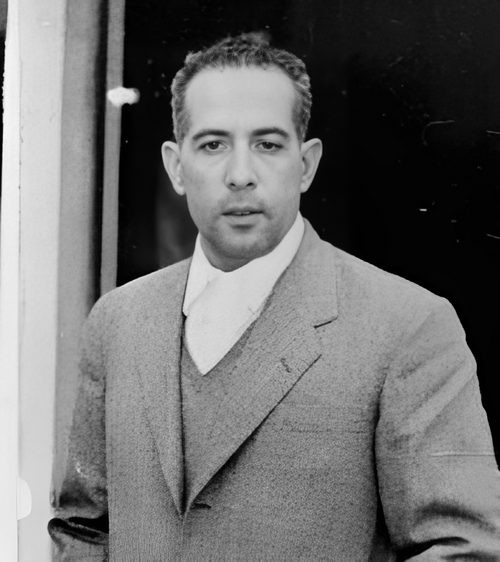
At a Glance
M'Sila, the Nationalist Formation, and the Path to the FLN
Mohamed Khider's political formation ran through the full sequence of Algerian nationalist organisations of the inter-war and immediate post-war period. He began in the networks associated with Messali Hadj and the Étoile Nord-Africaine — the North African Star, the first mass Algerian nationalist organisation, which the French authorities had dissolved multiple times without managing to destroy. Moving through the MTLD — the Movement for the Triumph of Democratic Liberties that succeeded the earlier formations — he accumulated the organisational experience, the personal networks, and the political analysis that would make him one of the most valuable members of the group that founded the FLN in 1954.
What distinguished Khider from most of his nationalist contemporaries was his direct experience of the French political system from the inside. His election as one of the Algerian deputies to the French National Assembly in 1947 placed him in the Palais Bourbon — the chamber in which the laws governing Algeria were debated and passed, in which the colonial relationship was periodically examined and consistently reproduced, and in which the formal mechanisms of French democracy revealed, to anyone paying close enough attention, their complete incompatibility with Algerian independence within the existing framework.
The experience was clarifying rather than discouraging. A man less analytically rigorous might have concluded from election to the French parliament that the constitutional path was viable and worth pursuing; Khider concluded the opposite. The French political system's treatment of its Algerian deputies — the restricted franchise, the manipulation of electoral procedures, the structural impossibility of translating even a significant Algerian electoral presence into actual legislative influence over the laws governing Algeria — demonstrated to him with precision and evidence what the more theoretically minded nationalists had been arguing in abstract terms: that Algerian independence could not be achieved within the framework of French constitutional politics.
The October 1956 Interception: The Sky Over the Mediterranean
The interception of the Air Maroc aircraft carrying Khider, Ahmed Ben Bella, Mohamed Boudiaf, Hocine Aït Ahmed, and Rabah Bitat on 22 October 1956 was one of the most audacious and diplomatically consequential acts of the Algerian War. The five men were flying from Rabat in Morocco to Tunis, where they were to participate in peace negotiations that the Moroccan and Tunisian governments were facilitating. The French military — acting without the knowledge or authorisation of the civilian government of Guy Mollet — ordered French fighter jets to intercept the Moroccan aircraft and force it to land at Maison-Blanche airport in Algiers.
The five FLN leaders were arrested and imprisoned. The French civilian government — which had known nothing of the operation and had not sanctioned it — faced an immediate diplomatic crisis: Morocco and Tunisia, whose trust had been exploited to facilitate the interception, were furious; the international community was shocked by the violation of Moroccan sovereignty and international aviation law; and the FLN, rather than being decapitated by the loss of five senior leaders, acquired five martyrs whose imprisonment generated international sympathy and galvanised the movement's internal commitment.
For Khider personally, the interception meant that he spent the remaining six years of the war in French detention — first in various French prisons and then in more comfortable custody as the war's political trajectory made the treatment of FLN prisoners increasingly politically sensitive. He was released as part of the Évian Accords process in 1962, returning to an independent Algeria whose independence his imprisonment had not prevented.
The FLN After Independence: Secretary-General and Its Limits
The Algeria that Khider returned to in 1962 was not the Algeria that the FLN's revolutionary programme had envisioned. The competition for power between the provisional government (GPRA), the army leadership under Houari Boumédiène, and the various wilaya commanders who had fought the war inside the country was being resolved through a combination of military force and political manoeuvre in ways that had little to do with the democratic principles that the FLN's programmatic documents had proclaimed. Ahmed Ben Bella's alliance with Boumédiène was producing a political consolidation that privileged personal power over institutional development, and the FLN as an organisation was being converted from a revolutionary movement into an instrument of state control.
Khider's appointment as the first Secretary-General of the post-independence FLN placed him at the centre of this conversion process, and his experience in the role gave him direct evidence of what was happening. The party that he was supposed to be building into a mass democratic organisation was being hollowed out — its internal democratic structures bypassed, its leadership subordinated to Ben Bella's personal authority, its relationship with the Algerian population converted from one of mobilisation and participation to one of control and demobilisation. The Algeria that was emerging was not the Algeria that the revolution had been fought for.
His resignation in 1963 was principled and costly. He had tried to work within the system, to build the party structures that might constrain personal power with institutional accountability, and had concluded that the system was not amenable to that kind of reform from within. His departure — taking with him the party funds that he argued were the party's and not Ben Bella's personal government's — was both a statement of principle and a provocation, and it guaranteed that his relationship with the Algerian government would be permanently hostile.
Exile, the Funds Dispute, and the Politics of Post-Independence Violence
The funds that Khider took into exile — estimated at various times at figures ranging from millions to tens of millions of dollars — were held in Swiss bank accounts and became the subject of a prolonged legal dispute between Khider and the Algerian government. His position was that the funds had been entrusted to the FLN as an organisation and that Ben Bella's government, by converting the FLN into a personal political instrument, had forfeited its claim to them; the government's position was that the funds belonged to the state and that Khider was an embezzler. The dispute wound through Swiss courts for years, with the legal ownership of the funds remaining unresolved at the time of his death.
The practical consequence of the dispute was to make Khider's continued existence in exile an ongoing problem for the Algerian government — not primarily because of the money, though the money mattered, but because a living Khider was a living critique of what the independent Algeria had become. His public statements from exile — his condemnations of Ben Bella's authoritarianism, and then of Boumédiène's coup against Ben Bella in 1965, which Khider regarded as a further step in the militarisation of Algerian political life rather than a correction of it — kept the question of what the revolution had been for alive in the international media and in the Algerian diaspora in ways that neither government found convenient.
The pattern of violence against exiled Algerian political figures — which would include Belkacem Krim, found strangled in a Frankfurt hotel in 1970, as well as Khider — was part of a systematic effort to silence the critics of post-independence Algerian governance whose historical standing gave them a credibility that less distinguished opponents would not have had. A man who had been one of the nine founders of the FLN, who had been arrested by the French and imprisoned for years, who had served as the first Secretary-General of the post-independence party — this was not a figure whose criticisms could be easily dismissed as those of an outsider or an enemy of the revolution. He had to be silenced.
Madrid, January 1967
Khider was shot dead outside his apartment in Madrid on 4 January 1967. The assassination was carried out with the efficiency and the lack of subsequent accountability that characterised state security operations of the period. The gunman was identified but never prosecuted in Spain; the Algerian government denied involvement; the international community — occupied with other concerns and reluctant to press the point against a government that remained a significant voice in the Non-Aligned Movement and the Arab world — did not press the question with the force it deserved.
He was fifty-four years old, had served the Algerian revolution from its earliest organised expressions in the 1940s through the armed uprising of 1954, had spent years in French imprisonment, had returned to build the independent state he had helped create, had resigned rather than participate in its corruption, and had been killed in exile for refusing to be silent about what had gone wrong. The funds dispute — still unresolved at his death — was eventually settled by his heirs and the Algerian government in subsequent years, the specific legal question outlasting the man whose principled stand had generated it.
The Meaning of a Life Cut Short
Mohamed Khider's career raises questions about the relationship between revolutionary commitment and post-revolutionary political reality that are among the most important in the history of decolonisation. He was not naive about power; his years in the French parliament had given him more direct experience of how power actually operated than most of his colleagues possessed. He was not a utopian; his understanding of the FLN's internal dynamics and the military establishment's interests was precise and realistic. What he refused to accept was that the Algeria that had been created by the revolution was the only Algeria possible — that the conversion of the revolutionary movement into an instrument of military and personal power was an inevitable outcome rather than a choice made by specific people for specific reasons.
His insistence on this refusal — maintained through resignation, exile, and the legal battles over the party funds — cost him his life. The nine historic founders of the FLN paid extraordinary personal costs for the revolution they made: Ben Boulaïd killed by a French booby-trapped package in 1956, Didouche killed in combat in January 1955, Ben M'hidi tortured to death by the French in 1957, Bitat imprisoned, Krim assassinated in 1970, Boudiaf assassinated in 1992, Khider assassinated in 1967. The revolution succeeded; its founders were systematically destroyed — by the French first and then, with bitter irony, by the state that the revolution had created.