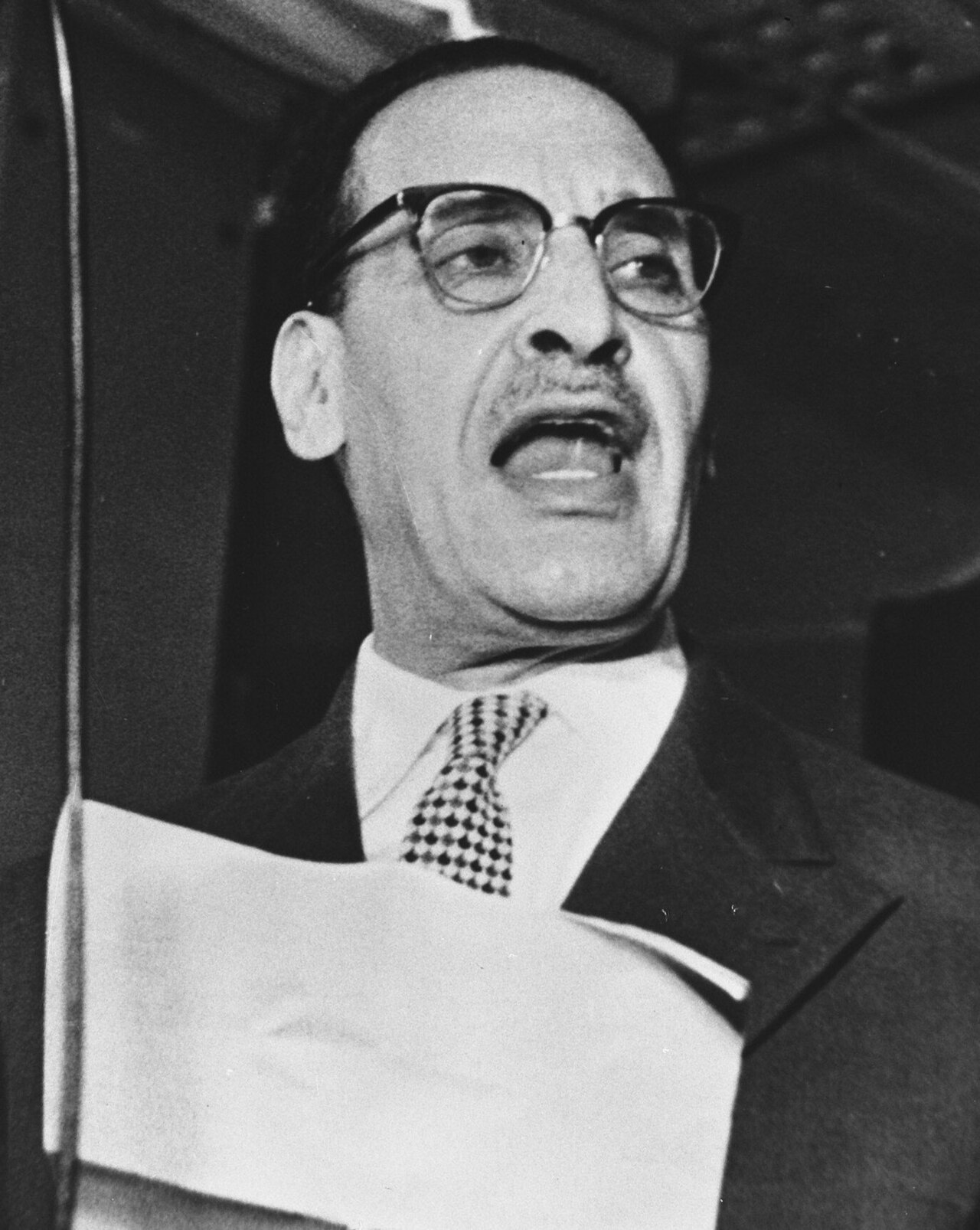
At a Glance
Setif's Son: Formation Between Two Worlds
Ferhat Abbas was born in 1899 in the eastern Algerian town of Taher, into a family whose position within the colonial system was characteristic of the small class of educated Algerians whom France had cultivated as administrative intermediaries. His father's service to the French administration gave the family a marginal stability and access to French education that most Algerians lacked, and Abbas moved through the colonial educational system to the University of Algiers, where he studied pharmacy — one of the very few professional qualifications that a small number of educated Algerians could access in the colonial period. He graduated, established a pharmacy in Setif, married a French woman, and became involved in the politics of the generation of Algerians who had received a French education, absorbed French republican values, and then discovered that France applied those values selectively.
His early politics were those of a man who genuinely believed that the French republican ideal — liberty, equality, fraternity — could be extended to Algeria if Algerian Muslims could demonstrate their eligibility for full French citizenship. He was a member of Ferhat Abbas’s generation of évolués — the term the French colonial system used for Algerians who had adopted French culture and education — who argued for assimilation not because they were ashamed of their Algerian identity but because they believed that full French citizenship was the fastest available path to political rights for Algeria's Muslim population. The argument had a logic: France had citizenship to offer, and the alternative — a separate Algerian national identity — had, in 1936, no institutional expression and no precedent in the form of a sovereign Algerian state.
The Famous Phrase and What It Actually Meant
In 1936, Abbas wrote: "If I had discovered the Algerian nation, I would be a nationalist and I would not blush for it as if it were a crime. Men who die for a patriotic ideal are honoured and respected... And yet I will not die for the Algerian homeland, because this homeland does not exist. I have not found it. I have examined history, I have asked the living and the dead, I have visited cemeteries; nobody spoke to me about it. I have then turned toward the Quran... I found the Arab empire, I found Islam, I did not find Algeria." The passage has been quoted, misquoted, and selectively cited ever since by commentators seeking to make various political points. What it meant, in its actual context, was not that Algerians lacked identity or culture or attachment to their land, but that France's colonial project had so thoroughly suppressed and denied the institutional expression of Algerian collective identity that the political form of nationhood — which requires collective institutions, recognised boundaries, and a shared political project — had not been permitted to develop. It was a critique of colonialism masquerading as an argument for assimilation, and its author changed his mind about assimilation as soon as it became clear that France was not going to offer it on any terms that made it meaningful.
From Manifesto to Revolution: The Education France Provided
The education was delivered in stages. The Blum-Viollette bill of 1936 — which would have extended French citizenship to approximately 25,000 Algerians meeting educational and service criteria — was killed by the lobbying of Algerian settlers before it could even be debated in the French parliament. The Second World War brought 300,000 Algerian soldiers into the French and Allied armies; their wartime service was sold to them as evidence of their full membership in the French community. The Setif and Guelma massacres of 8 May 1945 — conducted while the world was celebrating Germany's defeat — were France's answer to what that membership meant.
Abbas had published the "Manifesto of the Algerian People" in 1943, moving from assimilation to a demand for Algerian autonomy within a French union. France's response to the manifesto was indifference followed by arrest. After the Setif massacre, he founded the UDMA in 1946 — a party seeking Algerian self-governance through electoral politics — and spent the next ten years watching the French electoral and administrative system block, marginalise, and ultimately render futile every constitutional avenue for Algerian political advancement.
He joined the FLN in April 1956, dissolving the UDMA and throwing its membership and resources into the revolution. The decision was not made lightly; he was fifty-six years old, had spent thirty years arguing for constitutional politics, and was joining a movement whose methods he had consistently opposed. But the methods he had favoured had failed, and the revolution was happening whether he joined it or not. His decision to join brought legitimacy — the endorsement of the most prominent moderate nationalist in Algeria gave the FLN a broader political base and a more credible claim to represent the full spectrum of Algerian opinion, not merely its most radical wing.
The GPRA Presidency: Diplomat in a War
The Gouvernement Provisoire de la République Algérienne was established in Tunis in September 1958, partly in response to de Gaulle's return to power and the creation of the Fifth Republic, and Abbas was appointed its first president. The choice was deliberate: he was the figure in the FLN's leadership whose name and history were most likely to command respect from the international audiences whose support the independence movement needed. He had French contacts, international credibility, and a history of arguing for political solutions that governments more comfortable with negotiated settlements than with guerrilla warfare could take seriously.
As GPRA president, Abbas focused on building the international coalition that the independence movement required — speaking at the United Nations, meeting foreign heads of state, building support among the non-aligned movement and within the Arab world. He was more comfortable in the corridors of the UN than in the mountains of the maquis, and he understood that the war would ultimately be won or lost in the international diplomatic sphere as much as in the field. The FLN's campaign for international recognition — which by 1960 had produced a UN General Assembly resolution calling for Algerian self-determination over French objections — was substantially Abbas's work.
He was succeeded as GPRA president by Benyoucef Benkhedda in August 1961. The succession reflected the military commanders' preference for a figure more aligned with their own interests as the Evian negotiations approached their conclusion. Abbas remained within the GPRA but without executive authority.
Independence's First Dissident: The National Assembly and Its Dissolution
After independence, Abbas served as the first president of Algeria's National Constituent Assembly — the body charged with drafting the new state's constitution and providing the legislative framework for independent governance. He held the position from September 1962 until his resignation in August 1963, when he resigned in protest at Ben Bella's increasing authoritarian tendencies — specifically at the government's decision to pre-empt the constituent assembly's constitutional deliberations and impose a single-party constitution by decree.
The resignation was an act of personal integrity and political futility in equal measure. Ben Bella's government ignored it; Boumédiène's coup of 1965 further entrenched the single-party, military-dominated system that Abbas had opposed. He was placed under house arrest in 1964 for political opposition activities. He was periodically rehabilitated and re-marginalised as successive governments found his symbolic value useful and his principled opposition inconvenient by turns.
The Memoirs and the Legacy of Honest Dissent
Abbas wrote extensively in his later years — memoirs that documented his political journey, his experience of the revolution, and his assessment of what independent Algeria had become. His Autopsie d'une guerre and L'indépendance confisquée — "Autopsy of a war" and "Stolen independence" — were among the most honest accounts by a participant of what the Algerian Revolution had promised and what it had delivered. He died on 24 December 1985 in Algiers, at eighty-six years old, having outlived Ben Bella's government, Boumédiène's death in 1978, and the beginning of Chadli's liberalisation. The democratic Algeria he had sought across fifty years of political life remained unrealised.
His legacy is that of the principled moderate whose principles are vindicated by events while his politics are defeated by them. He was right that constitutional politics were the appropriate mechanism for achieving Algerian rights; France's refusal to permit constitutional politics to work is not his failure but France's. He was right that the revolution's military commanders would build a state in their own image rather than the democratic image the Soummam Platform had promised; his inability to prevent this is not a personal failure but an illustration of the structural impossibility of constraining military power through political argument when the military holds all the weapons. He represents, in Algerian history, the road not taken: the constitutional, democratic, civilian path that France refused to permit and that Algeria's own military commanders refused to build. The road not taken haunts the road that was taken, and Abbas's life is the haunting made visible.