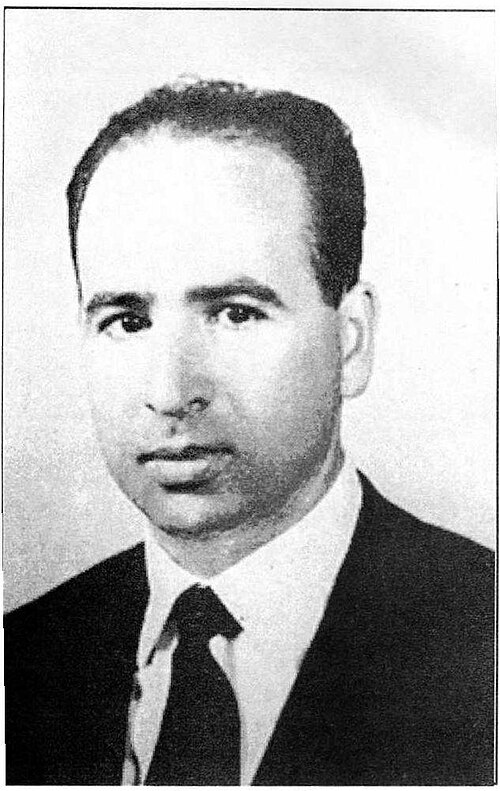
At a Glance
Seven Years Before the Revolution: The Maquis as Formation
Belkacem Krim was born in 1922 in Draâ El Mizan, a town in the Tizi Ouzou province of Kabylie. He received a French colonial education, worked briefly as a municipal employee, and became involved in nationalist politics in the period when Messali Hadj's MTLD was the dominant force in Algerian political opposition. In 1947, during a confrontation connected to clandestine nationalist activities in the mountain forests of Kabylie, Krim killed a French forest guard named Léon Laberthonnière. Facing certain arrest, he made the decision that committed the next twenty-three years of his life: he took to the mountains.
The seven years he spent in the Kabylie massif before the revolution's official launch were a sustained act of political will — maintaining an armed presence, building relationships with mountain villages, recruiting and training fighters, and conducting ongoing operations against colonial authority. By the time the nine founders met in the summer of 1954 to plan the November insurrection, Krim was the only one of them who was already at war. His seven years in the mountains gave him what none of the others had: the specific knowledge of how armed resistance worked in practice, what the mountains could sustain, what French military responses to guerrilla operations looked like from the receiving end. He brought operational credibility to the planning meetings that theoretical commitment alone could never have provided.
The Founding Decision and 1 November 1954
The nine activists who broke from the existing nationalist parties in 1954 included Krim alongside Mostefa Ben Boulaïd, Mourad Didouche, Larbi Ben Mhidi, Rabah Bitat, Amar Ouamrane, Mohamed Boudiaf, Ahmed Ben Bella, and Mohamed Khider. The coordinated attacks they launched on 1 November 1954 — targeting French military and administrative installations across six regions simultaneously — announced the beginning of an eight-year war.
In Kabylie, Krim's pre-existing organisation gave the initial operations a foundation the other wilayas took months to develop. The mountain villages he had cultivated for seven years provided the shelter, intelligence, and logistical support that guerrilla operations require. The revolution in Kabylie did not begin on 1 November 1954 — it had begun in 1947, in the forests above Draâ El Mizan, when Krim chose the mountains over surrender.
Commanding Wilaya III Through the War's Hardest Years
The Kabylie massif — the Djurdjura range rising to over 2,300 metres and covered with dense cedar and oak forests — was the natural terrain for Krim's mode of warfare. He knew it completely; the French army never did. French military operations against Wilaya III were persistent and intensive, deploying tens of thousands of troops in major offensives like Opération Jumelles (1959). Krim survived these operations through dispersal, constant movement, and the extraordinary loyalty of the Kabyle population.
That loyalty was cultivated through discipline: Krim enforced strict conduct rules on his fighters, prevented the abuses that would have alienated the population, and ensured the FLN's political programme was communicated alongside its military operations. He attended the Soummam Congress of August 1956 as one of the internal commanders whose presence gave it legitimacy, was appointed to the CCE that the congress established, and supported Abane Ramdane's platform — until the relationship between them deteriorated beyond repair.
The Murder of Abane and Its Moral Weight
In December 1957, Krim participated in the murder of Abane Ramdane — strangled in a farmhouse near Tétouan, Morocco, by Krim, Lakhdar Bentobbal, and Abdelhafid Boussouf. This killing is the darkest element of Krim's biography. Abane was the revolution's most important political mind, the author of the Soummam Platform, and the man who had done more than anyone else to give the FLN a coherent democratic programme. He was murdered by his colleagues for being too effective an advocate for those principles.
Krim's role was active, not merely complicit. He participated in the killing and in the cover-up — the false accounts of Abane dying in combat that were circulated and defended for years. The moral weight is not diminished by political context or military achievement. Krim was capable of murder for factional advantage, and the political culture this killing both expressed and consolidated would eventually be turned against him.
The GPRA, Évian, and the Signature That Made Independence
Krim's standing as a founding figure and experienced commander made him indispensable to the GPRA established in Tunis in 1958. He served as Minister of Armed Forces and Vice-President, and when France agreed to negotiate at Évian in 1961–1962, Krim led the Algerian delegation through months of difficult talks — France protecting settler interests and Saharan oil rights, Algeria demanding full sovereignty. On 18 March 1962, Krim signed the Évian Accords. The ceasefire took effect the following day. The referendum of 1 July 1962 produced a 99.72% vote for independence. Algeria was free on 5 July 1962 — 132 years after the French conquest the revolution had been launched to reverse. Krim had been fighting since 1947. At the moment of signing, he was thirty-nine years old.
Opposition, Exile, and the Frankfurt Hotel Room
The political settlement of independence did not honour what Krim had fought for. The factional struggle between the internal fighters and Boumédiène's external army was resolved by force in the external faction's favour. Krim opposed Boumédiène's coup of June 1965 publicly, went into exile, and founded the Mouvement Démocratique de Renouveau Algérien. The Algerian government condemned him to death in absentia and dispatched agents to carry out the sentence.
On 18 October 1970, Krim was found strangled in his room at the Hotel Intercontinental in Frankfurt. He was forty-eight years old. The symmetry with Abane's end — both murdered by Algerians, both strangled, both for political inconvenience — is a commentary on the political culture the revolution had built that does not require elaboration.
Legacy: The Founder Who Signed the Peace
Algeria commemorates Krim with the ambivalence appropriate to a figure of genuine greatness and genuine moral failure. His name is on streets and public buildings; his role at Évian is acknowledged as a moment of national triumph. The murder of Abane, and his own death at Algerian hands, are less prominently featured. The full accounting of his life — seven years of pre-revolutionary resistance, the November 1954 founding, the military command of Wilaya III, the Soummam Congress, the murder of Abane, the Évian signature, the exile, and the Frankfurt hotel room — is the full accounting of what the Algerian Revolution was: its greatness and its atrocities, its democratic aspirations and its political murders. Krim embodied all of it. To understand him fully is to understand the revolution fully — which is why the full understanding has been so carefully avoided.