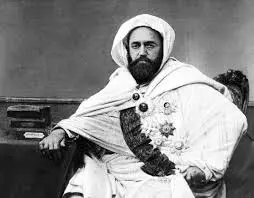
At a Glance
Origins: Scholar, Sufi, and Reluctant Commander
Abdelkader ibn Muhieddine was born in 1808 near Mascara in western Algeria into a family whose religious authority in the region preceded the French invasion by generations. His father Muhieddine was the head of the local chapter of the Qadiri Sufi order — one of the most widely distributed mystical brotherhoods in the Islamic world — and a scholar of considerable regional reputation whose network of religious relationships extended across the western Algerian tribal confederations. The family's combination of religious learning, Sufi spiritual authority, and claimed Sharifian descent from the Prophet Muhammad gave it a standing that was simultaneously theological and political, providing the social capital that Abdelkader would inherit and deploy in building his resistance movement.
The young Abdelkader received the education appropriate to his family's status: intensive training in classical Arabic, the Quran and its interpretive tradition, Islamic jurisprudence, logic, and the literature and philosophy of the Islamic world. He performed the hajj with his father in 1825, a journey that took them through Egypt and the Levant and gave the seventeen-year-old his first direct encounter with the wider Islamic world — its scholars, its political situations, and the debates about how Muslim communities should respond to European encroachment that were already circulating in Cairo and Damascus. He returned to Algeria in 1828 with a formation that was deeply Islamic but not parochial: he had seen the world, or at least the Arab-Islamic part of it, and he understood that the questions facing Algeria were questions being faced across the Muslim world.
France's Invasion and the Call to Lead
France invaded Algeria on 5 July 1830, bombarding and then landing at the Bay of Sidi Ferruch under the command of General de Bourmont. The pretext — a dispute over debts and a slight to the French consul that had resulted in the Dey of Algiers striking him with a fly-whisk — was as transparently inadequate as most colonial invasion justifications; the real motivation was the domestic political calculation of a French government seeking military glory to shore up its popularity. The conquest of Algiers was rapid; the conquest of Algeria was not. The Ottoman Dey's authority had been confined to the coastal cities and their immediate hinterlands; across the vast interior, power rested with tribal confederations and their leaders, who had their own relationships with the Ottoman administration but their own sources of authority that did not derive from it and did not disappear when it collapsed.
The tribal leaders of the Beni Hashim confederation in the Oran region approached Muhieddine, Abdelkader's father, in November 1832 and asked him to lead the jihad — the religiously framed armed resistance — against the French advance into the interior. Muhieddine was too old; he recommended his son. Abdelkader was twenty-four years old, had no military experience, and accepted with the phrase that has been variously translated but means essentially: I accept this burden from God. It was the most consequential acceptance in Algerian history.
Building the State: Administration as Resistance
What distinguished Abdelkader's resistance from the tribal uprisings that preceded and followed it was that he did not merely fight — he built. Within a few years of assuming leadership, he had created administrative structures that had no precedent in Algerian history: the territory under his control was divided into provinces, each governed by a khalifa (viceroy) who collected taxes, administered justice, and maintained order; a regular army was established and trained, equipped with captured French weapons and supplemented by manufactured arms from workshops Abdelkader established in the interior; a treasury managed the movement of resources; a postal system connected the different parts of his territory; and diplomatic contacts were maintained with Morocco, the Ottoman court, and the European powers.
The European powers, and particularly Britain, found in Abdelkader an interlocutor of unexpected sophistication. He negotiated with French commanders as an equal rather than as a supplicant; the Desmichels Treaty of February 1834 and the Tafna Treaty of May 1837 — which recognised his authority over substantial Algerian territory in exchange for his recognition of French sovereignty over the coastal cities — were diplomatic achievements that France had not anticipated making with an Algerian leader. He used the breathing space that the treaties provided to consolidate his army and administration, understanding that each period of peace was a period of preparation for the next phase of the war.
The Military Campaigns: Fifteen Years Against a Modern Army
The military history of Abdelkader's resistance is a record of tactical ingenuity against overwhelming material disadvantage. France was deploying, by the late 1830s, some of the most experienced military commanders of the Napoleonic era — Clausel, Valiée, Bugeaud — with tens of thousands of professional soldiers, modern artillery, and logistical resources that the Algerian resistance could not match. Abdelkader's response was the classic response of the militarily weaker party: mobility, knowledge of terrain, the denial of fixed targets, and the use of the civilian population as the logistical and intelligence foundation of his operations.
The French response to this strategy, under Marshal Bugeaud from 1840 onwards, was the razzias — systematic raids on Algerian villages and agricultural production, destroying the crops, livestock, and storage facilities that sustained both the civilian population and the resistance fighters. The most notorious expression of this policy was the massacres of the enfumades — occasions when French troops lit fires at the entrances to caves in which Algerian civilians were sheltering, asphyxiating them rather than allowing them to surrender. Colonel Pélissier's massacre of the Ouled Riah tribe in the cave of Dahra in June 1845 — in which approximately 1,000 people were suffocated — was reported even in the French press and provoked parliamentary debate, though without deterring the policy.
Abdelkader's army fought on, sustaining operations across a progressively contracting territory as France's systematic destruction of the agricultural base that sustained it reduced the population's capacity to support the resistance. By 1847 he was operating with a diminishing force in the Moroccan borderlands, having been denied sanctuary by the Sultan of Morocco under French diplomatic pressure. His surrender on 23 December 1847 came not from military defeat in the field but from the recognition that the material foundations of continued resistance had been destroyed.
France's Betrayal, Imprisonment, and Release
Abdelkader surrendered to the Duke of Aumale on the explicit terms that he and his followers would be given free passage to Alexandria or Acre — the Muslim cities he had named as his preferred destinations. France violated these terms. He and his household were transported to France and imprisoned at the Château d'Amboise in the Loire Valley — a cold, damp castle entirely unsuited to North African constitutions — where several of his companions died of illness over the following years. He spent his imprisonment writing, corresponding with scholars, and maintaining the dignified bearing that had characterised his entire public life, declining to compromise his religious principles or his political positions in exchange for better treatment.
He was released in October 1852 by Louis-Napoleon Bonaparte, the newly proclaimed Emperor Napoleon III, who met with him personally and extracted from him a promise not to return to Algeria or act against French interests. Abdelkader kept his word. He went first to Brusa in Ottoman Anatolia, then to Damascus in 1855, where he would spend the remaining twenty-eight years of his life.
Damascus: Scholar, Teacher, and Defender of Christians
The Damascus years transformed Abdelkader from a defeated resistance leader into an international moral figure. He established himself as a scholar and teacher of Islamic mysticism and philosophy — his commentary on the great Sufi philosopher Ibn Arabi, produced across his Damascus years, is considered an important contribution to Islamic intellectual history — and built a network of correspondents and visitors that included European statesmen, orientalist scholars, Freemasons (he became a Freemason in Paris, a membership that sat alongside his devout Islam with a comfort that puzzled European observers), and Islamic scholars from across the world.
In July 1860, a sectarian massacre erupted in Damascus as Druze forces attacked the Christian quarters of the city. Abdelkader and his Algerian followers — several hundred men who had accompanied him into exile — intervened directly, placing themselves between the attackers and the Christian refugees, sheltering somewhere between 10,000 and 15,000 people in his compound and home, and personally confronting Druze leaders to demand they stop the killing. He succeeded. The Christians he sheltered survived; those who had not reached him did not. His intervention was recognised internationally: Napoleon III awarded him the Grand Cross of the Légion d'Honneur; Pope Pius IX sent a personal letter; Abraham Lincoln, through the American consul in Algiers, commended him in terms that acknowledged the particular significance of a Muslim leader defending Christians; Harvard University gave him an honorary doctorate. He was sixty-one years old, twenty-three years removed from his last Algerian campaign, and had become something no one had anticipated — a global symbol of Islamic humanism.
Legacy: The Father Algeria Did Not Forget
Abdelkader died in Damascus on 26 May 1883. He was buried in the city, beside the tomb of Ibn Arabi — the philosopher whose work he had spent his Damascus years interpreting and whose mystical tradition he had transmitted to the next generation. His remains were returned to Algeria in 1966, four years after independence, in a ceremony that the FLN government invested with enormous symbolic weight: the repatriation of the founding father's body to the soil he had spent fifteen years defending was a statement about the continuity between his resistance and the revolution that had finally succeeded where he had been forced to surrender.
The FLN's claim to Abdelkader's legacy was not invented — the connection between his resistance and theirs was real, the tradition of Algerian national consciousness that the revolution expressed had been built, in significant part, on the memory of his example. His image appeared in FLN propaganda throughout the war; the Algerian national anthem, adopted at independence, includes a reference to the sacrifices of the ancestors who had resisted colonialism; Abdelkader is the paramount ancestor to whom the reference points.
But his legacy extends well beyond Algeria. The city of Elkader in Iowa, founded in 1846 by settlers who had read of his resistance in American newspapers, is named after him — a testament to the reach of his reputation in nineteenth-century America, where newspaper editors who were following the Algerian war saw in his combination of military prowess and religious principle something that commanded admiration across political and religious lines. His conduct at Damascus made him a figure of interfaith respect that remains relevant in a world still struggling with exactly the questions his life raised: what does a religious tradition require of its adherents in the face of violence against people of other faiths? His answer — protection, at personal risk, unconditionally — is one that the tradition he followed, and the traditions of those he protected, continue to invoke.