At a Glance
Military Formation: The French Army as Unwitting Teacher
Amar Ouamrane belonged to a cohort of Algerian nationalists whose political education was inseparable from their military one — men who entered the French armed forces as the only avenue for advancement available to Algerians of their class and era, and who emerged from that service with a precise understanding of how European armies thought, fought, and could be defeated. The French colonial military was simultaneously one of the most effective instruments of Algerian subjugation and one of the most important schools of the Algerian liberation movement: it taught the men who would eventually destroy it exactly what they needed to know.
Ouamrane served as a sergeant — the highest non-commissioned rank accessible to most Algerians in the racially stratified French military hierarchy, which reserved officer commissions almost exclusively for Europeans. The rank was significant: it meant he had demonstrated leadership ability, had been given responsibility for small units, had learned logistics, tactics, and the administrative structures of a modern army from the inside. His service spanned two of France's colonial wars — the Second World War, in which North African troops formed a substantial proportion of the Free French forces that fought in Italy and France, and the Indo-China war, where the French army developed the counter-insurgency doctrine it would later deploy in Algeria itself.
The Indo-China experience was particularly formative for the generation of Algerian soldiers who participated in it. They observed, at close range, the methods by which the Viet Minh fought and eventually defeated a modern European army — the political organisation of the rural population, the use of terrain, the integration of military and political struggle, the capacity to sustain resistance indefinitely against a technically superior opponent. Many of the Algerian soldiers in Indo-China returned home with this knowledge and with a deepened sense that the colonial system that had sent them to fight in Asia was the same system that denied them political existence at home. Ouamrane was among those who drew the obvious conclusion.
The Decision for Armed Struggle and the November Launch
By the early 1950s, Ouamrane had made contact with the network of nationalists who were coalescing around the decision to launch armed struggle. The constitutional path had been exhausted — or rather, it had been demonstrated to lead nowhere: France's response to every Algerian political demand had been repression, and the massacres at Sétif and Guelma in May 1945 had made explicit what the colonial system's response to Algerian political assertion would always be. The nine men who gathered in the summer of 1954 to finalise the plan for the November insurrection included Ouamrane among the broader network of the Organisation Spéciale — the paramilitary wing of the MTLD that had been training for armed struggle since 1947 — from which most of the first-generation FLN commanders were drawn.
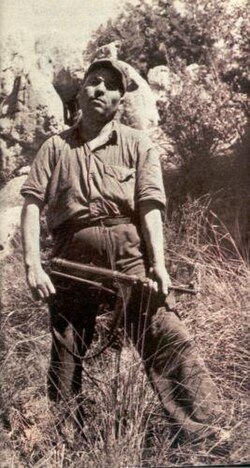
When the revolution launched on 1 November 1954 with coordinated attacks across the country, Ouamrane was among the commanders in the field. He took responsibility for the Blida Atlas region — the rugged mountain territory of the Tell Atlas range that rises sharply from the coastal plain south of Algiers, its forests and deep ravines offering the natural defensive advantages that guerrilla warfare requires. The region was strategically critical: its proximity to Algiers meant that operations there could threaten the colonial capital directly, and the mountain terrain made it exceptionally difficult for French conventional forces to operate effectively even with their overwhelming material superiority.
Wilaya IV: Building a Military Structure in the Mountains
The transformation of a clandestine revolutionary network into a functioning military command structure was the central organisational challenge of the war's early phase, and Ouamrane's military background gave him specific advantages in addressing it. He understood weapons, logistics, and unit organisation in a way that most of his civilian co-conspirators did not, and he could train fighters with the methodical competence of a man who had learned his craft professionally rather than improvised it under fire.
Wilaya IV — the FLN's military designation for the region covering the Blida Atlas, the Mitidja plain, and the approaches to Algiers — was one of the six wilayas established by the revolutionary command as the geographic framework for the armed struggle. Each wilaya had its commander, its political commissar, and its military structure of katibas (companies) and faoudjs (sections); each was responsible for a defined territory and operated with a degree of tactical autonomy within the overall FLN command. Ouamrane built Wilaya IV's structures from almost nothing in the face of intense French military pressure, recruiting fighters from the mountain villages, establishing supply networks, and developing the tactical doctrine that would sustain guerrilla operations in the region for the full eight years of the war.
The Blida Atlas presented particular challenges. Unlike the more remote Aurès mountains of Mostefa Ben Boulaïd's Wilaya I or the Kabylie of Belkacem Krim's Wilaya III, the territory of Wilaya IV was relatively close to the colonial capital and its large French military garrison. French operations against the wilaya were intense from the early phase of the war, and maintaining the organisation in the face of this pressure required the kind of operational discipline and tactical flexibility that only experience could provide. Ouamrane's military background was the difference between a guerrilla structure that could absorb losses and continue operating and one that would collapse under the first sustained French offensive.
The Soummam Congress and the Politics of Command
Ouamrane's attendance at the Soummam Congress of August 1956 placed him among the most important decision-makers of the entire revolution. The congress — organised by Abane Ramdane in the Iffri gorge in the Kabyle mountains in conditions of extraordinary logistical difficulty — brought together the internal commanders and political figures for the first time to build the institutional structures that the revolution had been lacking. Ouamrane represented the military commanders of the internal wilayas, whose authority and legitimacy Abane was seeking to formalise and protect against the claims of the external delegation in Cairo and Tunis.
The Soummam Platform's two most contentious principles — the primacy of the political over the military, and the primacy of the internal over the external — created a tension that would run through the revolution's remaining years and ultimately contribute to Abane's murder. Ouamrane, as a military commander who had been doing the actual fighting while the external delegation organised in relative safety in Cairo, had a natural affinity with the second principle: the men in the field, at personal risk, had a different kind of legitimacy from those who planned from abroad. His support for the Soummam framework gave it the military backing it needed to be taken seriously by the other wilaya commanders.
The Conseil National de la Révolution Algérienne (CNRA) that the congress established included Ouamrane among its members — a recognition of his status as one of the revolution's senior internal commanders. The CNRA was the closest the revolution came to a parliament: a collective body with authority over the FLN's overall direction that was intended to prevent the kind of personal autocracy that had characterised Messali Hadj's MTLD and that Abane feared would re-emerge in the new movement. Whether the CNRA could function as Abane intended depended on whether its members were willing to subordinate personal and factional interests to collective decision-making — a question the revolution ultimately answered in the negative, as Abane's murder demonstrated.
The War's Later Phases and the Path to Évian
The years between the Soummam Congress and the Évian Accords of 1962 were the most devastating of the war for the FLN's internal structures. The French military, having broken the urban network in Algiers through the Battle of Algiers, turned its full weight on the rural maquis with the systematic methodological intelligence of a counter-insurgency doctrine refined over years of colonial warfare. The Morice Line — the electrified fence along the Tunisian border, backed by sensors, minefields, and rapid-reaction forces — cut off the internal wilayas from the arms and reinforcements that had been flowing through Tunisia. The wilaya commanders were forced to sustain operations with diminishing resources, fighting a war of attrition against an opponent with enormous material superiority.
Ouamrane navigated these conditions with the pragmatism of an experienced soldier who understood the difference between what was militarily optimal and what was politically necessary. The FLN was not going to defeat the French army in the field — that was never the strategic objective. The objective was to sustain resistance long enough, at sufficient cost to France in blood, money, and international reputation, to make the political cost of continuing the war higher than the political cost of negotiating. Every month that the maquis continued to fight, however diminished, was a month that France could not claim military victory and therefore could not impose a political settlement on its own terms.
The Évian negotiations that ended the war in March 1962 were conducted by the Gouvernement Provisoire de la République Algérienne — the provisional government in exile that had been the political face of the FLN since 1958. Ouamrane's role was primarily that of a military commander who had sustained the internal struggle: the diplomatic work was done by others, but the credibility of the negotiating position rested on the fact that the internal maquis had not been broken. He was among the veterans who returned to independent Algeria in 1962 to find the political settlement immediately contested — the factions that had spent the war in external exile competing with the internal commanders for control of the new state, a competition that Boumédiène's well-organised external army ultimately decided in favour of the external faction.
Independence and the Long Aftermath
Ouamrane's post-independence career followed the trajectory of many of the revolution's internal military commanders: respected, honoured in rhetoric, but ultimately marginalised in the political settlement that Boumédiène's coup of 1965 consolidated. The state that the revolution built was organised around the FLN party, the army, and the security services — institutions that the external faction had shaped in its own image during the war years. The internal commanders who had done the actual fighting in the wilayas found themselves celebrated as heroes in the official history while their political influence was systematically curtailed.
He served in various official capacities in independent Algeria — the details of his post-independence career are less extensively documented than his wartime role — and died in 1988, the year in which the contradiction between the FLN's rhetoric of popular legitimacy and the reality of its one-party autocracy finally exploded in the streets. The October 1988 uprising — in which Algerian youth, many of them the children of the generation that had fought for independence, took to the streets of Algiers and other cities to demand political freedom and economic reform — was suppressed by the government with live ammunition. Hundreds were killed. The crackdown was ordered by President Chadli Bendjedid's government — the successor to the revolutionary state that Ouamrane and his generation had built. Whether he lived to see the crackdown or died before it, the October events were the verdict of history on the promise that the Soummam Platform had made in the Iffri gorge in August 1956: the democratic, sovereign Algeria that Abane Ramdane had tried to build remained, thirty-two years after his murder, a promise unfulfilled.
Legacy: The Commander the History Books Undercount
Amar Ouamrane is among the figures of the Algerian Revolution whose importance is fully appreciated only by specialists. The narrative of the revolution in popular memory tends to centre on the nine historic founders, on the dramatic figures of the Battle of Algiers, on the martyrs and the politicians — and the internal wilaya commanders who sustained the armed struggle through eight years of French counter-insurgency are often reduced to entries in lists. Ouamrane deserves better than that. The military structures he built in Wilaya IV, the fighters he trained and the operations he commanded over nearly a decade, the credibility he lent to the Soummam Congress by his presence as a genuine field commander — these were the foundations on which the political architecture of independence rested. The Évian Accords were possible because the maquis had not been broken. The maquis was not broken because men like Ouamrane had built it to survive.