Arkansas, Los Angeles, and the Prison Education
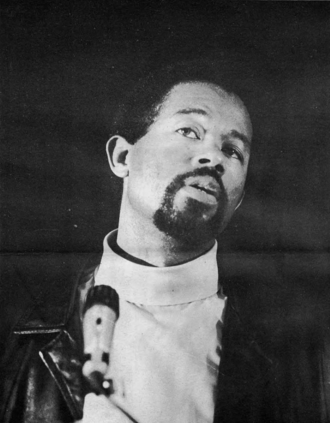
Eldridge Cleaver was born on 31 August 1935 in Wabbaseka, Arkansas — a small cotton-farming town in the Arkansas Delta where the racial hierarchy of the post-Reconstruction South was maintained through the familiar combination of economic dependence, legal exclusion, and the ever-present threat of violence. His family moved to Los Angeles when he was a child, settling in the Watts neighbourhood and then in the suburban fringe communities that were opening to Black residents in the late 1940s and early 1950s — a geography of aspiration and exclusion that was becoming, in those years, the specific landscape of Black Los Angeles.
He was first arrested at twelve, for theft — the beginning of a relationship with the California criminal justice system that would define the next fifteen years of his life. He was in and out of California Youth Authority facilities through his adolescence, and in 1954, at eighteen, was sent to Soledad State Prison on marijuana possession charges. He served two years, was released, and in 1957 was returned to prison — this time to Folsom — after a conviction for assault with intent to rape. He served nine years, during which he underwent the intellectual transformation that would produce Soul on Ice: reading voraciously, writing extensively, corresponding with the lawyer Beverly Axelrod who would eventually help him get the essays published, and developing a political consciousness that moved from the racial nihilism of his early prison years through Black nationalism toward a more structured radical politics.
Soul on Ice: The Prison Essays That Changed Everything
Soul on Ice, published in February 1968 after Cleaver had been released on parole in 1966, is one of the most discussed and most contested books in American political literature — praised as a work of searing political intelligence and condemned as a text that contains, alongside that intelligence, passages of moral catastrophe. The book's strengths are real: Cleaver wrote with a directness and a force that cut through the literary conventions of the period, and his analysis of the specific psychology of racial oppression in America — of what it did to the minds and bodies and sexual imaginations of both Black and white Americans — was original and in parts genuinely illuminating. His account of the prison experience, of the formation of Black political consciousness in the specific conditions of California's maximum security facilities, and of the relationship between Malcolm X's assassination and the subsequent radicalisation of Black America was the most vivid and immediate account of those experiences available in 1968.
The book also contains passages in which Cleaver describes his rapes of white women as a political act — as a form of "insurrectionary" violence against the racial system — passages that have made the book a site of sustained and unresolved debate about the relationship between political intelligence and moral accountability. Those passages are not peripheral to the book; they are central to its self-presentation, and they reveal something important about the specific pathology of a politics that was capable of extraordinary insight into structures of racial oppression while reproducing, within itself, a sexual violence that was inseparable from a view of women — particularly white women — as objects whose meaning was determined entirely by their racial and sexual symbolism in a male revolutionary drama. James Baldwin's public response to the book — in which he acknowledged Cleaver's literary gifts while confronting the homophobia and misogyny that ran through the text — remains one of the most important contemporary critiques, and the terms Baldwin established for evaluating Cleaver's legacy have largely held.
"The price of hating other human beings is loving oneself less."
Eldridge Cleaver, Soul on Ice, 1968The Free Huey Campaign and the Voice of the Panthers
Cleaver joined the Black Panther Party in 1967, shortly after his parole from Folsom, and almost immediately became its most powerful public communicator — the figure who could translate the Party's political analysis into language that reached the mainstream press, the white radical community, and the international solidarity networks that would make the Free Huey campaign a genuinely global phenomenon. His relationship with Kathleen Cleaver, whom he married in December 1967, produced a political partnership that was, in the specific context of building public support for Newton's defence, extraordinarily effective: Eldridge as the polemicist and provocateur, Kathleen as the strategist and communicator who understood how to move between the Panthers' internal world and the broader audiences the campaign needed to reach.
His 1968 presidential candidacy on the Peace and Freedom Party ticket — running alongside white radicals in an explicitly cross-racial coalition — was the most concrete expression of the Panthers' political strategy at that moment: the argument that Black liberation required alliances across racial lines, that the anti-war movement and the Black Power movement had convergent interests that could be organised into a political force capable of challenging the two-party system. The candidacy was symbolic rather than serious in electoral terms — Cleaver was not yet thirty-five, the constitutional minimum age for the presidency — but the campaign it generated extended the Panthers' reach into the white left in ways that created the financial and organisational support the Free Huey campaign needed.
The April 1968 Shootout and the Flight
The events of 6 April 1968 — the night that Bobby Hutton was killed — also produced the crisis that ended Cleaver's legal residence in the United States. He was present in the house from which Hutton emerged with hands raised to be shot; he was wounded in the firefight, arrested, and taken to hospital. His parole was revoked and he faced return to Folsom. He fought the revocation in court — a California judge found that it had been politically motivated and ordered his release — but the legal situation remained precarious and the political climate, in the months after Martin Luther King's assassination and the subsequent crackdowns on Black radical organisations, made his assessment of his prospects grim.
In November 1968, having been granted bail while his parole case worked through the courts, he disappeared. He made his way to Cuba — whose revolutionary government had already provided asylum to Black American radicals and was willing to receive him — and from Cuba to Algeria in 1969, where the government of Houari Boumédiène, which had recently nationalised the French oil companies and was positioning itself as the centre of Third World revolutionary solidarity, gave the Black Panther International Section official recognition and a suite of offices in the diplomatic quarter of Algiers. Cleaver became, in Algiers, the head of the most improbable diplomatic mission in the history of revolutionary politics: a Black American revolutionary organisation with an official presence in a North African capital, receiving delegations from liberation movements across Africa and Asia and hosting, at various points, the PLO, the ANC, and Timothy Leary, the psychedelic advocate who had escaped from a California prison and arrived in Algiers seeking asylum.
The Algiers Years and the Split with Newton
The Black Panther International Section in Algiers was, for a period in 1969 and 1970, one of the most visible expressions of the transnational connections between American Black radicalism and the anti-colonial movements of the Third World. Cleaver hosted solidarity meetings, gave interviews to international press, and articulated a version of the Panthers' politics that emphasised armed struggle and international revolution rather than the community service programmes that Newton was developing in Oakland. The political difference was real: Cleaver in Algiers was developing a position that was closer to the politics of the Palestinian liberation movement and the armed struggles of Southern Africa than to the Oakland-based community organising that Newton had turned toward after his release from prison in 1970.
The split became public and definitive in February 1971, when Newton and Cleaver conducted a radio conversation — broadcast live — in which the distance between their political positions became impossible to paper over. Newton expelled Cleaver from the Party. Cleaver's faction — which included members in New York and other cities who aligned with his more militaristic line — aligned with the Black Liberation Army and continued to operate independently. The split was real and damaging to both sides: it divided resources, created violent conflicts between factions, and gave the FBI's COINTELPRO operation exactly the internal disorder it had been working to produce. The fact that COINTELPRO had also been actively working to widen the split through disinformation and forged correspondence does not mean that the political differences were manufactured — they were real — but it does mean that the split was more complete and more destructive than it might otherwise have been.
The Return and the Conservative Conversion
Cleaver returned to the United States in 1975, having spent seven years in Cuba, Algeria, and France. He had converted to evangelical Christianity in France — an experience he described as a vision of the moon bearing the faces of his former revolutionary heroes transforming into the face of Jesus Christ, an account that was either a genuine religious experience or a carefully managed public narrative, depending on whose interpretation you found more plausible. He surrendered to American authorities, negotiated a plea deal on the 1968 assault charges, and received a sentence of community service rather than prison time — an outcome that his supporters attributed to his religious conversion and his cooperation with authorities, and that his critics attributed to the government's interest in having a former Black Panther leader publicly endorse Christianity and conservatism.
What followed was a sequence of political positions that moved steadily rightward: support for Ronald Reagan, a brief membership in the Mormon Church, a 1986 Republican primary campaign for the US Senate seat in California, and various business ventures including the "Cleaver Sleeve" — a fashion line for men's trousers that incorporated a decorative penile pouch, a product that was as bizarre as it sounds and that did not achieve commercial success. He also struggled with drug addiction through much of this period, arrests for burglary and cocaine possession appearing in the public record alongside the political reversals. By the time of his death in 1998 he had become, in the eyes of most of the people who had known him in his radical years, a cautionary story about political apostasy rather than a figure whose later work deserved serious engagement.
The Legacy Problem: Genius and Catastrophe
The question of how to evaluate Eldridge Cleaver's legacy is one that the history of the Black Panther Party cannot avoid, because he was too central and his work was too consequential to be dismissed, and because the specific nature of his failings — the sexual violence he described and celebrated in Soul on Ice, the political apostasy of his later years — are too serious to be minimised. The approach that does the least damage to historical accuracy is probably the one that holds both things simultaneously: that Soul on Ice is a work of genuine and lasting political intelligence that also contains passages of moral catastrophe; that Cleaver's contribution to the Free Huey campaign and to the Panthers' international profile was real and significant; and that his subsequent trajectory was a genuine and complete political defeat, not a temporary detour from an otherwise consistent life.
The rapes he committed and described are not separable from the political analysis he produced; they are part of the same formation, and a serious evaluation of his work has to hold that. James Baldwin — who was himself a target of Cleaver's homophobic attacks in Soul on Ice, attacks that Baldwin addressed with characteristic precision and grace — provided the model for how to do this: to take the work seriously enough to engage with its real qualities while refusing to exempt it from moral accountability on the grounds of its political importance. Cleaver's life is, in the end, a demonstration of the inadequacy of political intelligence as a sufficient basis for political leadership — of the ways in which genuine insight into structures of oppression can coexist with the reproduction of other structures of oppression, and of the specific costs, for the movements that depended on him, of that coexistence.