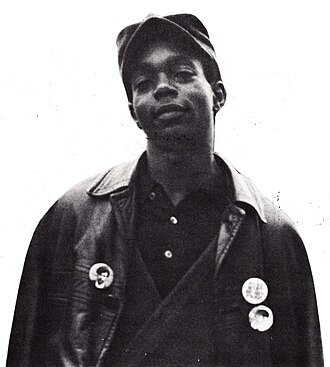
West Oakland and the World That Made the Panthers
Bobby James Hutton was born on 21 April 1950 in Jefferson City, Missouri, and moved with his family to West Oakland, California, as a young child — part of the continuous westward migration of Black families from the South and Midwest who arrived in the Bay Area during and after the Second World War to find industrial employment and discovered instead the specific West Coast version of the racial hierarchy they had come to escape. West Oakland in the 1950s and early 1960s was a community under systematic pressure: the construction of the Bay Area Rapid Transit system and the Interstate highway network had physically cut through Black neighbourhoods, displacing residents, demolishing housing stock, and accelerating the disinvestment that was already pushing white businesses and residents toward the suburbs. The Black community that remained in West Oakland was economically stressed, politically under-represented, and in daily contact with an Oakland Police Department that operated in Black neighbourhoods with a level of violence and impunity that the department's internal culture regarded as normal.
It was in this environment that Bobby Hutton grew up — not in abstract proximity to structural racism but in the immediate, daily, bodily experience of what it meant to be a young Black man in West Oakland in the early 1960s, to be followed by police in the street, to watch friends and neighbours arrested on thin pretexts, to understand that the city's institutions — its schools, its courts, its police force — were not designed to serve his community but to manage it. He was a teenager when Huey Newton and Bobby Seale came to the North Oakland Poverty Center in the autumn of 1966 with a mimeograph machine, a program, and a name: the Black Panther Party for Self-Defense. He was the first person to say yes.
The First Yes: Joining at Sixteen
The decision Bobby Hutton made at sixteen to join the Black Panther Party was not, by the standards of the West Oakland community he came from, an unusual decision for a young man of his generation to make — Black political consciousness was high, the civil rights movement had demonstrated that organised resistance was possible, and Malcolm X's assassination the previous year had sharpened the sense that the non-violent approach to that resistance had its limits. What was unusual was the specific organisation he was joining, which was not yet an organisation at all but a founding document, two older men with a political vision, and himself. He was present at the creation in the most literal sense: he was there when Newton and Seale drafted the Ten-Point Program, when they worked out the operational details of the armed patrols that would be the Party's first public activity, when the rules and structure of what would become the most significant Black radical organisation of the late 1960s were first articulated.
The Party gave him the title of Treasurer — a functional role that said something about how seriously Newton and Seale took even the administrative structure of an organisation that, at that point, had essentially no finances to manage. He was not a treasurer in any conventional sense; he was one of three people who constituted the entire organisation, learning the politics on the job, going out on the armed patrols, doing the work of recruitment and community outreach that would transform the Party from a founding document into a functioning operation over the following months. He was, by all accounts of the people who knew him in those early months, a serious and committed member — not a follower looking for a cause but a genuine political person who understood what the Party was trying to do and shared the analysis that motivated it.
The Year Between: 1966 to 1968
The seventeen months between the Party's founding in October 1966 and Bobby Hutton's death in April 1968 were the period in which the Black Panther Party went from a local Oakland organisation to a national political phenomenon — and Hutton was present throughout that transformation, watching it happen from the inside, as one of the people who had been there before there was anything to observe. The armed patrols of 1966 and early 1967 that built the Party's reputation in West Oakland. The Sacramento State Capitol march of May 1967 that made the Party nationally famous. The summer of 1967, when chapters were forming in cities across the country. The October 1967 arrest of Huey Newton on the murder charge that produced the Free Huey campaign. All of it Hutton watched and participated in as a member of the founding core — a young man who had been present before any of it was possible and who grew up politically as the organisation grew.
He was seventeen in April 1968, which means he had spent a third of his conscious life as a Black Panther by the time he died. The Party was not an organisation he had joined; it was an organisation he had helped to build from its first day of existence. The political education he received in those seventeen months — in the armed patrols, in the meetings, in the community work, in the experience of watching how the Oakland Police Department and the FBI responded to the Party's presence — was as serious a political education as was available anywhere in the United States in 1967 and 1968, and he received it at an age when most people his generation were worrying about college applications.
April 4, 1968: The Assassination of King and Its Aftermath
Martin Luther King Jr. was assassinated in Memphis, Tennessee, on the evening of 4 April 1968. His death detonated grief and rage in Black communities across the United States simultaneously — in more than a hundred cities, people took to the streets in uprisings that the National Guard was called in to suppress. In Oakland, the response was more politically organised but no less urgent: the Black Panther Party, which had spent two years arguing that the non-violent approach to racial justice was inadequate to the violence the state was prepared to deploy against Black people, found King's assassination a confirmation of its analysis that was also a moment of profound loss. Whatever their disagreements with King's politics, the Panthers understood that the assassination was an act of state terror against the entire Black community, and they responded accordingly.
The specific events of 6 April 1968 — two days after King's death — remain disputed in some of their details, but their outline is clear. A group of Black Panthers, including Eldridge Cleaver and Bobby Hutton, were involved in an encounter with Oakland police officers in West Oakland. How the encounter began — whether the Panthers initiated it or whether the police did — was disputed at the time and has never been definitively established. What is clear is that a gun battle ensued, in the course of which a police officer was wounded, that the Panthers took shelter in a house on 28th Street, and that after approximately ninety minutes of exchanged fire the house was on fire and the position was untenable.
The Surrender and the Killing
The decision to surrender was, by Eldridge Cleaver's subsequent account, made in the belief that Oakland police officers would honour the surrender of unarmed men — that the legal and procedural framework for taking prisoners, however imperfect, would assert itself once the shooting stopped. Cleaver was wounded and would be taken into custody alive. Bobby Hutton, who was not wounded, stripped to the waist — removing his shirt to demonstrate visibly and unambiguously that he was carrying no weapon — and walked out of the burning house with his hands raised.
He was shot multiple times by Oakland police officers. He died at the scene. He was seventeen years old, and he was unarmed, and his hands were raised, and he was shot anyway. The officers present offered various accounts of the circumstances — that Hutton had reached toward an officer, that there had been a misunderstanding about his intentions, that the situation was chaotic and decisions had to be made in seconds. None of these accounts changed what was visible to the witnesses who observed it: a teenager who had stripped to demonstrate he was unarmed, who had walked out with his hands raised, was shot dead in the street by police officers who had the option of taking him into custody and chose not to exercise it.
"They shot that boy down like a dog in the street. And that boy had his hands up."
Eyewitness account of Bobby Hutton's death, April 1968No officer was charged in connection with Hutton's death. The official account — that the shooting was justified by the circumstances of the preceding gun battle — was accepted by the Alameda County District Attorney's office without prosecution. Eldridge Cleaver, wounded and arrested, was charged with assault and attempted murder, charges that were eventually dropped after Cleaver fled to Algeria while on bail in November 1968. The legal reckoning for Bobby Hutton's killing never came.
The Funeral and Marlon Brando
The funeral of Bobby Hutton drew thousands of people to West Oakland and became a significant political event in its own right. Marlon Brando, then one of the most famous actors in the world and an established figure in civil rights politics, attended and read a statement on behalf of the community of white Americans who understood what the killing meant and wanted to register their witness to it publicly. His presence at the funeral was not merely celebrity solidarity — Brando had been consistently engaged with Black civil rights causes since the early 1960s and his appearance at Hutton's funeral was a deliberate political act, a statement that the death of a seventeen-year-old Black boy shot by police while surrendering unarmed was a matter of national moral significance and not merely a local law enforcement incident.
The funeral served as a galvanising event for the Black Panther Party and for the wider Black Power movement. Hutton's death demonstrated in the starkest possible terms the argument the Panthers had been making since 1966: that the Oakland Police Department would kill Black people regardless of whether they were armed or unarmed, regardless of whether they were surrendering or resisting, and that the legal and civic framework that was supposed to protect citizens from such killings was not functioning as advertised. The argument was abstract before 6 April 1968; after that date it had a name and a face and an age — seventeen — and a specific, documented set of circumstances that made it impossible to deny.
What Seventeen Years Means
Bobby Hutton was seventeen years old when he was killed, which means it is not possible to write the kind of account of his life that his older comrades' profiles require — the account of decades of work, of the development of a political analysis through experience, of the long arc of engagement with changing conditions. He had seventeen years, of which he spent one and a half in the Black Panther Party, and the profile of those seventeen years is necessarily a profile of potential rather than achievement: what he might have become, what role he might have played in the subsequent history of the organisation he helped to found, what kind of political person he was becoming in the months before his death.
The answer to those questions can only be inferred from the record of what he actually did. He joined a political organisation at sixteen that was asking its members to take on significant physical risk — the armed patrols that provoked the Oakland Police Department, the Sacramento march that made the Panthers national targets, the daily work of organising in a community under active police harassment. He did that work seriously and consistently for seventeen months, at an age when the courage required to do it, and the political understanding that motivated it, were not things most people develop. He was, by the accounts of the people who knew him, not a follower but a participant — someone who understood what the Party was trying to do and was building the capacity to contribute to it at a level beyond the founding core's initial vision for him.
Bobby Hutton Memorial Park and the Long Memory
In West Oakland, on the street where he grew up and in the community that the Black Panther Party had been built to serve, a small park carries Bobby Hutton's name — a modest form of civic memory in a city that has not always been generous in its acknowledgement of the people who died contesting its racial order. The park is not a monument to victory; it is a monument to what was lost on 6 April 1968, and to the specific quality of that loss: a seventeen-year-old boy, unarmed, hands raised, shot dead by the police force of the city he had spent his political life trying to change.
His name appears in every serious history of the Black Panther Party as the first martyr — the first member of the organisation to be killed by the state that the organisation had been founded to resist. That designation carries a weight that is easy to sentimentalise and important not to: the first martyr of any movement is not a symbol who chose to be a symbol, but a person who was killed, and the killing preceded the symbolism by however long it took for the movement to find language for what had happened. Bobby Hutton was a person first — a teenager from West Oakland who had found in the Panthers something worth committing his life to — and the symbol that his death produced was built on that person's absence. The park in West Oakland carries his name. The Party he helped to found carried his example. The movement that grew from both carried the memory of what it costs to be seventeen and Black in America and to believe that the cost can be changed.