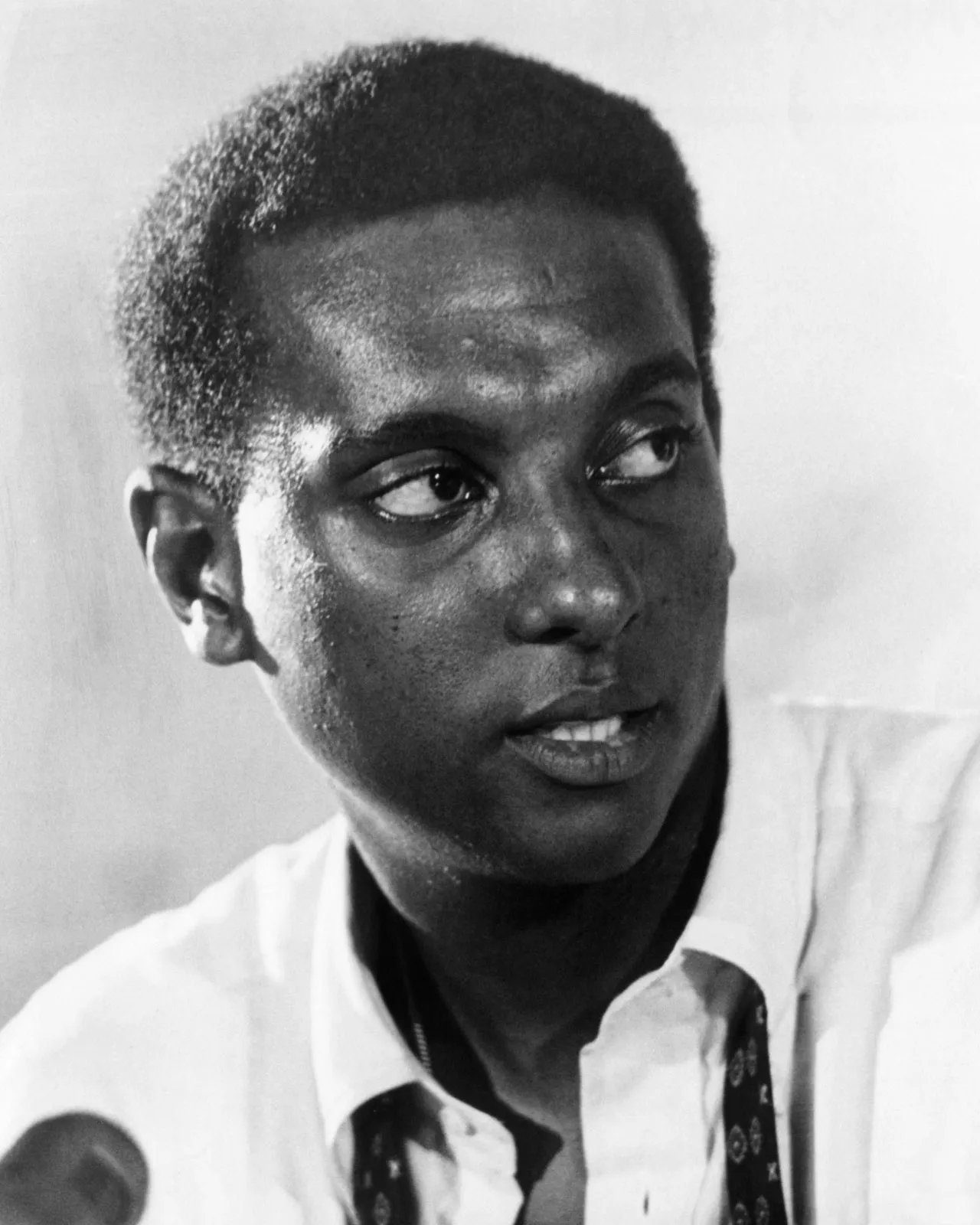
From Trinidad to Howard University: The Making of a Radical
Stokely Carmichael was born in Port of Spain, Trinidad, in 1941, the son of a carpenter and a domestic worker who were part of the wave of Caribbean migration that reshaped communities on both sides of the Atlantic in the mid-twentieth century. His family moved to New York when he was eleven, settling in the Bronx, and it was in New York that he came of age politically — not through the street organisations of the inner city but through the intellectual culture of the Bronx High School of Science, one of the city's most academically competitive public schools, which he attended on the strength of his remarkable abilities and where he first encountered the formal languages of politics, history, and social analysis.
His choice to attend Howard University in Washington, D.C., rather than several predominantly white institutions that offered him admission, was a deliberate political act as much as an academic one. Howard was the flagship of Black American higher education — the institution that had trained Thurgood Marshall, Zora Neale Hurston, Toni Morrison (later), and generations of Black professionals and intellectuals. It was also, by the early 1960s, a centre of student civil rights activism, connected through its proximity to the Southern campaigns of SNCC and the sit-in movement. Carmichael arrived at Howard in 1960, at the precise moment when the Southern civil rights movement was entering its most confrontational and transformative phase, and he threw himself into that moment with complete commitment, joining the Nonviolent Action Group and beginning the Freedom Rides of 1961 that put him on a bus into the Deep South at the age of nineteen.
The Freedom Rides and the Education of a Field Organiser
The Freedom Rides of 1961 — in which interracial groups of activists boarded interstate buses to challenge the Southern states' defiance of Supreme Court desegregation rulings — were among the most physically dangerous campaigns of the civil rights movement. Riders were beaten by mobs in Anniston and Birmingham, Alabama, with law enforcement standing aside or actively collaborating with their attackers. The Kennedy administration, more interested in managing its international image than in confronting Southern white supremacy, pressured the movement to abandon the Rides. The Rides continued anyway. Carmichael, not yet twenty, was among the riders arrested in Jackson, Mississippi, and spent seven weeks in Parchman Farm — the Mississippi State Penitentiary, one of the most brutal prisons in the United States, where civil rights activists were subjected to deliberate psychological and physical abuse intended to break their commitment.
Parchman Farm did not break Carmichael. It completed his political education in a way that no classroom could have: it gave him direct, embodied knowledge of what the American carceral state was prepared to do to Black people who organised, and it gave him the experience of resisting that state alongside other people who had made the same choice. The camaraderie and the courage he witnessed and participated in at Parchman — activists singing freedom songs to keep their spirits up under conditions designed to produce despair — shaped his understanding of what political solidarity looked like at its most elemental.
The years of SNCC field organising that followed — in Mississippi, Georgia, and most consequentially in Lowndes County, Alabama — built on that foundation. Carmichael spent years in some of the most violently defended white supremacist territory in the United States, doing the patient, dangerous, daily work of voter registration: going door to door in communities where Black residents outnumbered white residents but almost no Black person was registered to vote, because the system of economic terror and physical violence that maintained white political control was so complete and so credible that attempting to register was, for many people, a potentially fatal act. The Lowndes County Freedom Organisation that Carmichael helped to build in 1965 and 1966 was the direct institutional expression of this work — a political organisation, separate from the Democratic Party that had delivered nothing for Black Alabamans, that fielded its own candidates and organised its own constituency. Its symbol was a black panther — the image that would be adopted, with direct reference to Lowndes County, by Huey Newton and Bobby Seale when they founded the Black Panther Party for Self-Defense in Oakland in 1966.
Greenwood, Mississippi: The Two Words That Changed Everything
On the night of 16 June 1966, at a rally in Greenwood, Mississippi, during the Meredith March Against Fear — a march that had begun after James Meredith was shot and wounded on the second day of his solo walk across Mississippi — Stokely Carmichael stepped to the microphone after his twenty-seventh arrest of the civil rights movement era and said the words that would define his public identity for the rest of his life and beyond it.
"We want Black Power! That's right, that's what we want, Black Power. And we don't have to be ashamed of it. We have stayed here. We have begged the president. We have begged the federal government — that's all we've been doing, begging and begging. It's time we stand up and take over. Every courthouse in Mississippi ought to be burned down tomorrow to get rid of the dirt and the mess. From now on, when they ask you what you want, you know what to tell 'em. What do you want?"
Stokely Carmichael, Greenwood, Mississippi, 16 June 1966The phrase "Black Power" was not new — it had been used by Richard Wright, by Adam Clayton Powell Jr., and by others in the tradition of Black political thought. But the context in which Carmichael deployed it — at a mass rally, in the charged atmosphere of the Meredith March, responded to by an erupting crowd — gave it an electrifying public resonance that no previous use had achieved. The phrase spread through media coverage of the march and became within days the defining slogan of a new phase of Black American political consciousness: one that went beyond the goal of formal legal equality and demanded political, economic, and cultural self-determination as its objective.
The mainstream civil rights establishment — Martin Luther King Jr., Roy Wilkins of the NAACP, Whitney Young of the Urban League — responded with alarm, concerned that the phrase would alienate white liberal allies whose support the movement needed and that its confrontational tone would provide ammunition to those seeking to discredit the movement. Carmichael's response to those concerns, in speeches, interviews, and the 1967 book Black Power: The Politics of Liberation that he co-authored with political scientist Charles V. Hamilton, was patient and systematic: he argued that the model of racial integration into existing white-dominated institutions was not liberation but assimilation into a system designed to perpetuate Black subordination, that reliance on white liberal goodwill was a political strategy that had consistently failed to produce structural change, and that Black people needed to build independent political and economic power — in Black communities, under Black control — as the foundation for any genuine transformation of their conditions.
SNCC Chairman and the Evolution of a Political Programme
Carmichael's election as SNCC chairman in May 1966, replacing the more integrationist John Lewis in a vote that reflected the organisation's leftward and more militant shift, gave him the institutional platform to push the Black Power analysis beyond rhetoric into organisational form. Under his chairmanship, SNCC formally expelled its white members — a decision that was widely condemned as reverse racism but that Carmichael defended on the grounds that white activists organising in Black communities reproduced the paternalistic dynamics of white liberal benevolence, and that effective Black political organisation required spaces where Black people led without deferring to white discomfort.
The SNCC that Carmichael led was also an organisation engaged in an intensive reexamination of its relationship to international liberation movements — particularly in Africa, where the wave of decolonisation was producing independent states whose leaders, above all Kwame Nkrumah of Ghana, were articulating visions of Pan-African solidarity that connected the struggle of Black Americans to the broader global project of African liberation. Carmichael had become intensely engaged with this international dimension, and it was pulling him toward a political framework — Pan-African socialism — that would eventually take him far beyond SNCC and far beyond the United States.
His tenure as SNCC chairman was also a period of sustained FBI persecution. Hoover's COINTELPRO programme targeted Carmichael with particular intensity, flooding the Black community with forged documents designed to suggest he was a CIA informant, monitoring his communications, attempting to manufacture conflicts between him and other movement leaders. The campaign of disinformation was, by subsequent documentary evidence, extensive and sophisticated. Whether it contributed to his decision to leave the United States cannot be definitively established, but the context of sustained state harassment was certainly part of the environment in which that decision was made.
The Black Panther Party: A Brief and Contentious Alliance
Carmichael's relationship with the Black Panther Party — which adopted the black panther symbol directly from his Lowndes County work and which saw in his national profile a potentially transformative addition to its leadership — was brief, significant, and ultimately fractious. Huey Newton and Bobby Seale invited him to serve as the Party's Honorary Prime Minister in 1967, and for a period Carmichael's speeches on behalf of the Panthers brought national and international attention to an organisation that was still primarily a Bay Area phenomenon. He spoke at rallies, gave interviews in which he connected the Panthers' programme to the broader global struggle against imperialism, and used his rhetorical gifts to frame the Party's confrontational approach in terms that resonated with international liberation movements.
The break came over a fundamental strategic disagreement that went to the core of how each side understood the relationship between Black liberation and international communist politics. Newton and Eldridge Cleaver were moving toward a position that emphasised coalition with white radical organisations and located the Panthers' struggle within an international class struggle against capitalism. Carmichael, by contrast, was moving toward a position that placed race — specifically, the unity of African people across the diaspora — as the primary analytical and organisational category, and that was suspicious of coalitions with white leftists on the grounds that such coalitions inevitably subordinated Black interests to frameworks developed by and for people who did not share the specific condition of African people under racism and colonialism. The theoretical disagreement was genuine and deep, and it produced a split that neither side was particularly graceful about managing.
Conakry: The Third Life
In 1969, Carmichael and his then-wife, South African singer Miriam Makeba, relocated permanently to Conakry, Guinea, at the invitation of President Sékou Touré. The move was partly an escape from the sustained pressure of COINTELPRO and the hostile environment of the United States, and partly a positive political commitment to the project of African continental unity that had become, for Carmichael, the central strategic objective of Black liberation. Guinea was also, from 1972, the home of Kwame Nkrumah — the Ghanaian leader whom Carmichael regarded as the greatest political thinker of the African liberation era, whose theory of Pan-Africanism provided the framework for Carmichael's own developing politics, and who lived in Conakry in exile until his death that year. The few years in which Carmichael had direct access to Nkrumah as a political mentor were among the most formative of his intellectual life.
In Conakry, taking the name Kwame Ture in honour of Nkrumah and Touré, Carmichael devoted himself to building the All-African People's Revolutionary Party — an organisation whose goal was the political unification of Africa under a socialist government, which he regarded as the prerequisite for the liberation of African people everywhere, including in the United States. The AAPRP was a small organisation with limited resources and a demanding political programme that required potential members to commit to African socialist politics in a way that most Americans, Black or white, were not prepared to do. Carmichael was not dissuaded by the organisation's limited size. He argued, consistently, that correct politics mattered more than large numbers, and that the work of building a genuinely revolutionary organisation that would outlast any individual was more important than the work of managing a large organisation with a diluted programme.
The AAPRP and the Theory of Pan-African Socialism
The political theory that Kwame Ture developed and advocated through the AAPRP in the last three decades of his life was not simply a continuation of the Black Power politics of the 1960s. It was a more systematic and internationally grounded framework that drew on Nkrumah's theory of neo-colonialism — the argument that formal political independence without economic independence left African states as vulnerable to imperial exploitation as they had been under direct colonial rule — and integrated it with a specific programme for the continental unification of Africa as both a political necessity and an ideological project.
Ture argued that racism and capitalism were not separable phenomena — that the global system of racial hierarchy had been built in conjunction with, and in service of, the accumulation of capital through the exploitation of African labour and resources, and that neither could be effectively challenged without challenging the other. This analysis placed him in a different position from both the liberal integrationist civil rights tradition, which sought equality of opportunity within the existing economic system, and from the more separatist variants of Black nationalism that focused on building Black economic enclaves within American capitalism. For Ture, the United States itself was a neo-colonial structure — a system in which Black Americans were an internal colony — and the solution was not integration into that structure or cultural separation from it but the transformation of the global economic and political order through Pan-African revolution.
He returned frequently to the United States and to university campuses across the country to speak, organise, and recruit for the AAPRP. His lectures of the 1980s and 1990s — delivered with the oratorical power that had made him famous in 1966 and sharpened by thirty more years of reading, thinking, and political work — attracted large and enthusiastic audiences on Black college campuses and in Black communities that maintained his connection to the generation that had come of age after the Black Power era. He ended every speech, in those years, with the phrase: "Organise Africa."
Illness, the Accusation, and the Final Years
Ture was diagnosed with prostate cancer in 1996. He was public about his diagnosis and equally public about his analysis of its cause: he maintained consistently that his cancer had been deliberately induced by the CIA or other agencies of the American state as part of the ongoing campaign against him that had begun with COINTELPRO. He cited, as context for this claim, the documented history of the American intelligence community's operations against Black political leaders, including the poisoning allegations that have surrounded the deaths of other figures in the movement and the confirmed use of radioactive and chemical agents by the CIA in other contexts. The claim cannot be verified from available evidence, and it was disputed by medical professionals who noted that prostate cancer at the age of fifty-five was not medically unusual in an African American man of his generation. But it was also not the claim of a paranoid person without historical foundation — it was the claim of a man who had spent three decades under documented surveillance and active disruption by the world's most powerful intelligence apparatus and who had watched that apparatus kill people he knew and admired.
He died in Conakry on 15 November 1998, surrounded by family and AAPRP comrades, at the age of fifty-seven. His funeral in Guinea was attended by thousands of people. The outpouring of tributes from across the African diaspora — from the United States, the Caribbean, Africa, and Europe — measured the range of communities his life's work had touched. He had been more famous in the late 1960s than at his death; the thirty years in Guinea had removed him from the mainstream American media conversation even as his influence on Black political thought continued and deepened through the channels of movement culture, university teaching, and the circulation of his ideas through a generation of activists who had been shaped by his analysis.
Legacy: The Long Arc of Black Power
The phrase "Black Power" — two words spoken by a twenty-four-year-old in Greenwood, Mississippi, on a June night in 1966 — entered American political language as an electrifying confrontation and has never left it. Its meaning has been contested from the moment of its utterance: taken to mean anti-white racism by its opponents, interpreted as community self-determination by its advocates, domesticated into the language of diversity and representation by its liberal inheritors, reclaimed as a radical demand for structural transformation by its revolutionary descendants. That contest over meaning is itself part of Carmichael's legacy — the phrase was so apt, so historically charged, so precisely calibrated to the contradictions of the moment that it could not be easily contained or dismissed, and it has remained a live political concept across six decades and multiple generations of Black political struggle.
The deeper intellectual legacy — the analysis of neo-colonialism, the insistence on the inseparability of racism and capitalism, the argument for Pan-African unity as a strategic necessity rather than a cultural aspiration — has been less visible in mainstream political conversation but has continued to shape Black radical thought through the work of the scholars, organisers, and activists who engaged seriously with Ture's ideas during the decades of his relative obscurity and who have brought them back into circulation as the questions his analysis addressed have reasserted themselves with new urgency.
The Black Lives Matter movement that emerged after 2013 operates in a political landscape that Carmichael helped to create: one in which the demand for structural transformation rather than incremental reform, the insistence on Black political self-determination, and the connection of anti-Black racism in the United States to global systems of racial and economic hierarchy are recognised as serious political positions rather than extremist fringe views. Whether the movement's participants have read Carmichael or not — and many have — they are operating in intellectual territory that he helped to map. That is one measure of a political life well lived: that the questions you spent your life asking are still being asked, with renewed urgency, by people who were not yet born when you first asked them.