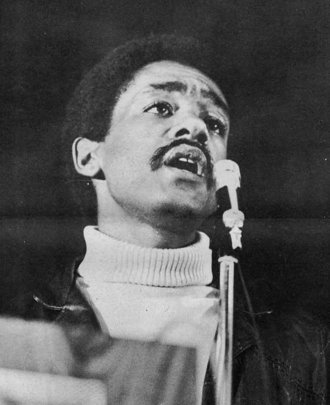
Dallas, Liberty, Oakland: Three Cities and a Formation
Bobby Seale was born in Dallas, Texas, on 22 October 1936, and his family's migration north and west traces the standard arc of the Great Migration — from the former Confederacy toward the industrial cities of the North and West that promised better wages and a looser racial hierarchy, and delivered, as they almost always did, a different version of the same fundamental condition. The Seales moved first to San Antonio, then to Port Arthur, then eventually to the San Francisco Bay Area, settling in Oakland during the wartime boom. Oakland in the early 1940s was absorbing Black migrants from the South faster than it could build housing or infrastructure for them, which meant that the communities they formed in West and North Oakland were dense, economically stressed, and in daily contact with a police force that regarded their presence as a problem to be managed rather than a constituency to be served.
Seale grew up in that Oakland — he attended Berkeley High School, worked in the aircraft industry as a young man, and in 1955 enlisted in the US Air Force, where he was trained as a sheet-metal mechanic and served until 1959. The discharge that ended his military career was not for misconduct in any conventional sense: he was dishonourably discharged after confronting a general who had ordered that Black airmen be barred from a base dance. The confrontation was direct and its consequences immediate — he was discharged, denied the benefits that an honourable discharge would have provided, and sent back to civilian life carrying the specific grievance of a man who had tried to use institutional channels to address institutional racism and had been punished for it. It was, in miniature, the argument the Black Panther Party would spend its entire existence making: that the institutions of American democracy did not function for Black people as advertised, and that the consequences of believing otherwise were borne by those who believed.
Merritt College and the Meeting with Newton
Seale went to Merritt College in Oakland on the GI Bill, studying engineering, and it was there that he encountered Huey Newton — a younger man whose intellectual intensity and political clarity made an immediate impression. The two moved in the same circles of Bay Area Black political life in the mid-1960s: they attended the same meetings, read the same pamphlets, debated the same questions about strategy and organisation and the relationship between cultural politics and material conditions. Newton had read more widely in revolutionary theory — Fanon, Mao, Che Guevara, the Cuban experience — and had a more systematic analytical framework; Seale had more practical experience of organising and a more intuitive understanding of how to communicate political ideas to people who had not spent years in libraries. The combination of their different strengths produced something neither would have built alone.
The founding of the Black Panther Party for Self-Defense at the North Oakland Poverty Center in October 1966 was, by Seale's account, a practical operation: they had access to a mimeograph machine, they had a set of political demands they had been working on for weeks, and they had the beginning of a vision for what an organisation that could actually change the conditions of Black life in Oakland needed to look like. Newton drafted most of the Ten-Point Program — the founding document that articulated what the Party wanted and what it believed — but the drafting was collaborative, a conversation between two people who had been arguing about these questions for months and who now committed their conclusions to paper and ran off copies on the mimeograph and posted them in community spaces across West Oakland. The Party was, at that moment, two men and a piece of paper. Within eighteen months it would be a national organisation that the FBI considered the most serious domestic threat to American security.
The Ten-Point Program and the Meaning of Demands
The Ten-Point Program that Seale and Newton produced in October 1966 deserves to be understood as a political document of genuine originality, not merely as a historical artefact. Its structure — "What We Want" followed by "What We Believe," a parallel set of demands and principles — was designed to do something specific: to translate the abstract language of revolutionary politics into the concrete language of daily life in Black Oakland, and to make that translation accessible to people who had no interest in reading Fanon or Mao but who knew exactly what it felt like to be stopped by an Oakland police officer, to be unable to afford rent, to send their children to schools that taught them to be ashamed of themselves.
The demands were specific and uncompromising: full employment, decent housing, education that taught the true history of Black people, exemption from military service in an army that used Black soldiers to fight wars against other people of colour, freedom for Black prisoners held in California and American jails, trial by a jury of peers defined as other Black people. The language of the last of the ten points — which quoted the Declaration of Independence's assertion that it is the right of the people to alter or abolish a government that does not secure their inalienable rights — was a deliberate provocation, a citation of the founding document of American democracy in support of arguments that the American government regarded as seditious. The irony was entirely intentional.
Sacramento and the Making of a National Symbol
The action that made the Black Panther Party nationally famous — and that also provoked the California legislature to pass the Mulford Act banning the open carry of loaded firearms — was the 2 May 1967 march on the California State Capitol in Sacramento. Seale led thirty armed Panthers from Oakland to Sacramento, into the capitol building, and onto the floor of the legislature while it was in session. He read Executive Mandate Number One — a statement drafted by Newton protesting the proposed Mulford Act as an attack on the Black community's right to armed self-defence — into the record of the legislature before the group was removed.
The images from Sacramento were broadcast nationally and internationally within hours. Thirty Black men and women, wearing black berets and leather jackets, armed with rifles and shotguns, standing on the floor of the California State Legislature — it was a visual statement about power and the right to armed self-defence that no press release could have communicated with equivalent clarity or force. The reaction was immediate: the Mulford Act was passed with bipartisan speed, signed by Governor Ronald Reagan, and the Panthers became, overnight, the most talked-about radical organisation in America. Chapter requests poured in from cities across the country. The Party that had been two men with a mimeograph machine eighteen months earlier became, in the weeks after Sacramento, a national organisation.
"We are not fighting for integration, nor are we fighting for separation. We are fighting for recognition as human beings."
Bobby SealeThe Free Huey Campaign and Seale's Role
When Huey Newton was arrested in October 1967 following the confrontation on Seventh Street that left Officer John Frey dead and Newton shot in the stomach, the immediate organisational challenge fell to Seale: how to keep the Party functioning and growing while its co-founder and most charismatic public intellectual sat in prison awaiting trial on a first-degree murder charge. The Free Huey campaign — which Eldridge Cleaver and Kathleen Cleaver developed as the Party's primary public message in the months after Newton's arrest — was also, in practical terms, Seale's organisational challenge: to build the chapters, train the cadres, establish the free breakfast programmes, and maintain the discipline and political coherence of an organisation that was simultaneously expanding rapidly and being targeted by every level of law enforcement from local police departments to the FBI's COINTELPRO programme.
Seale was in many ways better suited to this organisational work than Newton, whose brilliance was more theoretical and whose personal charisma worked best in the one-on-one or small-group settings where he could deploy his intellectual force directly. Seale was a builder — someone who understood the practical mechanics of how organisations function, how people are recruited and trained and retained, how a set of political principles becomes a set of daily practices that ordinary people can sustain over time. The Party that emerged from the Free Huey period — with functioning chapters in dozens of cities, with the breakfast programme feeding thousands of children every morning, with the legal and medical and educational services that Newton would later describe as "survival programmes pending revolution" — was substantially Seale's creation as an organisational achievement.
Chicago 1968 and the Trial of the Century
The 1968 Democratic National Convention in Chicago was a political disaster of historic proportions — a week in which the Democratic Party nominated Hubert Humphrey for president while Chicago police beat protesters in Grant Park on live television, and in which the fractures of the American left over Vietnam and racial justice were displayed for the world to observe. Bobby Seale was in Chicago for part of that week, having been invited to speak at a rally; he spent a total of approximately two days in the city before leaving. He had not organised the protests, had not coordinated with the other movement leaders who would later be charged alongside him, and had no significant involvement in the planning of the demonstrations that turned into confrontations with the police.
The federal government's decision to charge him as one of the eight defendants in the conspiracy trial that followed was, his lawyers argued from the beginning, a political prosecution — an attempt to implicate the Black Panther Party in the Chicago events and to put Seale in a courtroom alongside white radical leaders in a spectacle that served the Nixon administration's political interests regardless of its legal merits. Seale's own lawyer, Charles Garry, was hospitalised before the trial began and could not attend; Seale demanded that the trial be postponed until Garry recovered and he could be properly represented. Judge Julius Hoffman refused both the postponement and Seale's request to represent himself.
What followed was one of the most extraordinary sequences in American legal history. Seale — denied his lawyer, denied the right to represent himself, prohibited from cross-examining witnesses or addressing the court — continued to insist from the defendant's table on his constitutional right to counsel and to self-representation, interrupting the proceedings to assert those rights loudly and repeatedly. Hoffman's response, on 29 October 1969, was to order Seale bound to his chair with leather straps and gagged with a cloth — a scene that was photographed and broadcast and that became one of the defining images of the Nixon era's relationship between the state and Black political dissent. A federal judge had had a Black defendant physically restrained and silenced in open court because he would not stop asserting his constitutional rights. The image required no commentary.
New Haven and the Movement at Its Peak
In 1970, Seale faced a second major prosecution — this time in New Haven, Connecticut, where he was charged with the murder of Alex Rackley, a Black Panther member who had been killed by other Panthers on suspicion of being a police informant. The New Haven trial became a cause of national protest: Yale University's campus became the site of a massive May Day demonstration attended by an estimated 15,000 to 30,000 people — students, activists, workers — who gathered to demand that Seale receive a fair trial and to protest the government's sustained campaign against the Black Panther Party. The demonstration was addressed by Abbie Hoffman, Jerry Rubin, David Dellinger, and other figures from the anti-war and radical movements; the presence of Yale's President Kingman Brewster, who publicly stated that he doubted Black revolutionaries could get a fair trial anywhere in America, gave the event a gravity that went beyond the usual parameters of political protest.
The New Haven charges did not produce a conviction. Two trials ended in hung juries, and in 1971 the state dropped the charges against Seale. He walked out of the New Haven courthouse having spent years fighting two major federal and state prosecutions simultaneously, having been physically restrained in a federal courtroom, having watched the government use every tool at its disposal to imprison him — and having not been convicted of anything. The acquittals and dismissals were not exactly a vindication; they were more a demonstration that the government's case had been built on political determination rather than legal substance, and that when that determination met an adequate legal defence it did not always prevail.
The Oakland Mayoral Race and Electoral Politics
Bobby Seale's 1973 campaign for mayor of Oakland was one of the most significant experiments in electoral politics that the Black Power movement attempted — and its near-success was as revealing as a victory would have been. Seale ran on a platform that translated the Panthers' community programme agenda into the language of municipal governance: better city services for poor and working-class residents, civilian review of the police department, economic development that would benefit the communities the Panthers had been serving rather than the downtown interests that had dominated Oakland politics. He received 43,000 votes, forcing a runoff against the incumbent mayor John Reading, and came within six percentage points of winning the runoff.
The campaign demonstrated something that the Panthers had always argued but never had an opportunity to demonstrate so concretely: that the community organising the Party had done over seven years had built a real and durable political base in Oakland, one that was capable of challenging established political power in the arena of electoral competition. Seale did not win, and the reasons he did not win — the resources available to the incumbent, the racial composition of the electorate at the time, the specific political dynamics of Oakland in 1973 — were analysed extensively within the Party and the wider left. But 43,000 votes was not nothing. It was evidence that the work had built something, and that the something had electoral as well as organisational dimensions.
After the Panthers: The Long Continuation
Bobby Seale left the Black Panther Party in 1974, following the internal conflicts that Newton's return from Cuba and the subsequent fractures in the leadership had produced. His departure was not a repudiation of the Party's founding vision but a recognition that the specific organisation that had embodied that vision was no longer capable of pursuing it effectively — that the combination of COINTELPRO's systematic disruption, Newton's personal deterioration, and the broader shifts in the political landscape had transformed the Panthers from a mass organisation into something considerably smaller and more embattled. He left and built a life outside the organisation while remaining committed to the political analysis that had produced it.
He has spent the decades since as a speaker, writer, and educator — carrying the history of the Black Panther Party to audiences that would not have encountered it otherwise, insisting on the specificity of what the Party actually did rather than the mythology that has grown up around it, and maintaining his position as the most direct and unmediated surviving link to the organisation's founding. His 1970 book Seize the Time remains one of the essential primary sources for understanding the Panthers' early years, written with an immediacy and organisational detail that academic histories have not replicated. He has also, in a form of continuation that surprises people who know only his political history, become an accomplished barbecue chef — a development he has described with characteristic directness as entirely consistent with his political commitments, since feeding people well has always been a form of community service.
The Bound and Gagged Image and What It Meant
The image of Bobby Seale bound and gagged in Judge Hoffman's courtroom in October 1969 has become one of the iconic photographs of American political history — reproduced in textbooks, referenced in films, cited in legal scholarship as an example of judicial conduct that the legal profession has struggled to categorise. It is simultaneously a photograph of a specific moment — one man, in one chair, on one afternoon in Chicago — and a photograph of a structural condition: the American state's relationship to Black political dissent, the specific form that silencing takes when it cannot be accomplished through persuasion or legal argument, the image that the state produces when it drops the procedural forms and does directly what it has always been doing indirectly.
Seale himself has been characteristically precise about what he remembers of that morning: not the drama of it, which was real and which he understood as it was happening, but the specific physical experience of the restraints, the gag, the courtroom's response, the sense that what was being demonstrated was not his humiliation but the court's — that a system confident in its own legitimacy does not need to bind and gag its defendants, and that Hoffman's order was an admission of the system's inability to respond to his demands through its own stated principles. He was right about that. The image endures because it tells the truth about power, and the truth it tells is not comfortable for the power it depicts.