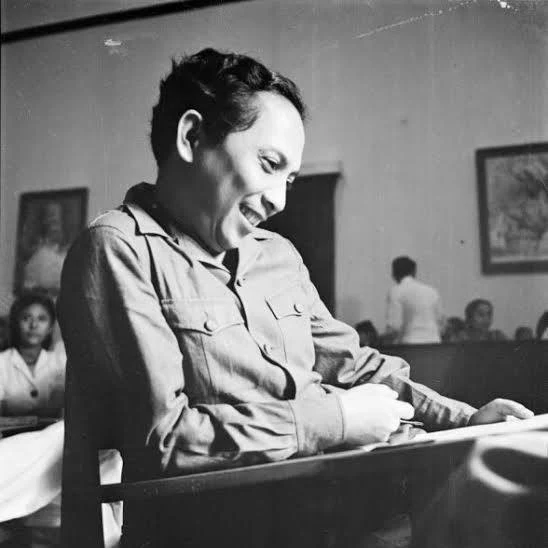
At a Glance
Padang Panjang and the Dutch Formation
Sutan Sjahrir was born on 5 March 1909 in Padang Panjang, a highland town in West Sumatra — the Minangkabau heartland that also produced Mohammad Hatta, and whose particular intellectual and Islamic modernist culture shaped both men in complementary ways. He was educated at Dutch-medium schools, and went to the Netherlands in 1929 to study law at the University of Amsterdam. The years in Amsterdam were the most politically formative of his life: he immersed himself in the Dutch socialist movement, in European social democratic thought, and in the broader intellectual world of the European left in the late 1920s and early 1930s — the period when the threat of fascism was becoming impossible to ignore and when the arguments about what democratic socialism required in the face of that threat were their most urgent and their most intellectually demanding.
He returned to Indonesia in 1931 without completing his degree — the political situation in the Dutch East Indies seemed to require his presence more urgently than Amsterdam did — and threw himself into nationalist organisation alongside Hatta, with whom he co-founded Pendidikan Nasional Indonesia (Indonesian National Education), an organisation that combined political consciousness-raising with practical education in the communities it worked with. The Dutch colonial authorities arrested them both in 1934 and exiled them — first to Boven Digoel, then to the Banda Islands — where they remained until the Japanese invasion of 1942.
The Japanese Occupation and the Underground
The Japanese invasion and occupation of the Dutch East Indies in 1941–42 transformed the political landscape for Indonesian nationalists in ways that required each of them to make a fundamental choice: collaborate with the Japanese administration in the hope of advancing independence through the occupying power's structures, or resist the Japanese on the grounds that collaboration with fascism was morally and politically unacceptable regardless of its tactical advantages.
Sukarno and Hatta chose collaboration — not from enthusiasm for Japanese imperialism but from the calculation that the independence movement could use the Japanese administration's need for Indonesian intermediaries to build the organisations, the mass mobilisation, and the institutional infrastructure that independence would require. It was a reasonable calculation, and it proved partially correct: the organisations built under Japanese patronage — the youth corps, the labour mobilisation units, the consultative councils — did provide some of the human material from which the independent republic was constructed.
Sjahrir chose differently. He went underground, maintaining clandestine contact with the Allied world through secret radio communications, organising networks of resistance across Java that preserved an Indonesian political presence not identified with the Japanese project, and writing. His book Onze Strijd (Our Struggle), published immediately after independence in 1945, reflects the clarity of conviction that the underground years had produced: a document of democratic socialist commitment that argued, with considerable intelligence, that Indonesian independence had to be founded on principles of democratic governance and social justice rather than on the nationalist mysticism that Sukarno's rhetoric tended toward.
First Prime Minister: The Diplomatic Impossible
When Indonesia declared independence in August 1945 and the new republic immediately faced the problem of international recognition — the Dutch were insisting on returning, the Allies were uncertain how to respond, and the United States was the crucial actor whose support could either legitimate or doom the republic — Sjahrir's wartime record gave him a credential that neither Sukarno nor Hatta possessed: he had not collaborated with the Japanese, and he could be presented to the Allied world as the leader of an anti-fascist resistance movement rather than as a Japanese collaborator claiming independence as a wartime reward.
He was appointed Prime Minister in November 1945 — the republic's first, under a parliamentary cabinet system that Hatta had introduced partly to separate the executive function of government from the symbolic function of the presidency, and partly to create a Prime Ministerial office that could engage diplomatically without compromising Sukarno's position as head of state. Sjahrir served three terms as Prime Minister between November 1945 and July 1947, each term a variation on the same extraordinarily difficult task: negotiating with the Dutch for recognition of Indonesian sovereignty while maintaining enough political support domestically to keep the negotiations viable.
The Linggadjati Agreement of November 1946 — negotiated by Sjahrir with Dutch and British participation — was the most significant diplomatic achievement and the most controversial political act of his prime ministership. The agreement provided for Dutch recognition of the Indonesian Republic's de facto authority over Java, Madura, and Sumatra in exchange for Indonesian agreement to work toward a Netherlands-Indonesian Union under the Dutch Crown. The Indonesian nationalist left — including the forces associated with Tan Malaka — condemned it as a surrender; the Dutch parliament ratified it only with reservations that effectively gutted its most important provisions; and when the Dutch launched their first "police action" military offensive in July 1947, the agreement collapsed entirely and Sjahrir resigned. He had attempted to secure independence through diplomacy; the Dutch had decided to secure their interests through force.
Marginalisation and the Long Decline
Sjahrir's political career after his resignation from the prime ministership followed the trajectory of the principled democrat in a political environment increasingly dominated by mass mobilisation, military power, and the personal authority of Sukarno. He founded the Indonesian Socialist Party (PSI) and led it through the 1950s — a party that attracted the best-educated and most internationally oriented segment of the Indonesian political class but that had very limited electoral appeal to the Indonesian mass public, which was more responsive to Sukarno's nationalism and the PKI's economic programme than to the PSI's social democratic politics.
He argued consistently and publicly against Guided Democracy as Sukarno moved toward it — arguing that parliamentary democracy was not merely a Western imposition but an expression of the values of deliberation and accountability that the independence movement had claimed to stand for. The argument was correct and politically ineffective, which is the characteristic fate of principled positions in political environments where charisma and mass mobilisation have replaced institutional constraint.
In January 1962, he was arrested by the Sukarno government without charge and without trial — held under the broad emergency powers that the Guided Democracy system had given the executive, detained at Madiun in East Java and then in Jakarta, without access to proper legal representation or to the normal procedures of Indonesian law. He was held for more than three years. His health deteriorated. By 1965, his condition had become serious enough that even the Sukarno government found it difficult to deny him medical treatment, and he was released to travel to Switzerland for treatment.
Death in Zurich
Sutan Sjahrir died of a stroke in Zurich on 9 April 1966. He was fifty-six years old. He was technically still a political prisoner of the Indonesian government at the time of his death — released for medical treatment but not pardoned, not rehabilitated, not formally freed. He had not returned to Indonesia after leaving for Switzerland, whether by choice or constraint. His body was returned to Jakarta and buried at Karet Bivak Cemetery.
The arc of his life — the Dutch exile, the underground resistance, the Prime Ministership, the diplomatic effort, the political marginalisation, the arrest, the death abroad — is the arc of the Indonesian independence movement's democratic possibilities: present in 1945, partially realised in the early republic, systematically undermined by Guided Democracy, destroyed by the 1965 coup and Suharto's New Order. The reformasi movement of the late 1990s that dismantled Suharto's authoritarian system and rebuilt Indonesian democracy recovered Sjahrir alongside Hatta as the intellectual founding figures of the democratic tradition that the New Order had suppressed. His book Onze Strijd, written in the first weeks of independence, argued that Indonesian freedom had to mean more than the replacement of Dutch colonialism with Indonesian authoritarianism — that the point of independence was a society in which every Indonesian had genuine dignity, genuine rights, and genuine participation in governance. Indonesia is still working on that. Sjahrir was right about what it would require.