At a Glance
Tondo: The World That Made the Revolutionary
Andrés Bonifacio was born on 30 November 1863 in Tondo — the oldest and most densely populated district of Manila, a neighbourhood of working people, fishermen, small traders, and the urban poor who serviced the Spanish colonial city without participating in its privileges. His father, Santiago Bonifacio, served as a barrio teniente — a local administrative headman — and his mother, Catalina de Castro, kept the household. Both parents died before Andrés had turned fourteen, leaving him, the eldest of six siblings, responsible for the younger children's welfare.
He found work as a warehouse clerk and then as a travelling salesman for a British trading firm, selling canes and paper fans across Manila and its surrounding provinces. The work gave him mobility and the experience of the Philippines beyond the single district he had grown up in; it also gave him time, on the road and in the evenings, to read. He was an avid and self-directed reader — of Tagalog poetry and prose, of Spanish literature and history, of the French Revolution's documents and the biographies of its figures, of Victor Hugo's novels, of the life of Rizal before he met Rizal in person. He read what educated ilustrado Filipinos read, without the school and the university they had used to get there.
The world that formed Bonifacio was one of colonial hierarchy experienced from its underside. The Spanish colonial system in the Philippines stratified society by race and education: peninsulares (Spanish-born) at the top, insulares (Philippine-born Spanish) below them, then the ilustrados — the educated Filipino elite of mixed descent who had navigated the colonial educational system and acquired professional standing — and below them the mass of indios, the indigenous Filipinos who provided the labour and the taxes on which the colonial economy ran. Bonifacio was an indio. His self-education did not change his classification. It changed his understanding of what that classification meant and what could be done about it.
La Liga Filipina and the Decision for Revolution
In 1892, José Rizal returned to the Philippines from his years in Europe and founded La Liga Filipina — a reformist organisation aimed at building Filipino unity and pursuing legal, constitutional reform within the Spanish colonial framework. Bonifacio joined it. He attended its founding meeting and was among its earliest members. But the Liga's reformist programme — petitions to Madrid, campaigns for equal rights within the colonial system — reflected the social position of its ilustrado founders: men with property and education to lose, men who could afford to wait for gradual reform, men whose stake in the existing order made revolution appear more costly than its benefits warranted.
The Spanish authorities arrested Rizal within days of the Liga's founding and deported him to Dapitan in Mindanao. The Liga collapsed without its founder. For the ilustrados, this was a signal to retreat and wait. For Bonifacio, it was a demonstration that the colonial government would never permit reform — that the only path forward was the one that reform had failed to provide. On the night of Rizal's arrest, or within days of it — the accounts vary in detail but agree in timing — Bonifacio and six companions met in a house in Tondo and founded the Katipunan.
The Katipunan: Four Years of Secret Organisation
The Kataastaasan Kagalanggalangang Katipunan ng mga Anak ng Bayan was a secret revolutionary society modelled consciously on the Masonic lodges that had provided some of the organisational infrastructure of European and Latin American revolutionary movements — with initiation rituals, secret signs and passwords, a hierarchical cell structure designed to limit the damage that any single betrayal could do, and a membership oath that bound members to the cause of Philippine independence under pain of death. It was not, initially, a mass organisation: it grew slowly through personal recruitment, each member bringing in those he personally vouched for, the cell structure ensuring that no member knew more of the network than their immediate contacts.
Bonifacio was its Supremo — its supreme leader — and its organisational driving force. He wrote its newspaper, Kalayaan (Liberty), in Tagalog rather than Spanish — a deliberate choice to reach the mass of Filipinos who did not read the colonial language. He developed its ritual and its ideology, drawing on Tagalog literary tradition and on the revolutionary political thought he had absorbed in his reading. He built it outward from Tondo through the working-class districts of Manila, into the provinces, and eventually into a network that by 1896 may have had thirty to forty thousand members — an extraordinary achievement for a clandestine organisation built without institutional backing, without foreign support, and without any of the social resources that the ilustrado reform movement had enjoyed.
The ideology of the Katipunan was simpler and more direct than the ilustrado reformism it had replaced: the Philippines should be independent, the Spanish should leave, and that independence was to be achieved by force. The racial and class dimensions of the movement were implicit but real: the Katipunan's base was among the indios, the workers and peasants, the people who had nothing to lose from revolution and everything to gain. Bonifacio's genius was to turn the social composition of colonial oppression — the fact that the majority of Filipinos were poor, unpropertied, and excluded from the colonial system's benefits — into a revolutionary resource.
August 1896: The Cry of Pugad Lawin
The Katipunan's secrecy was broken in August 1896 when one of its members confessed its existence to a Spanish priest, who reported it to the colonial authorities. Within days, the Spanish were arresting suspected members across Manila. Bonifacio understood that the network was compromised and that waiting would mean the movement's destruction without a blow being struck. He convened the members who could be reached at Pugad Lawin — a site in what is now Quezon City — and on 23 August 1896, in the act that Philippine history calls the "Cry of Pugad Lawin," he and the assembled members tore up their Spanish-issued community tax certificates — the cedulas that symbolised their submission to colonial authority — and shouted "Mabuhay ang Pilipinas!" — Long live the Philippines.
The uprising that followed spread with remarkable speed. Within weeks, fighting had broken out across the provinces of Luzon. Eight provinces — Bulacan, Cavite, Pampanga, Tarlac, Laguna, Batangas, Nueva Ecija, and Manila — were placed under a state of war by the Spanish governor, a decision that functionally recognised the scale of the revolt. The Katipunan forces won significant engagements in Cavite province under the local leadership of Emilio Aguinaldo, and Cavite became the strongest revolutionary base. Bonifacio's own forces in Manila and Morong fought less successfully against the entrenched Spanish defences of the capital.
Tejeros and the Betrayal: The Revolution Turns on Its Founder
The military and political success of Emilio Aguinaldo's Cavite-based faction created a power struggle within the revolutionary movement that the Tejeros Convention of March 1897 brought to a head. The Convention — called to unify the various revolutionary factions under a single government — held elections for the leadership of the new Philippine republic. Aguinaldo was elected president. When Bonifacio was elected to a lesser position, one of Aguinaldo's allies immediately challenged his qualifications, questioning whether a man without a law degree was fit for the role. Bonifacio, furious, declared the Convention's proceedings invalid and withdrew his recognition of its authority.
The split was irreconcilable. Aguinaldo, backed by the Cavite ilustrado faction and his military successes, moved to consolidate control. In late April 1897, Bonifacio and his brother Procopio were arrested by forces loyal to Aguinaldo. They were tried before a military tribunal at Naic on charges of sedition and treason against the revolutionary government — charges that amounted to accusing the founder of the revolution of betraying the revolution he had founded. They were convicted. The death sentences were initially commuted by Aguinaldo under pressure from some within his council, then reinstated. On 10 May 1897, Andrés and Procopio Bonifacio were taken to the slopes of Mount Buntis in Maragondon, Cavite, and shot.
The manner of Bonifacio's death — executed by the revolution he started, on the orders of the man who benefited most from displacing him — has haunted Philippine historical memory ever since. The Tejeros Convention and its aftermath are the defining instance in Philippine history of the ilustrado class's inability to accept leadership from below, of the revolutionary movement's reproduction of the social hierarchies it claimed to be overturning. Bonifacio was killed not by the Spanish but by Filipinos — by the class of educated property-owners who understood that a revolution led by a warehouse worker from Tondo might not end in the kind of republic they envisioned.
Legacy: The Supremo and the Nation He Made Possible
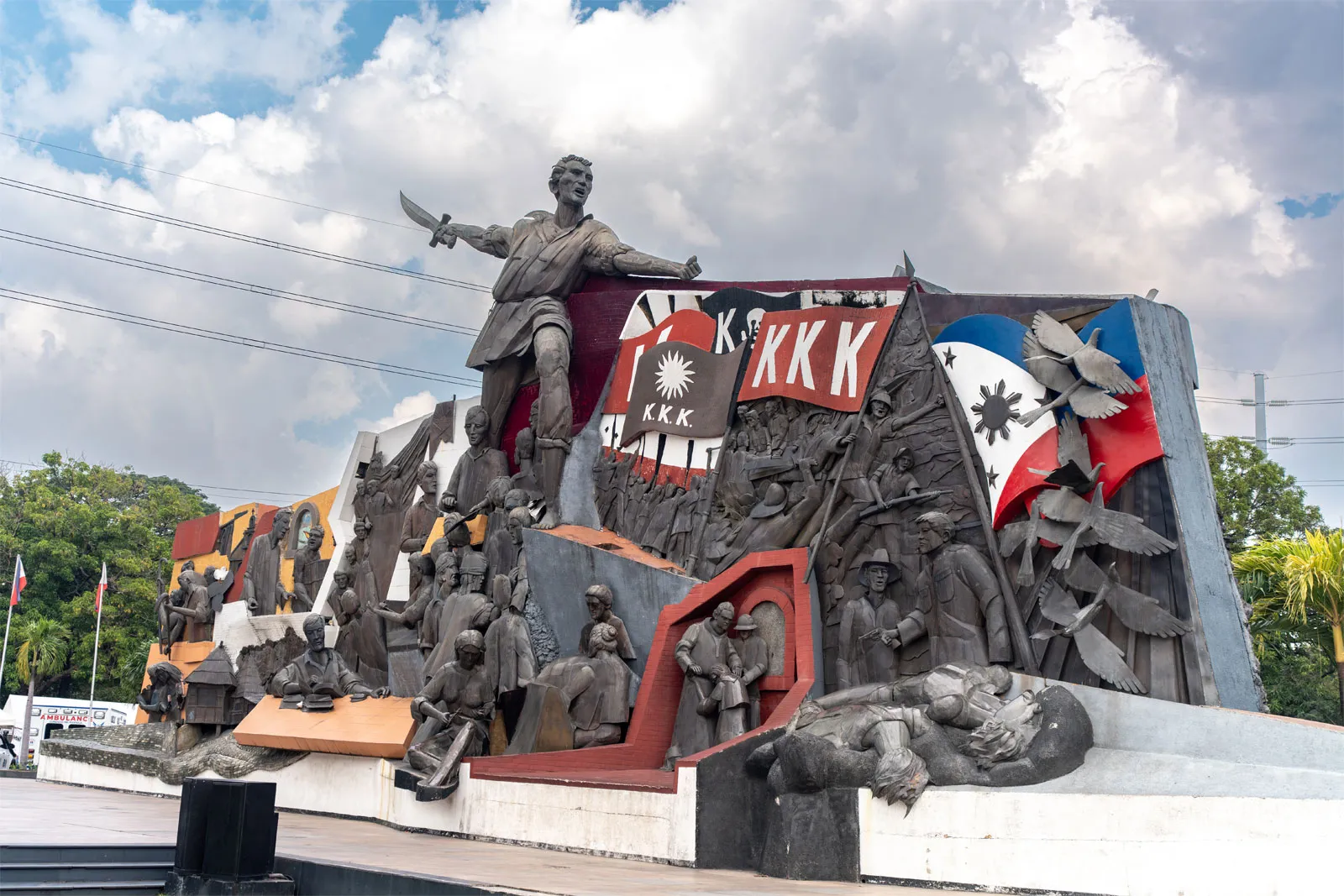
Andrés Bonifacio was declared a national hero of the Philippines, and his birth anniversary — 30 November — is observed as Bonifacio Day, a national holiday. The Bonifacio Monument stands at Caloocan, near the site of some of the earliest revolutionary fighting. Bonifacio Global City, the gleaming financial district of Metro Manila that rises where a former American military base once stood, carries his name across its luxury towers and corporate headquarters — an irony that he would probably have found instructive. His wife, Gregoria de Jesús — the "Lakambini ng Katipunan," the Muse of the Katipunan — kept the movement's documents and her own revolutionary identity through decades of post-revolutionary obscurity and is commemorated separately as a hero in her own right.
What Bonifacio represents in Philippine political culture is something that Rizal and Aguinaldo do not: the working-class foundation of the independence movement, the self-educated poor man whose organisational genius and political clarity built the Katipunan from seven members to tens of thousands, who launched the revolution that the elite then took credit for and eventually took over. The argument about whether Rizal or Bonifacio should be considered the Philippines' primary national hero — an argument that has run continuously in Philippine schools, universities, and public discourse since independence — is ultimately an argument about what kind of country the Philippines is and what kind of country it wants to be: the country of the ilustrado reformist, or the country of the Tondo warehouse worker who tore up his cedula and said that enough was enough.