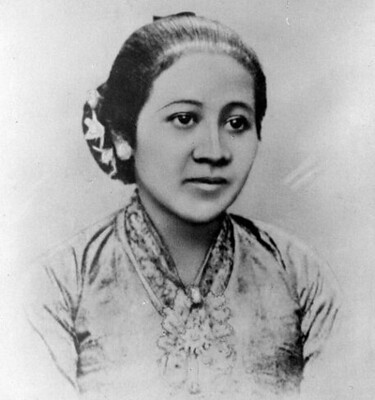
At a Glance
Jepara and the Prison of Aristocratic Privilege
Kartini was born on 21 April 1879 in Mayong, near Jepara, in Central Java — the fifth child of the regent of Jepara, Raden Mas Adipati Ario Sosroningrat, and his secondary wife Ngasirah, a commoner. The circumstances of her birth placed her in a precise and uncomfortable social position: noble enough, through her father, to receive the aristocratic title Raden Adjeng and the education and cultural privileges that came with it; but the daughter of a non-noble mother in a social system that tracked these distinctions with considerable care, which meant that her social position was secure in some respects and ambiguous in others.
Her father was, for a Javanese regent of the period, unusually progressive in one specific respect: he believed that his daughters should be educated, and he sent Kartini to the Dutch-medium primary school in Jepara alongside her brothers — an extraordinary exception to the norm for aristocratic Javanese girls, who were typically educated at home if at all. Kartini learned Dutch fluently, read widely, and developed the intellectual curiosity and the confidence in her own thinking that the best Dutch-medium education of the period could produce. She was twelve years old when this education ended — not because she had finished learning but because custom required that she enter seclusion, the pingitan, the period of confinement in the regent's residence that aristocratic Javanese girls underwent between the end of their childhood and their marriage. She was locked, at twelve, in the house. She had a library. She had pen and paper. And she had, through her father's official connections, some access to Dutch officials and their families who were willing to correspond with an unusually intelligent aristocratic girl whose Dutch was excellent and whose questions were arresting.
The Letters: What She Said and Why It Mattered
The letters that Kartini wrote between approximately 1899 and her death in 1904 — to Stella Zeehandelaar, a Dutch feminist; to Mevrouw Abendanon, the wife of the Dutch education official; to J. H. Abendanon himself; to other Dutch correspondents — are the documents on which her legacy rests, and they are remarkable not primarily for their political argument (which was consistent if not always original) but for the quality of mind they reveal and the way that quality of mind illuminates a situation.
She wrote about the condition of Javanese women — the seclusion, the arranged marriages, the polygamy that was standard among Javanese aristocrats and that meant that a woman might find herself the fourth or fifth wife of an elderly regent regardless of her own preferences — with a combination of personal anguish and analytical clarity that gives the letters their power. She was not writing from the outside about a condition she observed; she was writing from inside a condition she was living, and the letters simultaneously describe the condition and demonstrate, by their very existence, that the condition was not necessary. A woman this intelligent, this curious, this clearly capable of thought and argument and feeling — why should such a woman be locked in a house at twelve and given in marriage at twenty-four?
She wrote about the colonial system with a clarity that anticipated the anti-colonial thought of the following generation: the observation that Dutch colonial education was designed to produce obedient administrators rather than independent thinkers, that the extraction of Javanese wealth was systematic and deliberate, that the paternalism of Dutch liberalism — the claim that the Dutch were educating Indonesians for their own good — concealed a structure of exploitation that the education was meant to perpetuate rather than dismantle. She was not a nationalist in the political sense — she did not advocate Indonesian independence, and she maintained warm relationships with Dutch correspondents whose government she was critiquing. But the intellectual framework she was articulating — the argument that Javanese people deserved equal dignity, equal education, and equal respect — was the intellectual foundation on which the independence movement would build.
The Broken Promise and the Arranged Marriage
J. H. Abendanon, the Dutch Director of Education for the Dutch East Indies and one of Kartini's most important correspondents, promised her a scholarship to attend a teacher-training college in Batavia — a promise that would have given her the professional education she had been denied by the pingitan and the path to the teaching career she had been planning. The promise was withdrawn. The accounts differ on why: political changes within the Dutch colonial administration, the opposition of conservative elements who considered educating Javanese women in this way inappropriate, or the practical complications of the arrangement. The withdrawal of the promise was the defining betrayal of Kartini's life — the moment when the Dutch liberal system that she had been corresponding with about the possibility of change demonstrated that it was not actually prepared to change in the way that mattered most to her personally.
She accepted the arranged marriage to Raden Adipati Djojo Adiningrat, the regent of Rembang, in November 1903 — a man who already had three wives, as was standard among Javanese aristocrats of his position. She had argued against arranged marriage, against polygamy, against everything this represented; she accepted it because the alternative had been taken from her and because the man in question — apparently more enlightened than average — agreed to permit her to continue her educational work after their marriage. She opened a small school for the daughters of Jepara's regency officials before the marriage and planned to continue this work in Rembang.
Death at Twenty-Five
Kartini died on 17 September 1904, four days after giving birth to her first son. She was twenty-five years old. The son survived; the mother did not. The cause was the complications of childbirth that killed a disproportionate number of young women in the Dutch East Indies and across the colonial world in the early twentieth century, where maternal mortality was high and obstetric care inadequate. She had been writing letters about women's emancipation for six years. She had opened one small school. She had been working on a second. She had not seen her letters published, had not known they would be collected, had not known that they would become one of the most widely read documents of the Indonesian independence movement. She died in a regent's residence in Rembang, having been a wife for less than a year, a mother for four days.
Door Duisternis tot Licht: The Posthumous Revolution
Abendanon collected Kartini's letters and published them in Dutch in 1911 as Door Duisternis tot Licht — Through Darkness to Light. The collection was an immediate sensation in the Netherlands and in the Dutch East Indies: it introduced Dutch readers to the inner life of a Javanese woman of exceptional intelligence and gave them, in her own words, a perspective on Dutch colonial rule that no Dutch writer could have provided. It introduced Indonesian readers — through the eventual Indonesian translation Habis Gelap Terbitlah Terang — to a voice from within their own aristocracy that articulated, in terms of personal experience and philosophical argument, the case for women's emancipation and human dignity that the independence movement would later pursue in political terms.
The Indonesian women's movement that developed in the 1920s and 1930s — the organisations of educated Indonesian women who argued for women's rights within the broader independence framework — took Kartini as its founding figure and her letters as its founding text. The Kartini schools that sprang up across the Dutch East Indies in the 1910s and 1920s — institutions for girls' education named after her — were the institutional expression of the argument her letters had made. Dewi Sartika was building schools; Kartini had provided the philosophical justification for building them.
Kartini Day and the Living Legacy
President Sukarno declared Kartini a National Hero of Indonesia in 1964. Her birth anniversary, 21 April, is observed as Kartini Day — a national holiday on which Indonesian women and girls traditionally dress in Javanese batik and traditional clothes in her honour, and schools across the country hold commemorations and cultural events. Her face appeared on the 5,000-rupiah banknote. Kartini schools, Kartini streets, and Kartini organisations exist across Indonesia. Habis Gelap Terbitlah Terang remains in print and is part of the Indonesian national curriculum.
The argument about Kartini's legacy — whether it has been too focused on the costume and ceremony of Kartini Day and insufficiently focused on the substance of her critique; whether the colonial system's appropriation of her as a safe feminist erased the more radical dimensions of her thought; whether the emphasis on her as a symbol of women's traditional dress and domestic virtue misrepresents a woman whose letters argued precisely against the domestic confinement that the celebrations seem to honour — is one of the most active debates in Indonesian feminist scholarship. She was, finally, a woman who spent the last years of her short life trying to get out of the house and into the world, and whose legacy has sometimes been reduced to a day on which women dress beautifully and stay inside. She would have had something to say about that. She had something to say about everything.