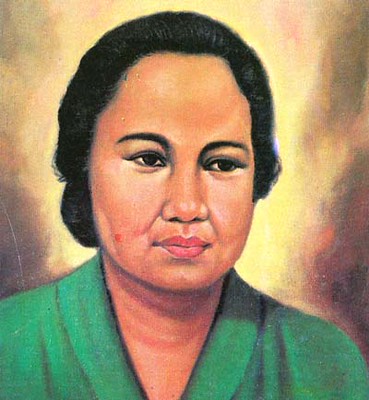
At a Glance
Cicalengka: A Noble Family, a Difficult Childhood
Dewi Sartika was born on 4 December 1884 in Cicalengka, a small town in the Bandung Regency of West Java, into a Sundanese priyayi family — the Sundanese aristocratic class that occupied the intermediate position between the Dutch colonial administration above and the mass of ordinary Sundanese people below, administering local affairs under Dutch supervision and carrying the complex burden of serving both as intermediaries of colonial rule and as guardians of Sundanese cultural and social life. Her father, Raden Somanagara, was a district head — a senior local official — and her mother came from a similarly prominent family.
Her childhood was disrupted by her father's exile by the Dutch colonial government — he had been involved in nationalist or anti-colonial activities that the Dutch found threatening, and his removal from office and exile from the region left the family's circumstances significantly reduced. Dewi Sartika was raised partly by her uncle, Raden Demang Aria Suriakartalegawa, a regent in Bandung who provided the household stability her father's exile had removed. The experience of her father's punishment for political engagement may have shaped both her wariness about direct political confrontation with the colonial government and her commitment to the more indirect but deeply consequential strategy of building institutions rather than staging confrontations.
She was educated partly by Dutch-trained teachers and partly through her own reading and observation, and she became aware early of the gap between the education available to boys of her class — who could attend Dutch-medium schools and in some cases higher institutions — and the education available to girls, which was minimal, informal, and oriented entirely toward domestic life. The gap was not accidental: it reflected the colonial government's assessment that educating indigenous women served no useful imperial purpose, and the Sundanese aristocracy's own ambivalence about women's education that went beyond the purely practical skills needed to manage a household.
16 January 1904: The School Opens
Dewi Sartika was nineteen years old when she opened the first school for indigenous women in the Dutch East Indies on 16 January 1904. The premises were the back porch of the Kabupaten in Bandung — the regent's official residence and office, where her uncle's position gave her access to space that she could not otherwise have obtained. The initial enrolment was twenty girls. The two teachers were herself and a colleague. The curriculum was carefully designed to be defensible to both the Dutch colonial government and the Sundanese aristocracy: it combined literacy in Sundanese and Malay with sewing, weaving, cooking, and household management — practical skills that no one could object to — while the literacy component quietly provided the foundation for everything else that education made possible.
The school grew quickly. By the end of its first year it had outgrown the Kabupaten porch and needed larger premises. The Dutch colonial government — initially indifferent — began to take notice, and Dewi Sartika navigated the colonial bureaucracy with the combination of persistence and strategic deference that the situation required: presenting the school as a practical contribution to the colony's social welfare, emphasising its vocational curriculum, and avoiding the explicitly nationalist framing that would have attracted immediate suppression. She obtained limited colonial government recognition and eventually modest financial support, which gave the school an official status that protected it from administrative obstruction while not compromising its essential purpose.
She married Raden Agah Kanduruan Suriawinata in 1906 — a teacher and education advocate who became a genuine partner in the school's work rather than an obstacle to it, in an era when women's public activities were frequently constrained by their husbands' preferences. The marriage, by the accounts that survive, was a working partnership: her husband supported the school's expansion, contributed to its curriculum development, and used his own networks to advance the project that his wife had founded.
Kartini and Dewi Sartika: Two Approaches to the Same Cause
Raden Adjeng Kartini — born in 1879 in Jepara in Central Java, five years before Dewi Sartika and in a different cultural milieu — was writing her letters arguing for Indonesian women's emancipation at almost exactly the same time that Dewi Sartika was opening her first school. Kartini's letters, published posthumously in Dutch in 1911 as Door Duisternis tot Licht (Through Darkness to Light) and subsequently in Indonesian and English translation, became one of the most read documents of the Indonesian independence movement and gave Kartini a international celebrity that Dewi Sartika's practical institution-building never generated. Kartini died in 1904, aged twenty-five, in childbirth — her martyrdom elevating her into the founding figure of Indonesian women's consciousness in a way that a long working life building schools could not replicate.
The comparison is not entirely fair to either woman. Kartini wrote with a philosophical and literary intelligence that Dewi Sartika did not claim for herself; Dewi Sartika built things that outlasted her in ways that letters, however brilliant, cannot. Their approaches were complementary: Kartini articulated the intellectual and moral case for women's emancipation; Dewi Sartika built the institutional infrastructure through which emancipation could be achieved in practice, one literate woman at a time. The Indonesian government eventually recognised both: Kartini Day is observed on 21 April, Kartini's birth anniversary; Dewi Sartika's birth anniversary, 4 December, is observed as Teachers' Day in West Java.
Expansion Across West Java: Four Decades of Building
The Sekolah Isteri — renamed the Sekolah Kaoetamaan Isteri (School for Women's Excellence) as it grew — expanded steadily through the 1910s and 1920s. Dewi Sartika opened branches in other towns in West Java, developed a more systematic curriculum, trained teachers to staff the expanding network, and built relationships with Sundanese cultural organisations that could provide community support and advocacy. By the 1920s the school had several hundred students and had become an established institution of Sundanese life — accepted by the colonial government as a useful contributor to social stability and by the Sundanese community as a recognised institution of education and prestige.
The curriculum evolved as the school grew. The early emphasis on practical domestic skills remained — it was, in the context of the time and the expectations of parents and students, both genuinely useful and politically necessary — but the literacy component deepened, and the school began producing women who could read and write with sufficient competence to participate in the expanding Indonesian-language public sphere of the 1920s and 1930s: the newspapers, the political organisations, the nascent women's movement that was building across the Dutch East Indies in the years before the Japanese occupation.
The Japanese occupation of the Dutch East Indies from 1942 to 1945 disrupted everything. The school's Dutch colonial government support ceased; the curriculum was forced to incorporate Japanese language and imperial ideology; the practical conditions of wartime — food shortages, forced labour mobilisation, the terror of Japanese military occupation — made education secondary to survival for most families. Dewi Sartika maintained the school's operation as best she could through the occupation years, adapting to the demands of each successive authority while preserving the essential function: keeping girls in school, keeping the institution alive.
The Revolution and a Death in Exile
Indonesia declared independence on 17 August 1945, two days after Japan's surrender. The Dutch — unwilling to accept the loss of their most valuable colonial possession — returned to Indonesia and attempted to reoccupy it, leading to four years of war between the Dutch and the Indonesian Republican forces before the Dutch finally recognised Indonesian independence in 1949. In Bandung, the confrontation produced one of the iconic events of the Indonesian Revolution: the "Bandung Sea of Fire" of March 1946, in which Indonesian forces burned the southern part of the city rather than allow the Dutch to reoccupy it intact. The burning destroyed large parts of the city, including areas where Dewi Sartika's school operated.
She fled Bandung with other civilians displaced by the burning and the fighting, moving east toward Tasikmalaya. She was sixty-one years old, in poor health, and the physical and psychological strain of the displacement — abandoning the city and the schools she had spent forty years building — was severe. She died in Cineam, near Tasikmalaya, on 11 September 1947, in the difficult conditions of wartime refuge. She did not live to see the independence for which the revolution she fled was being fought.
President Sukarno declared her a National Hero of Indonesia in 1966. Her face appeared on the 50,000-rupiah banknote issued in 2011. Dewi Sartika University in Bandung carries her name. Her schools — transformed and expanded beyond recognition from the twenty-girl class on the Kabupaten porch — are the living descendants of what she started on 16 January 1904. The liberation of Indonesia required armed fighters, political organisers, diplomats, and ideologues. It also required the woman who understood, before most of the others, that no liberation is complete until the women of the country it liberates can read.