At a Glance
Aceh and the War That Would Not End
The Aceh Sultanate at the northwestern tip of Sumatra had maintained its independence throughout the period of Dutch colonial expansion in the Indonesian archipelago — protected by its strategic position at the mouth of the Strait of Malacca, by a series of treaties with European powers, and by the military reputation of its population, who had resisted external conquest for centuries with a tenacity that the Dutch would come to know intimately. When the Dutch invaded Aceh in 1873, they expected a rapid conquest. What they got was the longest and most costly colonial war in Dutch imperial history: a conflict that officially lasted until 1914 and in practice continued in various forms well beyond that, consuming Dutch resources, Dutch soldiers, and Dutch confidence in a jungle campaign that produced no decisive victory and no sustainable peace.
Cut Nyak Dhien was born into this world — into the Acehnese aristocracy, into a society whose Islamic identity and fierce independence were intertwined, and into the generation that would see the Dutch invasion and choose how to respond to it. Her father, Teuku Nanta Setia, was a senior official of the Aceh Sultanate, and her first marriage, to Teuku Ibrahim Lamnga, placed her within the network of Acehnese noble families whose men were the natural commanders of the resistance. She was approximately twelve years old when she was married — the norm for aristocratic women in Aceh at the time — and the marriage was by the accounts that survive a genuinely close partnership rather than merely a dynastic arrangement.
The Death of the First Husband and the Choice That Followed
The Dutch invaded Aceh in March 1873. The initial expeditionary force was repulsed — the Acehnese defenders killed the Dutch commanding general, Major General Johan Harmen Rudolf Köhler, and forced a Dutch withdrawal. The Dutch returned in December 1873 with a larger force, captured the Acehnese capital Kutaraja (now Banda Aceh), and killed the Sultan. But capturing the capital did not end the resistance. The Acehnese nobles and religious leaders — the ulama and the uleebalang — withdrew into the countryside and the jungle and continued fighting a guerrilla war that the Dutch found themselves unable to suppress regardless of the force they deployed.
Teuku Ibrahim Lamnga was killed at the Battle of Glee Tarum in 1878, fighting Dutch forces in the hills near Banda Aceh. Cut Nyak Dhien was approximately thirty years old. The Dutch offered her, as they offered other Acehnese nobles whose husbands had been killed, a form of accommodation: a pension, a house, the security of colonial protection in exchange for accepting the new order. She refused. She is reported to have burned her possessions rather than accept Dutch charity, and to have joined other resistance families in the jungle rather than remain in Dutch-controlled territory. The choice — made by a woman of rank and comfort, with every practical reason to accept the Dutch terms — established the moral position that she maintained for the next thirty years.
Teuku Umar and the Jungle War
Cut Nyak Dhien married Teuku Umar around 1880. The marriage was a union of the resistance movement's most formidable figures: Teuku Umar was Aceh's most celebrated military commander, a man of strategic intelligence and considerable personal courage who had been fighting the Dutch since the beginning of the war and who would eventually conduct one of the most celebrated acts of tactical deception in the conflict's history — feigning submission to the Dutch in 1893 to acquire weapons and ammunition, then returning to the resistance in 1896 with the arms he had obtained. Cut Nyak Dhien was not a passive wife in this partnership. She participated in the jungle campaign directly, lived the guerrilla life in the Acehnese interior, and maintained the household and the networks that sustained the resistance through the years of her second marriage.
The conditions of the jungle guerrilla life were physically brutal even for the healthy and young: the Acehnese interior was densely forested, the climate hot and wet, disease endemic, and the Dutch military pressure — intensified from the 1890s by the more aggressive tactics of General Johannes van Heutsz — relentless. Cut Nyak Dhien began developing rheumatism in the 1890s — a progressive condition that made movement increasingly painful and that, combined with the glaucoma that was slowly destroying her vision, was reducing her physical capacity even as her will to resist remained unchanged.
After Teuku Umar: The Final Years of Resistance
Teuku Umar was killed by Dutch forces at Meulaboh on the west coast of Aceh on 11 February 1899. He was ambushed — informed upon by a spy, the accounts suggest — and shot. He was approximately forty-five years old. His death removed the resistance's most effective military commander and left Cut Nyak Dhien, now in her early fifties, with worsening rheumatism, deteriorating eyesight, and no husband to share the command of the forces she was still directing in the jungle.
She continued fighting. This is the fact that all accounts of her life return to and that none of them fully explains in conventional political or military terms, because the conventional explanations — ideology, calculation, the reasonable hope of eventual success — do not adequately account for a woman in her fifties, in chronic pain, going blind, maintaining a guerrilla resistance that she had to understand was not going to defeat the Dutch Empire. What sustained her was something closer to identity than to strategy: she was an Acehnese noblewoman, the wife of the resistance, the keeper of the commitment that the deaths of her two husbands had demanded. To stop was to betray everything that had been done and suffered. So she did not stop.
The years between Teuku Umar's death in 1899 and her capture in 1905 are the years of her most remarkable endurance. She moved through the Acehnese jungle with a shrinking band of followers, coordinating with other resistance commanders, maintaining the fiction of an organised resistance long after the resistance had been reduced to a symbolic presence. Her physical condition deteriorated steadily. The rheumatism made walking without assistance nearly impossible. The glaucoma reduced her vision to the point where she could barely see. She was carried between camps by her followers.
Betrayal, Capture, and Exile
Pang Laot — one of her followers — informed the Dutch of her jungle location in February 1905. His motivation, by the accounts that survive, was not venality but a form of desperate compassion: he had concluded that her physical condition meant she would die in the jungle within months if not rescued, and that informing the Dutch was the only way to ensure she survived. The Dutch arrived at the camp. Cut Nyak Dhien reportedly drew her rencong — the traditional Acehnese dagger — and attempted to defend herself, and had to be physically restrained and disarmed. She did not go quietly. She had to be carried out of the jungle.
She was taken to Banda Aceh, where the Dutch colonial administration was based, and held there briefly before being exiled to Sumedang in West Java — far from Aceh, far from the resistance networks and the population that might have sustained any continued influence. The Dutch calculated, correctly in operational terms, that separating her from Aceh would remove her from the conflict. What they could not remove was what she represented: the thirty years of resistance, the refusal of every Dutch offer, the maintenance of opposition under conditions of physical devastation that would have broken most people long before.
She died in Sumedang on 6 November 1908, aged approximately sixty. She had been in exile for three years. The Dutch colonial administration reported that she died peacefully. Her grave in Sumedang became a site of pilgrimage.
National Hero and Enduring Symbol
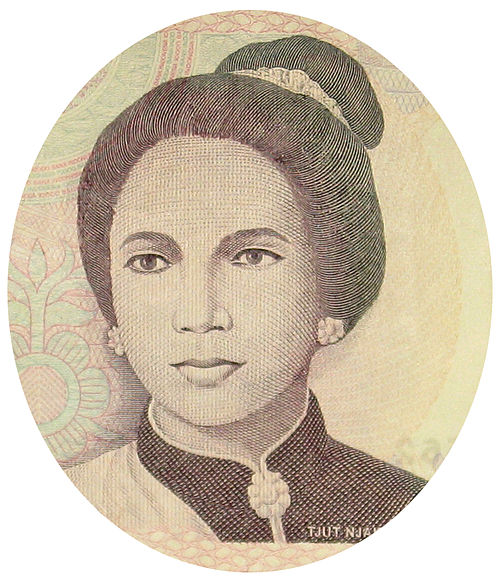
President Sukarno declared Cut Nyak Dhien a National Hero of Indonesia by presidential decree in 1964 — one of five women among the initial cohort of national heroes, a recognition that women's contribution to the resistance against colonialism was as central as men's. Her face appeared on the 10,000-rupiah banknote in the 1975 series. The 1988 film Cut Nyak Dhien, directed by Eros Djarot and starring Christine Hakim in a performance of exceptional power, brought her story to generations of Indonesians who had not encountered it through the history curriculum, and won the Asia-Pacific Film Festival's Best Film award. Schools across Indonesia carry her name.
What her story means, finally, is something that the official commemorations necessarily simplify: not the romantic heroism of the warrior princess, but the specific, grinding courage of someone who had every physical and practical reason to stop and chose not to, year after year, for thirty years. The Aceh War was the longest and most costly colonial war in Dutch imperial history — it consumed more Dutch soldiers and more Dutch money than any other imperial enterprise in the Indonesian archipelago. It produced no clean Dutch victory. The resistance that Cut Nyak Dhien embodied was not defeated militarily; it was outlasted, worn down, and eventually suppressed by the combination of overwhelming force, systematic resettlement, and the physical attrition of the jungle years. She was part of the reason it lasted as long as it did. That it lasted as long as it did is part of the reason Indonesia is Indonesia.