At a Glance
Murshidabad and Calcutta: The Formation of a Revolutionary
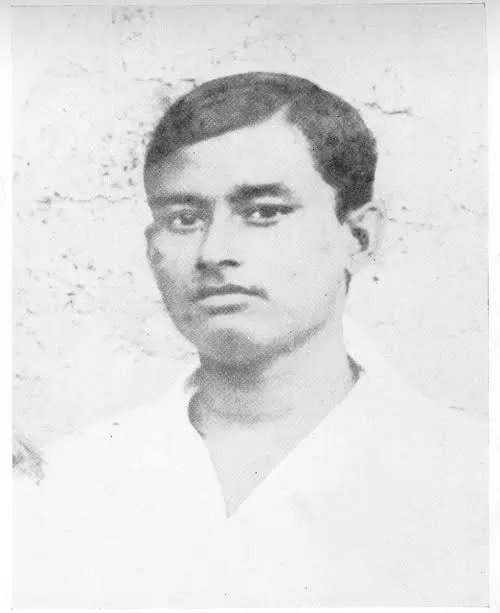
Binoy Basu was born on 11 September 1908 in Murshidabad District — the district of eastern Bengal whose capital, also called Murshidabad, had been the seat of the Nawabs of Bengal before the British East India Company's victory at Plassey in 1757 effectively transferred Bengal's sovereignty to the Company. The historical weight of that transition was part of the cultural atmosphere of Bengal's educated Hindu middle class, for whom Plassey and the subsequent two centuries of colonial rule were not distant history but the direct context of their own lives and the cause of the poverty and exclusion that surrounded them. Binoy Basu grew up in this atmosphere, educated in Bengali and English, absorbing the political tradition that had produced the Swadeshi Movement, the Alipore Bomb Case, and the steady stream of revolutionary martyrs that Bengali nationalist memory celebrated.
He moved to Calcutta for his education — the route that educated young men from Bengali district families took, since Calcutta contained the province's best schools and colleges and also its most active revolutionary networks. The city in the late 1920s was politically charged in ways that had been building for thirty years: the Anushilan Samiti and Yugantar networks had been suppressed but not eliminated by the Alipore prosecutions; the Swadeshi tradition had kept alive the argument that armed resistance was legitimate; and the events of 1930 — Gandhi's Salt March, the Chittagong Armoury Uprising, the intensifying repression of political prisoners across Bengal — had created the political atmosphere in which the Bengal Volunteers recruited and in which young men like Binoy Basu decided that the cause required more than they had so far given it.
The Bengal Volunteers: The Organisation That Built the Operation
The Bengal Volunteers was one of several revolutionary organisations active in Bengal in 1930, operating in the broader network of armed nationalist groups that had been building since the Swadeshi years and that took direct inspiration from the Chittagong Armoury Uprising of April 1930. The uprising — in which Surya Sen's Indian Republican Army briefly seized control of Chittagong — had demonstrated that disciplined armed action on a significant scale was possible and had radicalised a new generation of young Bengalis who took the Chittagong revolutionaries as their models.
The Bengal Volunteers' choice of N. S. Simpson as the target for the Writers' Building operation was not arbitrary. Simpson was the Inspector General of Prisons for Bengal, and in that role he was the administrator directly responsible for the conditions in which political prisoners across the province were held. The treatment of those prisoners had become a cause of sustained public anger: political detainees were subjected to degrading treatment, force-feeding during hunger strikes, isolation from family and legal counsel, and conditions that the mainstream nationalist movement had been protesting for months through petitions and demonstrations that the colonial government largely ignored. Shooting Simpson was a statement that these protests had not been heard and that the organisation responsible for the prisoners' suffering would bear a personal cost for it.
Binoy Basu was selected as the operation's leader — the person responsible for planning the entry, guiding the group through Writers' Building to Simpson's office, and managing whatever happened after the shooting. The selection reflected the organisation's assessment of his reliability, composure, and practical competence. He was twenty-two years old.
Writers' Building: Architecture of Colonial Power
Writers' Building stands on the northern side of what was then called Dalhousie Square — now BBD Bagh — in the heart of colonial Calcutta. It is a long, low building of red-painted brick with a neoclassical facade, stretching almost the full length of the square's north side, its entrance approached through a gate from the square. The name derives from the "writers" — the junior clerks — of the East India Company who were originally housed there in the eighteenth century when the Company was building the administrative machinery that would become the Government of Bengal. By 1930 it was the working address of the most senior colonial administrators in the province: the Lieutenant Governor, the Chief Secretary, the Inspector General of Prisons, and the other officers through whom British rule in Bengal was conducted on a daily basis.
The building was not a fortified installation. It had no military guard, no weapons checkpoint, nothing that would prevent three young men in convincing military uniforms from entering, climbing to the upper floors, and reaching an office. The uniform — the khaki of army dispatch riders — was the operation's key security measure: it provided a plausible reason for being in the building that would not trigger immediate police attention. Binoy Basu, Badal Gupta, and Dinesh Gupta had obtained or made these uniforms, had presumably rehearsed the route to Simpson's office, and had chosen the morning of 8 December 1930 as the day when the plan would be executed.
8 December 1930: The Raid in Detail
The three young men entered Writers' Building on the morning of 8 December 1930 and made their way up through the building to the floor where N. S. Simpson's office was located. They reached the office. They shot Simpson — he was hit by multiple rounds and was critically wounded; he died from his injuries subsequently. The gunfire brought immediate response: police and building security converged on the upper floors, and the three men found themselves surrounded with no route of escape available.
What followed in the next few minutes is the moment that BBD Bagh commemorates. Badal Gupta swallowed the potassium cyanide he had carried into the building for exactly this contingency — he had decided in advance that capture meant torture, trial, and execution on the colonial state's terms, and that he would deny the state that satisfaction. He died later on 8 December. Binoy Basu drew his revolver and shot himself — a gunshot wound that proved fatal, though accounts vary on whether he died in the building or survived for some hours afterward before dying the same day. Dinesh Gupta did not have a weapon at hand for self-inflicted death or chose differently: he was captured alive, taken into custody, tried, and hanged at Alipore Jail on 7 July 1931.
The three different fates of the three men are worth sitting with. Badal chose the prepared death by poison. Binoy chose death by his own gun. Dinesh chose — or found himself without the alternative to — capture and the legal process. The outcome for Dinesh was not substantially different from the outcome for Binoy and Badal in terms of death by the state's violence: he was executed eight months later. But the manner and timing were different, and the manner mattered in the culture of the Bengal revolutionary movement, which maintained a complex and sometimes contradictory set of positions about the ethics of surrender, trial, and voluntary death.
The Context: Political Prisoners and the Simpson Target
The choice of Simpson as the target requires some expansion to be fully understood. The hunger strikes of political prisoners in Bengal jails in 1929 and 1930 had produced a sustained public campaign around the conditions of imprisonment. The prisoners demanding political prisoner status — the right to better food, access to books, freedom from the most degrading forms of hard labour — were being force-fed when their hunger strikes reached dangerous lengths, held in solitary confinement, and denied the access to legal counsel and family visits that would have been automatic for equivalent prisoners in Britain.
Simpson, as Inspector General, was the face of this regime. He was not a random target or a symbolic one chosen for maximum shock effect: he was the specific administrator responsible for the specific conditions that the Bengal Volunteers had identified as intolerable. The operation was framed, in the Bengal revolutionary tradition, as an act of political justice rather than terrorism — the distinction that the colonial government and the moderate nationalist mainstream did not accept, and that the revolutionary movement insisted on. Whether that distinction holds depends substantially on one's view of whether armed violence against specific identified agents of an occupying power is categorically different from armed violence against the population that power governs. It is a question that the Binoy-Badal-Dinesh operation poses without fully answering.
BBD Bagh and the Permanence of Names
The renaming of Dalhousie Square as BBD Bagh — Binoy-Badal-Dinesh Bagh — by the Government of West Bengal after independence was an act of deliberate historical overwriting. Dalhousie Square had been named for Lord Dalhousie, the Governor-General of India from 1848 to 1856 whose annexation policies had been among the most aggressive expressions of British imperial expansion in the subcontinent — including the annexation of Awadh in 1856 that helped precipitate the 1857 uprising. Replacing his name with those of three young Bengali revolutionaries who had tried to kill a senior officer of the administration he had helped build was a statement about whose version of Bengal's history the independent state endorsed.
The statement is now embedded in daily life in Kolkata in a way that most of its residents absorb without necessarily knowing the story behind it. Taxi drivers say BBD Bagh. Office workers give their address as BBD Bagh. The square is the terminus for multiple bus routes. The West Bengal Secretariat — the successor to Writers' Building as the administrative centre of the state — sits on the same ground. Every person who navigates to that square encounters the three names without necessarily connecting them to the three young men who walked into the building on its north side on a December morning in 1930 and did not walk out again.
The Revolutionary Tradition and What It Demanded
Binoy Basu died at twenty-two having lived almost entirely within the logic of the Bengal revolutionary tradition — a tradition that demanded not merely political commitment but a willingness to accept death as the probable cost of that commitment, and that regarded the manner of dying as itself a political statement. The tradition had produced Khudiram Bose at eighteen, Prafulla Chaki at nineteen, Bhagat Singh at twenty-three, and dozens of others whose youth was inseparable from the quality of the sacrifice they made. They had not yet built lives that were fully their own; they had given those potential lives to the cause before they had been lived.
What made this possible — what made it seem not merely inevitable but right to the young men and women who chose it — was the political atmosphere of late colonial Bengal, in which the evidence of colonial violence was immediate and personal, in which the revolutionary tradition had already produced martyrs who were celebrated as heroes rather than mourned as victims, and in which the philosophical framework of the Bhagavad Gita — action in a righteous cause without attachment to outcome — was available as a justification that the educated middle-class Bengali world these young men had grown up in understood and respected.
Binoy Basu left almost no written record. He was not a pamphleteer or an essayist; the available documentation of his interior life before 8 December 1930 is thin. He is known through what he did, which was to lead two companions into a government building, shoot a specific official he had identified as responsible for specific injustices, and then choose to die rather than be taken. It is a spare record. It is also complete: the action and the choice it contained say everything that needs to be said about what Binoy Basu believed and what he was willing to pay for it. Kolkata remembers that. It prints his initial on every map that shows the square where the building stands.