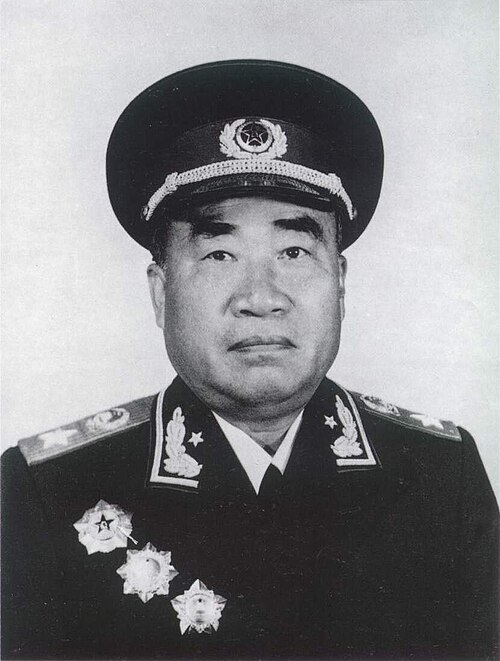
At a Glance
Yilong County: Tenant Farmers, Fifteen Children, and the Academy
Zhu De was born on 1 December 1886 in Mazao Village in Yilong County, in the province of Sichuan — one of the more remote and impoverished corners of an empire already deep in its terminal crisis. His family were tenant farmers, working land they did not own for a landlord's share of whatever the harvest produced, with the remainder stretched among a household that eventually included fifteen children, eight of whom survived. The conditions of Zhu's childhood were conditions of structural poverty: enough food most years to survive, never enough to achieve anything approaching security, and a clear understanding from childhood that the system that organised rural Sichuan was organised against families like his.
He was able to attend the Yunnan Military Academy — a modern military institution established on Western lines in Yunnan Province — through a combination of personal ability and the assistance of relatives who could cover the costs of his early education. At the Yunnan Military Academy he met Cai E, the brilliant young officer who would become both his mentor and a model for the kind of commander Zhu aspired to be. He graduated in 1911 — the year the Qing dynasty fell — and immediately joined Cai E's forces in the expeditionary campaign that the 1911 Revolution launched in Sichuan. Within five years, through a combination of battlefield ability, the patronage of Cai E, and the rapidly shifting opportunities that the warlord period created, Zhu had risen from second lieutenant to brigadier general. It was a remarkable ascent for a tenant farmer's son. It was also, by 1916, producing a man who was losing himself.
The Opium Years: Warlord, Addict, Decadent
The death of Cai E in 1916 — from tuberculosis, at thirty-three, a loss that devastated Zhu personally — coincided with the death of Zhu's first wife, Xiao Jufang. The double bereavement triggered what Zhu himself described as a collapse: he fell into the opium addiction that was endemic in the Yunnan and Sichuan armies, began building a personal power base in the warlord manner — with cronies in key offices, family in positions of advantage, himself at the financial and political centre — and watched his own political idealism dissolve into the corruption that every Chinese who had fought for Sun Yat-sen's republic had hoped the revolution would end.
Agnes Smedley, the American journalist whose biography The Great Road (1956) remains the most detailed account of Zhu's early life based on direct interviews with him, records his own account of this period with unusual candour. He knew what he was doing was wrong. He could feel his original purpose draining away into the opium pipe and the warlord's compound. He described himself to Smedley as "hopeless and confused" — a man with one foot in the revolutionary future and one foot unable to find purchase in the old order. The crisis of recognition — understanding what he had become and deciding to change — came sometime around 1920. In 1922, he made the break: he checked himself into a French hospital in Shanghai, underwent treatment for his addiction, and quit opium permanently. He was thirty-six years old.
Berlin, Göttingen, and Zhou Enlai's Sponsorship
Freed from the addiction and the warlord existence, Zhu left China for Europe in 1922 — travelling to France briefly before settling in Germany, where he enrolled at Göttingen University. Göttingen in the early 1920s was an intellectual centre of the first rank, home to some of the finest mathematical and scientific minds in Europe, and the encounter between Zhu De — a Chinese warlord general turned communist student — and this environment produced something unexpected: a man who read deeply, thought carefully, and developed the theoretical framework for his subsequent revolutionary career.
In Berlin, he met Zhou Enlai, who was organising the CCP's European branch and recruiting promising Chinese students and workers into the party. Zhu approached Zhou about joining the CCP. Zhou presented the request to the party leadership — and it was initially rejected. Zhu's warlord past, his opium addiction, his years of building a personal power base in the manner of a Sichuan strongman: these were not the credentials of a committed communist, and the party was understandably sceptical. Zhu persisted. Zhou — who had spent enough time with him to assess the depth of his transformation — sponsored his eventual acceptance. The CCP admitted Zhu De as a member with Zhou Enlai's personal endorsement, one of the most consequential acts of party recruitment in its history. Zhu was expelled from Germany in 1925 for his role in student protests, went to Moscow for a period of military study, and returned to China in 1926.
Nanchang and the Birth of the Red Army
Back in China and concealing his CCP membership, Zhu worked within the Kuomintang military apparatus — commanding a military school in Nanchang, Jiangxi Province, building relationships with officers who would become his subordinates in the coming insurrection. When the CCP voted to challenge Chiang Kai-shek's betrayal through armed uprising, Zhu was at the centre of the planning. On the night of 31 July–1 August 1927, Zhu used his relationships with the Nanchang garrison troops to engineer the defection of key units to the Communist cause — the uprising that the Chinese Communist Party dates as the founding moment of the Red Army and, subsequently, of the People's Liberation Army. August 1st is the PLA's birthday because of what Zhu De organised in Nanchang.
The uprising could not be held. Nationalist counter-attacks forced the Communist forces out of Nanchang within days, and the subsequent retreat southward through Guangdong cost the force the great majority of those who had fought in the city. Zhu, using the alias Wang Kai, led the thousand or so survivors who remained as a coherent unit southward, eventually finding shelter with the warlord Fan Shisheng in Hunan — buying time while the political situation clarified. In the spring of 1928, with Chen Yi and Lin Biao helping to facilitate, Zhu led his forces northward into Jiangxi toward the Jinggang Mountains, where Mao Zedong had established a small revolutionary base the previous year.
The Longjiang Bridge and Zhu Mao
The meeting on the Longjiang Bridge on 28 April 1928 — facilitated by Mao's brother Mao Zetan, who served under Zhu — was one of the defining moments of the Chinese revolution. Mao's forces and Zhu's forces merged to form the Fourth Red Army, with Zhu as commander and Mao as political commissar — the division of roles that would persist, with variations, for the next two decades. The two men were complementary in ways that went beyond mere functional role division: Mao was the political visionary, the theorist, the strategic intelligence who could see what needed to be done across the long horizon of Chinese history; Zhu was the operational commander, the trainer, the man who knew how to turn irregular forces into armies and how to lead soldiers who were fighting against superior odds with inferior equipment.
In the villages surrounding Jinggangshan, Mao and Zhu became so inseparable in the peasants' understanding that they were known collectively as "Zhu Mao" — a single compound name, a single political-military force. The name captures something important: the Jinggangshan Soviet and the revolutionary state-within-a-state that grew from it was not the creation of either man alone but of their combination. Zhu provided the military capacity that protected Mao's political project; Mao provided the ideological framework that gave Zhu's military service meaning and direction. The combination was, in the conditions of 1928–1935, more formidable than either part would have been independently.
Zhu's reputation among his soldiers was built on specifics. He was known for eating the same food as the ordinary soldiers rather than claiming officer mess privileges. When the Red Army occupied Jinggangshan's remote mountain base, supplies were desperately short; food had to be carried up narrow mountain paths from the valleys below. Accounts of Zhu De carrying rice on his own shoulders alongside ordinary porters — putting a shoulder pole on himself while the soldiers around him carried their loads — became the central story of the "Zhu De and the load" school lesson that every Chinese child under Mao would eventually memorise. The story may be embellished in its retelling, but its core — that Zhu shared physical hardship with his soldiers rather than exempting himself from it — is consistent with every contemporary account of his leadership style.
Commander-in-Chief Through Every War
Through the Jiangxi Soviet's encirclement campaigns (1930–1934), the Long March (1934–1935), the Second Sino-Japanese War (1937–1945), and the Civil War (1945–1949), Zhu De served as commander-in-chief — the supreme military authority over forces that grew from a few thousand to millions. His command style was notable for its delegation: he trusted his subordinates — Peng Dehuai, Liu Bocheng, Chen Yi, Lin Biao, Su Yu — to exercise operational judgment within his strategic framework, intervening when necessary but not substituting his own tactical instincts for theirs when they were better positioned to judge. The result was a command culture that developed exceptional field commanders because it gave them room to operate.
During the Anti-Japanese War, Zhu commanded the Eighth Route Army from its Yan'an headquarters and worked with Peng Dehuai to plan and execute the Hundred Regiments Campaign of August 1940 — the largest single Communist military operation of the war, involving over 100 regiments attacking Japanese railways and installations across North China. The operation demonstrated the offensive capacity that the Communist forces had developed through the war years, even if its long-term strategic wisdom remained debated. During the Civil War, Zhu coordinated the three great campaigns — Liaoshen, Huaihai, Pingjin — that destroyed Nationalist military power in the north and center of the country, and oversaw the crossing of the Yangtze and the sweep through southern and southwestern China that completed the Communist victory.
The People's Republic, Lushan Loyalty, and the Cultural Revolution
After the PRC's founding in October 1949, Zhu retained the title of commander-in-chief until 1954 and became the first among the Ten Marshals conferred in 1955 — his name at the head of the list acknowledging his foundational role in the creation of the revolutionary army. He served as Vice Chairman of the People's Republic under Mao and Liu Shaoqi, and from 1959 as Chairman of the National People's Congress Standing Committee — China's nominal head of legislature — a position he held until his death in 1976.
At the 1959 Lushan Conference — where Peng Dehuai's private letter criticising the Great Leap Forward produced Mao's explosive political reaction — Zhu De declined to join the full denunciation of his old comrade. He offered mild criticism of Peng's approach rather than the categorical condemnation that Mao demanded, a gesture of loyalty to a man he had known for thirty years that cost him his position as Vice Chairman of the Central Military Commission. It was a small act of principle, carefully calibrated to be insufficient to save Peng but sufficient to demonstrate that Zhu retained his own moral compass. Mao was not satisfied. The relationship between the two men — which had been the closest in the revolution's history — cooled permanently.
During the Cultural Revolution, Red Guards denounced Zhu De as a "warlord" — which was historically accurate as a description of his 1916–1922 phase but was weaponised as a political accusation — and subjected him to struggle sessions. Zhou Enlai's protection prevented his imprisonment or physical harm, and his NPC chairmanship, while stripped of real content, provided some institutional insulation. He continued to receive foreign visitors in his nominal capacity, though his effective influence had been reduced to almost nothing by the factional pressures of the Cultural Revolution period.
He died on 6 July 1976 — six months after Zhou Enlai and two months before Mao Zedong. He was eighty-nine years old. The tenant farmer's son who had lived through the Qing dynasty's fall, the warlord period, the revolution, the Long March, three wars, the Great Leap Forward, and the Cultural Revolution outlasted almost everyone who had been his contemporary, and died in the same year as the Chairman whose revolutionary partnership had defined his historical legacy. The peasants of Jinggangshan had known them as Zhu Mao — inseparable, a compound force. In death, they were separated by only eight weeks.