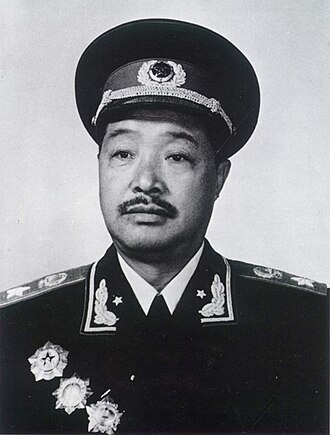
At a Glance
Sangzhi County: Poverty, the Tujia People, and an Outlaw Beginning
He Long was born on 22 March 1896 in a mountain village in Sangzhi County, western Hunan Province, in the homeland of the Tujia ethnic minority — one of China's non-Han peoples whose mountain territory straddled the borders of Hunan, Hubei, and Sichuan and whose culture maintained a fierce independent identity within the broader Chinese world. His family was poor by any standard: his father was a minor official in a secret society, and the family survived through subsistence agriculture and whatever additional income could be scraped from the local economy. There was no question of formal education beyond the most basic village schooling, and He Long grew up working — as a farm labourer, as a salt vendor working the trade routes through the mountain passes of western Hunan.
The salt trade introduced him to the world of the roads, to other young men in motion, to the informal networks of mutual aid and resistance that knit together the marginalised communities of the Hunan uplands. He acquired martial arts skills — a common accompaniment to the physically demanding life of mountain trade — and developed the physical toughness and practical intelligence that would characterise his military leadership. He was not a theorist. He was never going to be the kind of communist who wrote essays about dialectical materialism or spent years in Moscow absorbing Soviet orthodoxy. He was a man of the mountains and the roads, and the revolution he eventually embodied was one that made sense to the people of those mountains in immediate, material terms.
Two Kitchen Knives: The Legend of 1916
In 1914, He Long joined the Chinese Revolutionary Party — the organisation of Sun Yat-sen — at a moment when Yuan Shikai had dissolved the National Assembly, suppressed the parliament, and was moving to restore monarchical government. The resistance to Yuan Shikai across China was widespread and largely informal — local armed groups, secret society militias, and bandit formations with varying degrees of nationalist or reform motivation all contributed to a turbulent landscape of rebellion. He Long's entry into this world came in 1916 in circumstances that became the founding legend of his revolutionary career.
Local government tax assessors arrived in He Long's district to collect payments that the community regarded as extortionate and illegitimate. He Long, with no military weapons available, used the kitchen knives to hand to disarm the officials — seizing their weapons — and with those weapons organised a small armed group that he named the Republic Protection Army, nominally in opposition to Yuan Shikai's attempted monarchical restoration. The story spread through the district and beyond: a young man from the poor mountain people who had taken on the tax collectors with kitchen knives and won. The legend was born. Its power lay not in its military significance — the action was small, local, and immediately practical — but in what it communicated about the man: that he would do what needed doing with whatever was at hand, and that he would not be stopped by the absence of the conventional tools of power.
He Long continued building armed forces in western Hunan through the years of the warlord period, gradually expanding his organisation and reputation. By the time he joined the Northern Expedition of 1926 — the Kuomintang's military campaign to unify China under nationalist government — he commanded the 15th Separate Division and then the 20th Corps of the National Revolutionary Army, forces that had fought through Hunan and into the centre of the country under his personal leadership. Chiang Kai-shek valued his forces sufficiently to give him senior command. He Long's loyalties, meanwhile, were moving steadily leftward: he joined the Chinese Communist Party in late 1926, concealing his membership while maintaining his position in the Nationalist military hierarchy.
The Nanchang Uprising: 1 August 1927 and the Birth of the PLA
The Shanghai Massacre of April 1927 — Chiang Kai-shek's violent purge of Communists and left-wing activists from the cities, which killed thousands and shattered the First United Front — made He Long's situation, as a covert communist in a Nationalist army, immediately untenable. The Communist Party's response was to plan an armed uprising in Nanchang, the capital of Jiangxi Province, using the military units it could still command. The planning was coordinated by Zhou Enlai and involved He Long, Zhu De, Ye Ting, and others. He Long — commanding the 20th Corps, the largest single force available — was designated commander-in-chief of the uprising.
On the night of 31 July/1 August 1927, He Long's forces and those of his co-commanders seized Nanchang in a coordinated assault that took the city with manageable casualties and established, briefly, a revolutionary government. The date — 1 August — became the founding date of the People's Liberation Army, and it is He Long's most enduring contribution to Chinese revolutionary history that August 1st is the PLA's birthday because the commander-in-chief of the action that created it was He Long. The uprising could not be sustained: Nationalist counter-attacks forced a withdrawal southward within days, and the communist forces suffered devastating casualties in the two months of fighting that followed. Of the 24,000 troops who went into Nanchang, only around 2,000 survived to fight for the Communists in subsequent years.
He Long escaped south to Guangdong after the collapse, having joined the CCP formally on the day of the uprising. The party offered him the opportunity to study in the Soviet Union — the standard pathway for cadres requiring ideological and military training — and he turned it down. He returned instead to his home territory in Hunan, which was both a testament to his roots and a practical strategic decision: he knew the land, the people, and the networks of the western Hunan mountains in a way that made him effective there in a way that any party-assigned commander from outside would not be.
Building the Western Hunan-Hubei Soviet
From 1927 to 1934, He Long built the Western Hunan-Hubei Revolutionary Base and Soviet — carving out liberated territory in the mountain country he knew best, expanding his forces from a few hundred survivors to an army of tens of thousands, and organising the peasant communities of the area into the administrative and military structures of a revolutionary state-within-a-state. Chiang Kai-shek posted a reward of 100,000 silver dollars for He Long's capture — a measure of how seriously the Nationalist government took the threat his base posed — and dispatched successive encirclement campaigns to destroy it.
The human cost to He Long's family was catastrophic. His father, in the language of the revolutionary hagiography, died for the cause; five of his brothers and sisters also died in the revolution, killed by Nationalist forces pursuing the family connections of the man the government had branded an outlaw. The price extracted from rural families whose sons and daughters had chosen the revolutionary side was often paid in blood by those who had not, and He Long's family paid it heavily. He continued fighting.
When Kuomintang forces intensified their encirclement campaigns in 1932, He Long's forces abandoned their Hunan-Hubei bases, moved southwest, and established new positions in Guizhou. In 1934, Ren Bishi arrived with the remnants of his own forces after his soviet had also been overrun, and the two commanders merged their armies — He Long taking military command, Ren serving as political commissar — creating the Second and Sixth Corps of the Red Army that would form the nucleus of the Second Front Army on the Long March.
The Long March: The Only Army That Grew
He Long's Long March began in November 1935, over a year after Mao Zedong and the First Front Army had departed Jiangxi — the delay reflecting the independent operational situation of the Second Front Army, which was fighting its own encirclement campaign rather than retreating with the main force. From November 1935 through October 1936, He Long and Ren Bishi led their forces through some of the most difficult terrain of the entire Long March — the mountains and highlands of Guizhou, Yunnan, and Sichuan, crossing the Jinsha River, joining forces with the Fourth Front Army in Ganzi, Sichuan, and eventually reaching Shaanxi to link up with Mao Zedong by the end of 1936.
The most remarkable military fact about He Long's Long March is that his forces were the only Red Army column whose numbers increased rather than decreased during the march. The First Front Army that left Jiangxi in October 1934 numbered approximately 86,000; of those, perhaps 8,000 survived to reach Yan'an. He Long's Second Front Army arrived in Shaanxi in better shape than it had departed Hunan — the combination of He Long's recruiting ability among the minority and peasant communities of western China, his logistical adaptability in mountain country, and his ability to maintain unit cohesion under sustained pressure producing a result that no other commander of the Long March could match.
The Anti-Japanese War and the 120th Division
When the Red Army was reorganised into the Eighth Route Army for the Second United Front against Japan in 1937, He Long was given command of the 120th Division — one of the three main divisional commands of the Eighth Route Army, alongside Liu Bocheng's 129th and Lin Biao's 115th. He settled his division in northwestern Shaanxi and established the Shanxi-Suiyuan Base Area, conducting operations against Japanese forces throughout northwestern Shanxi that combined conventional harassment of Japanese supply lines with the construction of a comprehensive guerrilla base organisation in the occupied countryside.
His most effective operations of the Japanese war period were the battles of Qihui and Chenzhuang, in which his forces ambushed and destroyed Japanese columns attempting to pacify the base area, and the broader campaign to establish and defend the Shanxi-Suiyuan region as a communist-administered territory that the Japanese found impossibly expensive to suppress. By 1943 he commanded all Communist forces across several provinces. By the end of the war in 1945, He Long's total forces under command had grown to approximately 175,000 troops — a measure of the expansion of Communist influence in the north during the years of the Japanese occupation, and of He Long's particular effectiveness as a recruiter and organiser in the rural communities where the war's burden fell most heavily.
Post-Liberation: Sports, Government, and the Coming Storm
After the Communists' victory in 1949, He Long served in a variety of military and civilian roles in the southwest — as commander of the Northwest Military Region, as director of the Xi'an Military Control Committee, and as a member of the CCP Central Committee elected at the Seventh Congress in 1945. He was named one of the Ten Marshals of the People's Liberation Army at the inaugural rank conferral in September 1955. He served as Vice Premier of the State Council.
His most unusual post-liberation assignment was as the director of China's national sports and physical culture programme — a position he held from 1952 until the Cultural Revolution. He Long threw himself into it with the same energy he had brought to everything else: organizing the First National Games in 1959, overseeing the expansion of competitive sport across Chinese provinces, and building the international sporting programme that would eventually produce China's emergence as a global athletic power. The appointment seemed incongruous for one of the revolution's most celebrated warriors, but He Long's approach — combining organizational drive with genuine enthusiasm for physical competition — made him an effective sports administrator in the same way that his mountain origins had made him an effective guerrilla commander: he understood the human dimensions of physical endeavour in ways that more bureaucratically minded officials did not.
The Cultural Revolution: A Soldier's Ignoble End
The Cultural Revolution destroyed He Long through the agency of Lin Biao — the former PLA commander who had risen to become Mao's designated successor and who viewed He Long, with his independent base of support within the military and his personal relationship with Peng Dehuai (already purged), as a threat to his own position. Lin Biao's faction targeted He Long with accusations of anti-party activity, Kuomintang connections, and counter-revolutionary conspiracy — the standard vocabulary of Cultural Revolution purges — and the accusations, unsupported by evidence but sufficiently amplified by the political pressure of the moment, were sufficient.
He Long was removed from his positions in 1966, subjected to struggle sessions and public humiliation, and denied the medical care his deteriorating health required. He was a diabetic who needed insulin to survive; his persecutors ensured he could not receive it. He died in Beijing on 9 June 1969, alone, in a hospital where the treatment that could have sustained his life was deliberately withheld. He was seventy-three years old. The man who had survived two kitchen knives, the Nanchang Uprising's 50 per cent casualties, years of encirclement, the Long March, the Japanese war, and the Civil War was killed by the deliberate denial of a medication that had been available for nearly fifty years.
He was posthumously rehabilitated — his reputation restored, his persecutors condemned — after Mao's death and the arrest of the Gang of Four in 1976. A bronze statue nine tonnes in weight stands in the square of the He Long Garden Mausoleum at Tianzi Mountain, Hunan — in the mountain country where he grew up, among the people whose cause he never left. He is buried there, in the landscape that made him.