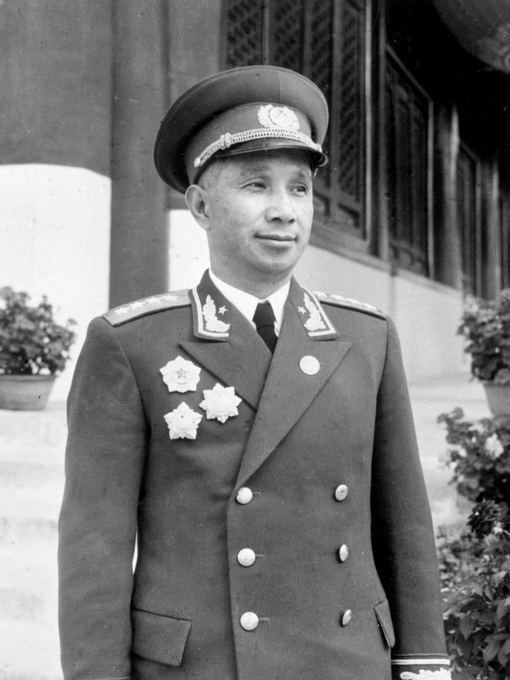
At a Glance
Huitong County: Dong Origins, Farming Family, and the Normal School
Su Yu was born on 10 August 1907 in Huitong County, in the southwestern corner of Hunan Province where the hills roll toward the Guizhou border and the ethnic Dong people — one of China's largest non-Han minorities, traditionally known for their elaborate wooden drum towers and polyphonic singing — maintained a distinct cultural presence alongside the Han majority. Su's family was Dong by ethnicity, though Su later identified as Han — a choice common among Dong who integrated into the broader Han administrative and educational systems. The family farmed thirty mu of inherited land, subsisting without comfort but without destitution. Su was the third of six children.
By eighteen, he had entered the Hunan Provincial 2nd Normal School at Changde — an institution with a strong tradition of producing politically engaged students — where he joined the Communist Youth League in 1926 and the Communist Party in 1927, at the moment of the party's most acute crisis: the collapse of the First United Front and Chiang Kai-shek's bloody purge of Communists from the Nationalist movement. He participated in the Northern Expedition before the split, then joined the Nanchang Uprising of 1 August 1927 — the founding moment of the People's Liberation Army — alongside He Long, Zhu De, and Chen Yi. He was twenty years old.
Staying in the South: Guerrilla War Without a Long March
Su Yu served in the Jiangxi Soviet during the early 1930s, commanding guerrilla units and developing the tactical instincts for mobile warfare and encirclement that would define his entire career. When the Long March began in October 1934, he did not go with the main force — he was assigned, along with Chen Yi, to remain in southern China and continue guerrilla resistance while the main Red Army retreated to the north. This assignment — holding the rear, buying time, sustaining a Communist presence in territory that the Nationalists were methodically sweeping — was one of the most dangerous in the revolution's history, and the years Su spent conducting guerrilla operations in Zhejiang, Fujian, and Jiangsu with shrinking forces and no external support shaped his tactical philosophy at its foundations.
He was seriously wounded during this period: shrapnel fragments from an explosion lodged near his brain, and the injury would prove medically significant twenty years later when Mao selected him to command China's forces in Korea and the shrapnel caused neurological episodes that made him unfit for the command. The fragments were never safely removable given the technology of the era, and Su carried them for the rest of his life — a physical memento of the guerrilla years in the southern hills that had made him the commander he became.
New Fourth Army: Building the Guerrilla Legend
When the Second United Front reunited Communists and Nationalists against Japan in 1937, Su Yu joined the New Fourth Army — the Communist force designated for operations in central China's lower Yangtze region — and established himself rapidly as one of the most effective battlefield commanders in the revolutionary movement. Operating in Jiangsu and Zhejiang in the shadow of the Japanese occupation, he developed a distinctive approach to guerrilla warfare that emphasised aggressive action over passive evasion, seeking to destroy isolated enemy units rather than simply avoiding contact, and building the base areas through demonstrated military effectiveness rather than through political organisation alone. His reputation as the "Military God" — the commander whose forces always won, whose tactical intuition was uncanny, whose ability to sense the enemy's vulnerabilities before they were visible in the intelligence picture appeared almost supernatural — dated from this period.
By 1941 he commanded the New Fourth Army's 1st Division, and by the end of the Anti-Japanese War in 1945 he had extended Communist influence across large areas of Jiangsu that would become the operational base for the Civil War campaigns that followed. The discipline and quality of his forces — their ability to move quickly, concentrate rapidly, strike hard, and disperse before the enemy could bring superior numbers to bear — reflected years of refinement under his command and set the standard that the East China Field Army would maintain through the Civil War.
The Central Jiangsu Campaign: Seven Victories Against Four-to-One Odds
The Civil War resumed in June 1946, and Su Yu's response to its opening phase produced one of the most celebrated military achievements in PLA history. In July 1946, operating in central Jiangsu with approximately 30,000 Communist troops, he faced an offensive by Nationalist forces numbering approximately 120,000 — four-to-one odds, and the Nationalist forces were equipped with American weapons, vehicles, and communications equipment that the Communist units could not match. Over 46 days in July and August 1946, Su Yu fought and won seven separate engagements against different elements of the Nationalist force, capturing or killing approximately 53,000 enemy soldiers while sustaining much lighter casualties himself.
The Central Jiangsu Campaign reversed the conventional military wisdom about the Civil War's likely trajectory. Nationalist commanders had expected that their material superiority would be decisive; Su Yu demonstrated that material superiority was not a substitute for tactical intelligence, speed of movement, and the ability to concentrate overwhelming force at a chosen point before the enemy could adjust. The successes of the campaign persuaded Mao Zedong to shift Communist military strategy from the traditional defensive guerrilla approach — waiting for the enemy to overextend, then striking — toward a more mobile and eventually conventional approach that sought to destroy Nationalist military units in open-field engagements. Su Yu's battlefield results had changed the party's strategic thinking.
Menglianggu: Destroying the Nationalist Elite
In May 1947, Su Yu directed the Menglianggu Campaign in Shandong — an encirclement battle that destroyed the Nationalist army's most prestigious formation. The 74th Reorganised Division was Chiang Kai-shek's finest unit: American-equipped, American-trained, veteran of the Burma Campaign, commanded by the aggressive and capable General Zhang Lingfu, and regarded as the elite of the Nationalist military establishment. It had been deployed to Shandong specifically to drive the Communist forces from the province.
Su Yu's forces caught the 74th Division on unfavourable terrain near the village of Menglianggu, cut its communications with adjacent Nationalist units, and conducted a three-day battle of encirclement and annihilation from 13 to 16 May 1947. The 74th Division — approximately 30,000 men — was destroyed completely. Zhang Lingfu was killed. No significant element of the division escaped. Chiang Kai-shek, who regarded the 74th Division as his best instrument, wept publicly on receiving the news. The battle demonstrated that the Communists could now destroy, rather than merely repel, Nationalist elite units in prepared defensive positions — a transformation in the correlation of forces that signalled the Civil War was approaching its decisive phase.
Proposing the Huaihai Campaign: The Plan That Won the Civil War
On 22 January 1948, Su Yu sent a telegram to the Central Military Commission proposing an operational plan for what would become the Huaihai Campaign. The plan was characteristically bold: rather than continuing to fight the Nationalist forces piecemeal in Shandong and Jiangsu, Su proposed concentrating the East China Field Army and the Central Plains Field Army commanded by Liu Bocheng and Deng Xiaoping for a massive encirclement operation against the Nationalist forces concentrated around Xuzhou — the major railway junction that anchored Nationalist military power in central China. The plan called for encircling and destroying multiple Nationalist army groups in a single coordinated campaign rather than engaging them one at a time.
The Central Military Commission — initially cautious about the operation's scale and complexity — debated and modified the plan before approving it. Su Yu was appointed acting field commander of the joint headquarters, with Chen Yi as political commissar. The campaign began on 6 November 1948 and ran for 65 days. In those 65 days, employing the sudden-concentrate, sudden-disperse strategy that Su had proposed and that the plan's joint headquarters executed, Communist forces destroyed or captured over 550,000 Nationalist troops — five army group headquarters, dozens of divisions — in a series of encirclement battles across the Huai River plain. Du Yuming, the overall Nationalist commander, was captured. Huang Baitao's Seventh Army was destroyed to the last man. The Twelfth Army was annihilated after weeks of desperate resistance. The Nationalist military capacity in central China effectively ceased to exist.
The Huaihai Campaign, together with the Liaoshen and Pingjin campaigns, decided the Chinese Civil War. Crossing the Yangtze followed in April 1949, with Su Yu commanding elements of the crossing force, and in May 1949 his forces entered Shanghai — the greatest city in China, taken with the deliberate discipline that Chen Yi, as mayor-designate, had insisted upon. Su Yu's daughter would later marry Chen Yi's youngest son.
Korea Denied: The Shrapnel Decides
When Mao Zedong decided that China must intervene in the Korean War in October 1950, his first choice to command the Chinese People's Volunteer Army was Su Yu — the assessment that Su was the finest tactical commander available was broadly shared within the senior leadership. Su began preparations for the Korean command. But the shrapnel fragments lodged near his brain from the guerrilla years in the 1930s triggered neurological episodes under the stress of preparation — headaches, dizziness, cognitive disruptions — severe enough to make it medically impossible for him to take the command. Peng Dehuai was appointed in his place. The exchange of commanders was one of history's more consequential medical substitutions: Su Yu's injury from twenty years earlier in the southern hills changed who fought the Korean War.
He served subsequently as Chief of General Staff of the PLA from 1954 to 1958, working on the institutional development of the military in the post-Korea period. In 1958 he was wrongly accused of "arrogance" and personal ambition — charges without serious evidentiary foundation but consistent with the factional politics of the late 1950s — and partially marginalised from the positions his abilities warranted. He survived the Cultural Revolution with less personal damage than many of his contemporaries, though he was not immune to the pressures of the period. In his later years he served as Vice-Chairman of the NPC Standing Committee and wrote his memoirs, which were published in the early 1980s and provided the most detailed inside account of the East China Field Army's operations available in Chinese.
He died in Beijing on 5 February 1984, at seventy-seven. He left instructions that his body should be cremated and his ashes scattered on the places where he had fought — the hills of southern Jiangsu and Zhejiang where he had conducted the guerrilla campaigns of the 1930s and 1940s, and the fields of the Huai River plain where the Civil War had been decided. The wish was granted. The Military God's ashes went back to the earth of his battles, which was perhaps the only memorial he had ever wanted.