At a Glance
Changsha Origins: The Orphaned Boy Who Chose "Military"
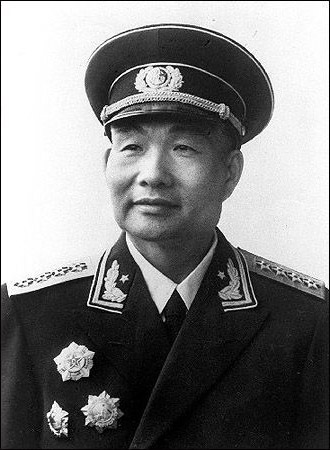
Xiao Jinguang was born on 4 January 1903 in Zhaozhou Port in Shanhua County — now part of Changsha — in Hunan Province, into a poor peasant family whose misfortunes compounded almost immediately. When he was barely two years old, his father and grandfather died within months of each other, leaving the household diminished in labour and income and dependent on whatever the surviving family members could scrape together from the land and from whatever additional work presented itself. It was a beginning that offered no material advantages and no obvious path toward the prominence he would eventually achieve.
He gained admission to Changsha Changjun High School in 1917 and was drawn into the political awakening of the May Fourth Movement in 1919 — joining student strikes, participating in the boycott of Japanese goods, and absorbing the anti-imperialist, nationalist fervour that was reshaping young Chinese political consciousness. By 1920 he had joined the Socialist Youth League of China, and in 1921 he was selected for study at the Communist University of the Toilers of the East in Moscow — the Comintern's training institution for revolutionary cadres from Asia.
The detail that sets Xiao apart from his cohort at this first Moscow study is the admission form. The registration document asked students to specify their desired occupation. Most young Chinese studying at the Moscow institution wrote something broadly political — party worker, organiser, propagandist. Xiao Jinguang, at eighteen, wrote a single word: "military." The clarity of the choice reflected something fundamental about his self-understanding that would remain consistent for the next sixty years. He was, from the beginning, a soldier. He joined the CCP in 1922, studied at the Oriental University and the Soviet Red Army School, and returned to China in 1924 to participate in the Northern Expedition as party representative of the Sixth Division of the Second Army.
The Leningrad Academy and the Falsely Charged Traitor
After the collapse of the First United Front and Chiang Kai-shek's 1927 purge of Communists, Xiao was sent again to the Soviet Union — this time to the Leningrad Political-Military Academy, one of the most prestigious military education institutions in the USSR, where he spent three years systematically studying military theory and operational planning at a level of formal rigour that only a handful of Chinese communist officers ever achieved. He returned to China in 1930 as one of the most formally educated military commanders in the revolutionary movement, equipped with the theoretical framework that his subsequent career as a builder of professional military institutions would require.
The crisis of 1933 nearly ended that career before it reached its most significant phase. The Jiangxi Soviet period was marked by intense factional conflicts between those trained in Moscow — labelled the "28 Bolsheviks" or "dogmatists" for their insistence on applying Soviet military orthodoxy to Chinese conditions — and those who favoured the more empirical, terrain-adapted approach that Mao Zedong and others were developing. In 1933, Xiao Jinguang was swept up in the "Luo Ming Line" persecution — a campaign against cadres accused of implementing the "opportunist" military line associated with Fujian party secretary Luo Ming. The charges against Xiao were fabricated; there was no credible evidence of political deviation. He was nonetheless convicted and sentenced to death.
Mao Zedong personally intervened to stop the execution. The precise circumstances of Mao's intervention have been recounted in slightly different ways in different sources, but the essential fact — that Mao blocked what would have been the judicial murder of one of the revolution's most capable trained military minds on the basis of false charges — is well attested. Xiao was stripped of his command positions and subjected to political supervision, but he survived. The episode left him with a specific and personal gratitude to Mao that deepened his already strong loyalty to the party chairman — and it left Mao with an awareness that this particular officer was both capable and personally indebted, a combination that would prove useful in the post-1949 period when Mao needed someone he could trust absolutely to build an institution from nothing.
Long March and Guarding Yan'an's Heartbeat
After the Zunyi Conference rehabilitated Mao's military authority and opened the possibility of review for those who had been falsely accused under the previous line, Xiao Jinguang's position gradually recovered. He participated in the Long March (1934–1935) and arrived at Yan'an with the main force, where he was assigned one of the most critical but least glamorous tasks of the Yan'an period: commanding the Eighth Route Army Stay Corps — the garrison force responsible for physically protecting the party's headquarters and the leadership cadres who gathered there.
The assignment sounds administrative; in practice it required constant operational alertness. Japanese aircraft began regularly reconnoitring Yan'an from 1938 onward, and Nationalist forces under Hu Zongnan maintained positions that threatened the border region's periphery throughout the war years. Xiao's Stay Corps — renamed and reorganised several times but always under his command — maintained security for the party centre while managing the complex political and military relationships with the Kuomintang formations nominally sharing the anti-Japanese mission. He also played a central role in the Nanniwan production campaign — the effort to make the Yan'an border region self-sufficient in food by opening new agricultural land — which Mao Zedong would later joke had kept the entire Yan'an base fed: "I have told you that in Yan'an, we eat by relying on you Xiao!"
Manchuria and the Civil War: Three Guarantees to Changchun
After Japan's surrender in 1945, Xiao Jinguang was initially ordered to the Shandong Military Region as deputy commander and chief of staff, but was redirected to Manchuria before taking up the posting — reflecting the supreme importance the party attached to securing the northeast before the Nationalists could consolidate control there. In October 1946, at a moment of critical danger when Nationalist forces were pressing hard in South Manchuria and the Communist position there was precarious, Xiao was ordered south as commander of the Liaodong Military Region, working alongside Chen Yun, to stabilise the situation.
The operations he conducted in the following months — the "four guarantees along the riverside" campaign series, fighting multiple engagements to hold the Communist position in South Manchuria while Luo Ronghuan and Lin Biao consolidated in the north — demonstrated the operational flexibility that his combined practical and theoretical military formation had produced. He subsequently commanded the besieging forces at Changchun, where extended siege operations combined with political work to persuade Nationalist garrison commanders produced the city's surrender with minimal fighting — what Xiao's biographer compared to the establishment of Hanzhong by Liu Bang, the founder of the Han Dynasty, suggesting that the achievement through strategic position rather than costly assault.
After the Beiping-Tianjin Campaign secured North China, Xiao's forces moved south for the Yangtze Crossing, subsequently liberated Wuhan, and entered Hunan — Xiao's home province — where the Hengbao Campaign against General Bai Chongxi's forces produced a striking result: over 50,000 Nationalist troops eliminated at a cost of approximately 4,000 Communist casualties. Bai Chongxi — nicknamed "Little Zhuge" for his tactical skill, after the legendary Three Kingdoms strategist Zhuge Liang — was driven to what Chinese military historians describe as desperation by the defeat.
October 1949: Mao's Dinner and a Navy Built from Nothing
In mid-October 1949, two weeks after the People's Republic was proclaimed, Mao Zedong summoned Xiao Jinguang to dinner. The conversation was brief and decisive: the party central committee had decided that Xiao would establish and command a navy for the new state. The challenge before him was extraordinary. The People's Liberation Army was a land force; it had no meaningful naval traditions, no established officer corps with maritime experience, almost no warships of any significance, no naval infrastructure beyond a scattering of former Nationalist vessels of uncertain condition, and no doctrine for how a communist Chinese naval force should be constituted, trained, or employed. What it had was Xiao Jinguang, his two Soviet military educations, and whatever the new state could provide from its stretched resources.
On 12 January 1950, Xiao was formally appointed Commander of the PLA Navy. The story of a new naval officer corps' formation captures the scale of the task: when Xiao went to recruit the first cohort of naval students, he reportedly had to explain to young soldiers what a navy actually was and why ships were needed. He simultaneously founded the Dalian Naval Academy — the first professional naval education institution in the People's Republic — and established the doctrinal framework for the new service.
His doctrine, articulated at the first PLA Navy conference in August 1950 and refined in subsequent years, was characteristically practical given China's resources and geography: the Navy should be an offshore defensive-offensive force built around submarines, torpedo boats, and mine warfare rather than capital ships. Fast, light, lethal at close range. The doctrine prioritised asymmetric capability over prestige tonnage — a calculated adaptation to China's industrial limitations and strategic circumstances that would shape PLAN development for three decades. In June 1956 he formally proposed the theory: "our work base on the existing power and focus on the air force, the submarine and the torpedo boat." It was a doctrine born of necessity that proved strategically sound.
Thirty Years of Building: Fleets, Academies, Nuclear Submarines
Xiao established the three operational fleets — the North Sea Fleet, East Sea Fleet, and South Sea Fleet — that divided maritime responsibility around China's coastline. In January 1955 he commanded the first PLA joint operation involving naval, air, and ground forces simultaneously, capturing Yijiangshan Island from the Nationalists — a significant demonstration of the new navy's combat capability. In September 1958 he led the naval and joint forces bombardment of Kinmen (Quemoy), the Nationalist-held island group near Fujian, in the Second Taiwan Strait Crisis — testing both combat capability and political nerve.
When Khrushchev withdrew Soviet technical advisers in 1960, tearing up equipment contracts and halting the transfer of naval technology that had been planned, Xiao directed the navy's continuation of its development programme under conditions of self-reliance — a parallel to what Nie Rongzhen was doing simultaneously with the nuclear weapons programme. The withdrawal of Soviet support was a severe setback; it was not fatal. The Chinese naval engineering teams, trained at the Dalian Academy and at Soviet institutions before the break, continued working. The programme that Xiao shepherded through these years of isolation eventually produced China's first nuclear submarine — a development he had advocated since the mid-1950s and that reached operational status in 1974.
Lin Biao attempted to marginalise him in 1962 — ostracising him from the defence establishment's inner circle in the factional manoeuvring that preceded the Cultural Revolution — but Xiao survived. During the Cultural Revolution itself, when Red Guards attacked PLA institutions, Mao Zedong reportedly declared that so long as he was alive, no one else would run the People's Liberation Army Navy — a personal endorsement that provided a degree of protection unusual among senior military figures of the period. The man Mao had saved from a firing squad in 1933 was being protected again, three decades later, in very different but equally personal terms.
Xiao Jinguang commanded the PLA Navy from January 1950 to January 1980 — thirty years, a tenure longer than Sergei Gorshkov's command of the Soviet Navy (1956–1985, twenty-nine years) and the longest continuous command of any major naval service in the world in the twentieth century. He served as Deputy Minister of National Defence from 1954 to 1982. He died in Beijing on 29 March 1989 of colon cancer, at eighty-six, and his ashes were scattered at sea — the land general who had spent thirty years building a navy consigning himself, in the end, to the element he had made his professional home.