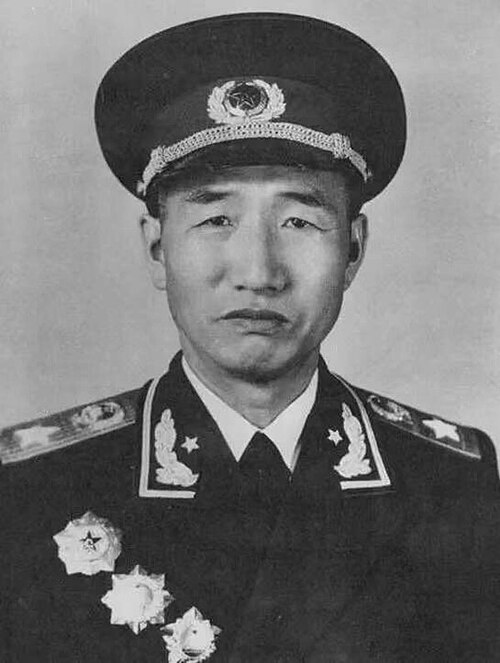
At a Glance
Wutai County: Scholar Father, Poverty, and the Schoolteacher Who Chose a Different Path
Xu Xiangqian was born on 8 November 1901 in Yong'an Village, Wutai County, Shanxi Province — in the northern heartland of China, far from the Hunan and Sichuan provinces that produced the majority of the revolutionary generation's military leadership. His father Xu Maohuai had passed the traditional imperial examinations, giving him the status of a classically educated Confucian gentleman even as the circumstances that had once rewarded such education were dissolving around him. The family background was nominally scholarly-gentry but materially modest; as Xu's biographers note, proximity to the wealthy Yan Xishan family — the warlord who dominated Shanxi politics for decades — did not translate into any shared prosperity for the Xu household.
Xu attended the Shanxi Provincial National Normal School, graduating in 1921, and briefly worked as a primary school teacher — reportedly losing his position after instilling patriotic and progressive ideas in his students that the school authorities found inappropriate. Against his parents' wishes, he travelled south to Guangzhou in 1924 to enrol in the first class of the Whampoa Military Academy. At the academy, Chiang Kai-shek reportedly looked at the quiet, unprepossessing student from Shanxi and told an associate that this ordinary young man would amount to little in life. Xu joined the CCP in the same year, served as a bodyguard for Sun Yat-sen during the Whampoa period, participated in the Northern Expedition in various officer roles from 1925 to 1927, and was present through the collapse of the First United Front. Chiang's assessment would prove to be one of the more spectacular misjudgements in modern Chinese military history.
The Fourth Front Army: 80,000 Against 300,000
Xu's operational military career began in earnest in the Oyuwan (Hubei-Henan-Anhui) Soviet, where he rose rapidly through command positions to become the first commander of the newly organised Fourth Front Red Army in January 1931. The force he took command of numbered approximately 20,000 troops — growing rapidly as the base area expanded and new recruits joined. Zhang Guotao arrived as the overall party leader of the Soviet later in 1931, bringing his own political authority and his own suspicions of the officers already established there. Zhang purged several top-level commanders he regarded as insufficiently loyal. Xu sided with Zhang — and watched Zhang have Xu's wife Cheng Jun executed in one of the same purges. He remained at his post.
The moral complexity of that decision has occupied historians ever since. Xu's loyalty to Zhang — maintained even as Zhang murdered Xu's wife — is explicable only in terms of the absolute subordination to party authority that the revolutionary generation's training had instilled, combined with the specific circumstances of a military commander in a war zone who understood that fragmenting the command structure would destroy the military effectiveness on which everything else depended. He continued to command. He continued to expand the Fourth Front Army. And he delivered results that made Zhang's factional brutalities worth enduring in purely military terms.
Forced westward from the Oyuwan base in 1932 by Nationalist pressure, Xu led his forces through a difficult breakout and established the Sichuan-Shaanxi Revolutionary Base — a vast new territory in the mountains between Sichuan and Shaanxi where the Fourth Front Army expanded to 80,000 troops by 1935. When the Sichuan warlord Liu Xiang organised a "six-route encirclement" using forces totalling over 300,000 against the Communist base, Xu commanded the defence — and won. The Wanyuan Defence Battle of 1934, in which his forces held mountain positions against wave after wave of attacks by forces four times their size, stands as one of the most tactically impressive defensive operations in the Red Army's history. Liu Xiang issued what Chinese sources call "six kill orders" to terrorise the defenders into submission. The defenders did not submit.
The Long March Split: The Decision That Saved the Revolution
In June 1935, as Mao Zedong's First Front Army — exhausted, reduced from 86,000 to perhaps 10,000 survivors by the Long March — staggered into Sichuan and made contact with Xu's Fourth Front Army at Maogong, the encounter between the two forces was the meeting of two very different revolutionary worlds. Mao's force was a remnant; Xu's was an army. The Fourth Front Army's soldiers were well-fed, well-armed by the standards of the Red Army, and numerous. The Central Committee contingent that arrived with Mao was diminished and desperate.
Zhang Guotao recognised in this moment an opportunity to assert his own authority over the unified force — and, by extension, over the party's direction. At the Brasang Conference in September 1935, after weeks of manoeuvring, Zhang insisted on directing the combined force southward and westward rather than continuing north to Shaanxi as Mao's Central Committee insisted. Zhang established a rival "second central committee" to Mao's leadership. And at some point during this factional split, Zhang issued orders for the Fourth Front Army — which Xu commanded — to move against Mao's forces. Xu refused. The precise circumstances of the refusal are reconstructed from participant accounts and are not entirely consistent in their details, but the essential fact — that Xu Xiangqian refused to turn his forces against the Red Army's own central leadership — is clearly established. His refusal prevented what could have been a catastrophic and possibly fatal civil war within the revolutionary movement, and it was remembered by Mao Zedong with lasting gratitude.
Ye Jianying, who served as Xu's Chief of Staff, went further: he defected to Mao's forces, secretly taking the military maps of the combined army with him — giving Mao's group the intelligence advantage that secured their northern escape. Xu did not defect, remaining with Zhang's Fourth Front Army through its subsequent westward movement and the catastrophe that followed, but his refusal to fire on Mao's forces was the moral line he held when it mattered most.
The West Route Army Catastrophe and the Long Path Back
The westward movement of Zhang's forces — which eventually became the West Route Army crossing the Yellow River into the Hexi Corridor — was the disaster that Li Xiannian also survived, though from a different command position. Xu Xiangqian was present as the overall military commander of the West Route Army as it was progressively destroyed by the Ma clique Muslim cavalry in the mountains and deserts of Gansu. Of the 21,800 who crossed the Yellow River, the great majority were killed, captured, or scattered. Xu survived with a small remnant, making his way back to Communist-controlled territory under conditions of extreme adversity.
At Yan'an, the political reckoning was unavoidable. Those who had followed Zhang Guotao — including Xu — were required to make self-criticisms of varying degrees of severity. Xu made his self-criticism, acknowledged the errors of the Zhang Guotao line, and was accepted back into the party's mainstream — though in a position substantially below what his military record otherwise warranted. The rehabilitation was genuine but slow; the taint of association with Zhang's deviation took years to dissipate, and Xu's assignments during the Anti-Japanese War reflected the wariness with which the party leadership managed his reintegration. He served in several different commands — briefly with Luo Ronghuan in Shandong building base areas, then as deputy commander of He Long's United Defence Army — without receiving a command commensurate with the abilities he had demonstrated in Sichuan.
Civil War Redemption: Liberating Shanxi
The resumed Civil War gave Xu his opportunity for operational redemption in the region he knew best. In 1947 he was assigned command of the Shanxi-Hebei-Shandong-Henan Military Region's forces in Shanxi itself, conducting the campaigns that progressively rolled back the Nationalist and Yan Xishan forces from the province where Xu had been born. The Jinzhong Campaign of June–July 1948 — one of the most rapid manoeuvre operations of the entire Civil War — saw his forces advance over 400 kilometres in 29 days, destroying 100,000 Nationalist troops in the process. The Taiyuan Campaign of 1948–49 completed Shanxi's liberation, capturing the heavily fortified provincial capital that Yan Xishan had defended for months with American-trained forces.
The liberation of Taiyuan had personal dimensions that went beyond the military: this was Xu's home province, the land where he had been a schoolteacher and where his revolutionary journey had begun. After the fall of Taiyuan he served as PLA Chief of General Staff from 1949 to 1954 — the military's highest professional post — before handing over to Su Yu. He was named one of the Ten Marshals in September 1955, the only one among them from northern China, a distinction that reflected the revolution's geographic centre of gravity but also the specific circumstances of Xu's career path through Shanxi and Sichuan rather than the Hunan-Jiangxi heartland where most of his comrades had begun.
Cultural Revolution, Protecting Deng, and the End of an Era
Xu participated in the February Countercurrent of 1967 — the collective confrontation by senior marshals against the Cultural Revolution's excesses — and was subsequently required by Mao to make self-criticism and take a leave of absence. He survived the Cultural Revolution with fewer personal injuries than many of his contemporaries, in part because of the residual institutional protection that senior military ranks provided and in part because his relatively low political profile made him a less attractive target for the factional violence that destroyed more prominent figures.
In 1976, when the Gang of Four orchestrated the second purge of Deng Xiaoping following Zhou Enlai's death, Xu Xiangqian was among the military figures who provided Deng with protection — ensuring he was not imprisoned and that his physical safety was maintained until Hua Guofeng's coup against the Gang of Four in October 1976 changed the political landscape. Xu supported that coup actively. He served as Minister of National Defence from 1978 to 1981, led the military preparations for the Sino-Vietnamese War of 1979, and continued in Politburo and Central Military Commission roles until his formal retirement in 1985 at the age of eighty-three.
In 1978, during a demonstration of the Chinese HJ-73 anti-tank missile, the weapon malfunctioned and turned 180 degrees after launch — flying back toward the observation platform where Xu and other senior officers were watching. The missile landed directly in front of the platform without exploding; Xu and the other officers survived by a margin of metres. He had survived a firing squad, the Long March, the West Route catastrophe, the Cultural Revolution, and political purges. The malfunctioning missile found him equally impervious.
His last public political act came in June 1989, at the age of eighty-seven, when he and Nie Rongzhen — the two longest-surviving members of the founding military generation — published a statement calling for civil order during the Tiananmen Square protests while explicitly warning that the People's Liberation Army should not resort to bloodshed to suppress the demonstrations. The statement, published while the final decision about military intervention was being made, was overridden by the civilian leadership. The tanks moved. Xu died the following year, on 21 September 1990, at eighty-eight. His memoir, Retrospection of History, remains one of the most candid and detailed accounts of the revolution's military campaigns written by any of its principal participants.