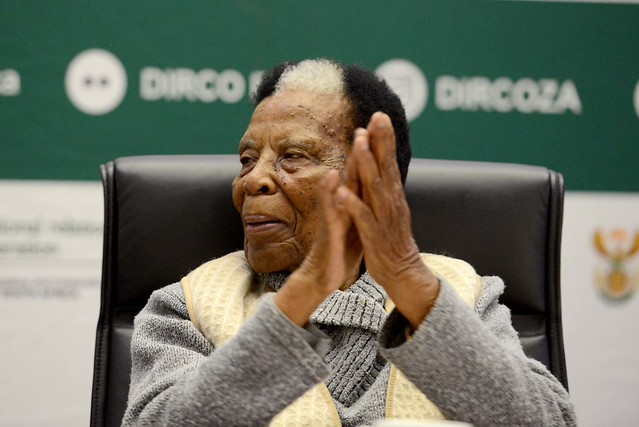
Gertrude Shope, President of the ANC Women's League in exile from 1981 to 1990, photographed during her years of liberation movement work abroad. Shope led the Women's League through its most significant period of development in exile and worked to ensure that women's rights remained central to the ANC's programme.
South Africa · Africa

Gertrude Shope

Gertrude Shope was born in 1925 and spent her adult life in the liberation movement — first inside South Africa with the ANC Women's League, then in exile after her husband Mark Shope, a significant ANC and SACP figure, went underground and eventually into exile. The exile years, which stretched from the early 1960s to the unbanning of the ANC in 1990, were spent in multiple African countries and in the broader networks of the ANC's external mission, maintaining the Women's League's organisational existence and developing its political programme in conditions that exile imposed: the constant movement between countries, the limited resources, the distance from the communities and the struggles that the League was supposed to serve. She was elected President of the ANC Women's League in exile in 1981 and served in that role until 1990, leading the League through its most significant period of external development — the years when the internal resistance was building through the United Democratic Front, when the international anti-apartheid movement was at its height, and when the question of what the liberation movement would commit to on women's rights in the post-apartheid order was being actively contested within the ANC's own structures. She argued, consistently and persistently, that women's liberation was not a secondary question to be addressed after political democracy had been achieved, but an integral part of what liberation meant — the same argument that Fatima Meer was making in Durban, that Albertina Sisulu was embodying in the UDF, and that the Women's League's eventual formal equality commitments were the institutional expression of. She returned to South Africa in 1990, was elected to the ANC's National Executive Committee, and served as an ANC MP after 1994. She died in 2019 at the age of ninety-four.

South Africa ANC Women's League African National Congress ANC External Mission Women's Liberation Anti-Apartheid Exile

Born: 1925, South Africa  |  Died: 2019, South Africa — aged ninety-four; ANC Women's League president in exile 1981–1990; ANC MP after 1994

At a Glance

Full NameGertrude Shope, born 1925; married to Mark Shope, a significant ANC and SACP leader who was himself a central figure in the liberation movement's external mission; the Shope household was embedded in the ANC's exile community across multiple African countries, and Gertrude's leadership of the Women's League was conducted within the broader context of the ANC's external mission under Oliver Tambo's leadership
Born1925, South Africa; became involved in ANC Women's League politics before going into exile; the specific details of her pre-exile political formation are less thoroughly documented than her exile career, partly because the Women's League's internal South African work in the 1950s and early 1960s has been less systematically documented than the external mission's activities
Died2019, South Africa, aged ninety-four; she had outlived the liberation struggle by twenty-five years and had lived to see the post-apartheid South Africa take shape — with its formal constitutional commitments to gender equality, its Women's League structures that she had helped to build, and its ongoing failures to address the structural conditions that made women's liberation incomplete; her death was mourned by the ANC Women's League and by the broader women's movement that recognised in her a foundational figure whose work in exile had shaped the formal commitments the movement made
ANC Women's League PresidentElected President of the ANC Women's League in exile in 1981; served until 1990 when the ANC was unbanned; her presidency covered the most significant period of the League's external development — the years when it was developing the political programme on women's rights that would eventually influence the ANC's constitutional positions and the post-apartheid South Africa's formal commitments to gender equality; she was elected to the ANC's National Executive Committee after the unbanning
Exile WorkSpent over two decades in exile in multiple African countries as part of the ANC's external mission; maintaining the Women's League's organisational existence in exile required sustained effort in conditions of limited resources, constant movement between host countries, and the difficulty of staying connected to the communities and struggles the League was supposed to serve; the League's exile work produced political documents, organisational structures, and personal networks that shaped the Women's League's character after the transition
Women's Rights AdvocacyConsistently argued within the ANC's exile structures that women's liberation was integral to the liberation struggle rather than secondary to it; her advocacy contributed to the ANC's gradual adoption of more explicit commitments to women's equality — the ANC's Constitutional Guidelines of 1988, which Albie Sachs helped draft, included explicit commitments to non-sexism alongside non-racialism, and this inclusion reflected the sustained pressure from the Women's League and its leadership on the ANC's male-dominated executive
Return and ParliamentReturned to South Africa in 1990 following the unbanning of the ANC; was elected to the ANC's National Executive Committee at the organisation's first post-unbanning conference; served as an ANC MP after the 1994 elections; her parliamentary career brought her formal institutional recognition of the decades of liberation movement work she had contributed, though the recognition came at an age when she had already given most of what she had to give

The ANC Women's League and the Challenge of Exile Organisation

The challenge of maintaining the ANC Women's League as an organisational entity in exile — across multiple African countries, with limited resources, separated from the communities the League was supposed to serve, and operating within the broader structures of the ANC's external mission under Oliver Tambo's leadership — was one that required both organisational skill and sustained personal commitment. The external mission's primary focus was on maintaining the ANC's international presence, building the diplomatic relationships that eventually produced the global anti-apartheid movement, managing the movement's military training and personnel, and sustaining the political and ideological coherence of a banned organisation across multiple decades.

Within this framework, the Women's League occupied a position that required constant advocacy to maintain. The ANC's exile leadership was predominantly male, and the tendency in male-dominated liberation movements to treat women's liberation as a secondary question — to be addressed after the primary political goals had been achieved — was a persistent pressure that the Women's League had to resist. Shope's presidency was partly about the straightforward work of maintaining the League's organisational existence and developing its political programme, and partly about the political work of ensuring that women's rights remained a visible commitment within the ANC's broader platform rather than being quietly subordinated to the more immediately urgent demands of the armed struggle and the constitutional negotiations.

The arguments she made — that women's liberation was integral to the liberation struggle, that non-sexism belonged alongside non-racialism as a foundational principle of the post-apartheid order, that the ANC's constitutional commitments had to explicitly address the conditions of women rather than leaving them to be addressed by a general commitment to equality — were arguments that the Women's League had been making since its founding, and that required sustained advocacy because the tendency to defer was constant and came from within the movement as well as from outside it.

The ANC Constitutional Guidelines and the Formal Commitment to Non-Sexism

One of the most important outcomes of the Women's League's sustained advocacy in the exile period was the inclusion of explicit non-sexism commitments alongside non-racialism in the ANC's Constitutional Guidelines of 1988 — the document that Albie Sachs and others drafted as the framework for the post-apartheid constitutional order. The Guidelines' statement that the post-apartheid South Africa would be a non-racial and non-sexist democracy was not a formulation that appeared automatically or without political effort. It was the product of sustained pressure from the Women's League and from the women activists across the ANC's exile structures who had been arguing for this inclusion.

Shope's leadership of the Women's League during the period when this advocacy was most important — the years from 1981 to the late 1980s when the ANC was developing the constitutional framework that would guide the transition negotiations — meant that she was directly involved in the political work that produced this outcome. The formal commitment to non-sexism in the 1988 Guidelines became the foundation for the post-apartheid Constitution's strong gender equality provisions and for the ANC's subsequent adoption of gender quotas for its leadership structures.

These institutional commitments have been imperfectly realised — the post-apartheid South Africa's high rates of gender-based violence, its persistent gender pay gaps, and the structural conditions that continue to subordinate women's opportunities to men's are evidence of how far the constitutional commitments remain from substantive equality. But the formal framework that makes those commitments possible — the constitutional provisions, the legislative structures, the Women's League organisations that continue to advocate for their implementation — was built partly through the sustained advocacy that Shope and her Women's League colleagues conducted through the exile years.

Return, the NEC, and the Parliamentary Career

Shope returned to South Africa in 1990, after more than two decades in exile, to a political environment that had been transformed by the internal resistance of the UDF years and by the international pressure that the anti-apartheid movement had built. She was elected to the ANC's National Executive Committee at the organisation's first post-unbanning conference — a formal institutional recognition of the work she had done in exile and of her standing within the ANC's leadership structures.

Her subsequent parliamentary career after 1994 brought her formal representation in the democratic South Africa that the liberation movement had helped to create — a recognition that her decades of work warranted, and that arrived at an age when she had already given most of what she had to give to the cause. She remained active in ANC structures and in the Women's League's work for several years after the transition, contributing the authority of her experience and the perspective of someone who had maintained the Women's League's commitments through the most difficult years of its exile existence.

Legacy

Gertrude Shope's legacy is partly the legacy of the Women's League's exile period — the decades of organisational work in difficult conditions that maintained the League's existence and developed its political programme in ways that shaped the post-apartheid commitments to gender equality. It is also the legacy of the sustained advocacy within the ANC's male-dominated exile structures that produced the formal commitment to non-sexism that the Constitutional Guidelines of 1988 and the post-apartheid Constitution embodied.

She died in 2019 at ninety-four, having outlived the liberation struggle by a quarter century and having lived to see both the formal constitutional commitments to gender equality that her work had helped produce and the persistent gap between those commitments and their full realisation. The gap is the unfinished business of her life's work, and closing it is the most appropriate tribute to what she spent those nine decades doing.

Also Profiled — South Africa

South Africa Albertina Sisulu ANC activist; United Democratic Front co-president South Africa Albie Sachs ANC lawyer; bomb survivor; Constitutional Court justice South Africa Bertha Gxowa ANC Women's League; 1956 Women's March; East Rand organiser South Africa Dorothy Nyembe ANC Women's League Natal president; MK operative; 15 years South Africa Emma Mashinini SACTU organiser; CCAWUSA founder; TRC commissioner South Africa Fatima Meer Sociologist; Mandela biographer; four-times banned; feminist South Africa Florence Mkhize ANC Women's League Natal leader; Durban organiser South Africa Frances Baard SACTU organiser; treason trialist; memoir author South Africa George Naicker NIC president; Congress Alliance organiser; Durban doctor South Africa Helen Joseph Women's march organiser; first house-arrested person in SA South Africa Ida Mntwana ANC Women's League president; pass laws campaigner South Africa Lilian Ngoyi Led 20,000 women to the Union Buildings, 1956 South Africa Lydia Kompe ANC Women's League and rural women's rights activist South Africa Nelson Mandela ANC leader; Rivonia trialist; first democratic president South Africa Nokukhanya Luthuli Wife and support of Albert Luthuli; activist in her own right South Africa Oliver Tambo ANC President-in-exile; kept the movement alive abroad South Africa Ray Alexander Simons Food and Canning Workers Union founder; SACTU; SACP South Africa Rita Ndzanga Railway workers union; detained and tortured by police South Africa Sophia Williams-de Bruyn Led women in the 1956 march; Women's League leader South Africa Thandi Modise MK guerrilla; ANC Women's League leader; ANC Deputy President South Africa Victoria Mxenge Human rights lawyer; assassinated by death squad 1985 South Africa Winnie Mandela ANC activist; Mother of the Nation; complex legacy
Share X Facebook WhatsApp LinkedIn