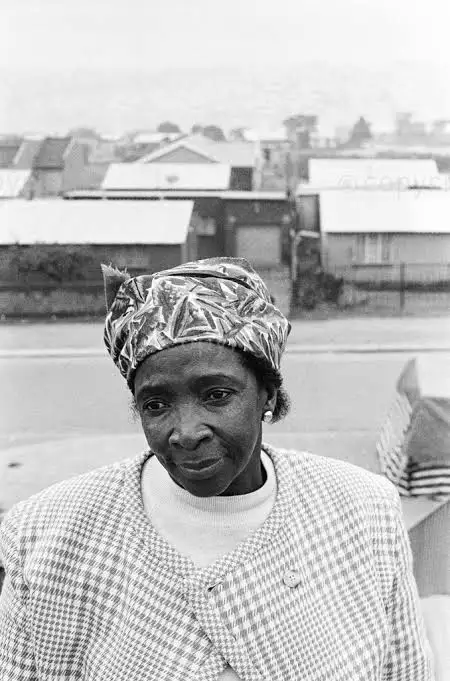
At a Glance
Johannesburg, Domestic Work, Garments, and the Discovery of Union Power
Emma Mashinini was born in Johannesburg in 1929 — in the city that was the economic heart of South Africa and one of the most socially complex and politically charged environments in the country. Her mother was a domestic worker, and the conditions of domestic service in white South African households were among the most exploitative in the apartheid economy: long hours, minimal wages, accommodation in backyard servants' quarters that combined housing with surveillance, and the complete absence of the labour rights and protections that the apartheid state reserved for white workers. Growing up in this environment gave Mashinini a direct personal knowledge of the specific conditions of working-class women under apartheid — knowledge that would eventually find expression in her union organising and her writing.
She left school at fourteen to support her family — a choice that was not unusual for working-class African girls in the Johannesburg of the 1940s, where the combination of inadequate schooling and immediate economic necessity made early school-leaving common. She worked in the garment industry, then in the retail sector, experiencing in both the specific conditions of Black women workers: wages that were lower than those of white women workers doing the same jobs, the absence of union representation, the vulnerability to arbitrary dismissal, and the daily indignities of the racial hierarchy that structured every workplace relationship.
Her encounter with SACTU — the South African Congress of Trade Unions — in the 1950s was transformative. SACTU's alignment with the Congress Alliance gave it a political dimension that went beyond industrial relations, connecting the workplace organising work to the broader liberation struggle's analysis of racial capitalism and the inseparability of economic and political liberation. For Mashinini, the union movement was not merely a vehicle for better wages and working conditions — though it was that — but a framework through which the conditions she had experienced directly could be understood as structural rather than inevitable, and through which collective action could begin to address them.
Building Unions in the Commercial Sector
The commercial and retail sector — the shops, restaurants, and hotels of South Africa's urban economy — was not the sector that first attracted the liberation movement's union organising attention. The mines and the heavy manufacturing industries, with their concentrated workforces and their central importance to the apartheid economy, were the primary focus of the labour movement's organising efforts through the 1950s and into the 1970s. The commercial sector's workforce was more dispersed, less concentrated in the large workplaces that made organising easier, and predominantly female — which meant that building union structures there required both organisational innovation and a willingness to address the specific conditions of women workers that the predominantly male union leadership did not always prioritise.
Mashinini brought both to the work. Her organising in the retail and commercial sectors through the 1960s and early 1970s — the years when SACTU had been banned and the new independent unions that would eventually become COSATU were being built — was patient, creative, and attentive to the specific conditions of the women who made up the majority of the sector's workforce. She understood that organising women workers required addressing the intersecting pressures of race, gender, and class that shaped their working lives, and that a union movement that addressed only the racial dimensions of exploitation while ignoring the gender dimensions would fail to represent a significant portion of its potential membership.
The founding of CCAWUSA in 1975 was the culmination of years of this organising work. The union brought together workers in the commercial, catering, and allied industries into an organisation with genuine collective bargaining power, and under Mashinini's general secretaryship it grew into one of the larger unions in the sector. Its eventual merger into SACCAWU and that federation's affiliation with COSATU connected the commercial sector organising that Mashinini had built to the broader labour movement coalition that was becoming one of the most powerful forces in the anti-apartheid struggle.
Detention, Solitary Confinement, and the Destruction of Memory
The detention of 1981 — Mashinini was arrested under the security legislation and held in solitary confinement for approximately six months — was both a personal catastrophe and, in its aftermath and its documentation, one of the most important testimonies to what the apartheid detention system did to human beings. The apartheid state's use of solitary confinement as a tool of political interrogation was systematic and calculated: isolation, the absence of human contact, the removal of all the sensory and social inputs that give human experience its continuity, were deployed not randomly but as instruments designed to produce psychological breakdown and thereby either information or incapacitation.
In Mashinini's case, the confinement produced an outcome that she describes in her memoir with a directness that is itself a form of political testimony: she emerged from detention having lost her memory of the period entirely. Not the selective amnesia of emotional trauma — though that was present — but a more fundamental disruption of the memory function itself, leaving her unable to reconstruct what had happened to her during those months. She knew she had been detained. She knew approximately how long she had been held. She had no recollection of the specific experiences of that time.
The memoir she wrote about this experience — Strikes Have Followed Me All My Life, published in London in 1989 — is one of the most significant personal documents of the liberation struggle. Its significance lies not primarily in the political events it describes, though those are important, but in the psychological honesty with which it addresses what the detention had done to her: the memory loss, the subsequent psychological damage, the difficulty of reconnecting with her family and her political work after emerging from a period she could not remember. It is a document that refuses the convention of political memoir — the narrative of suffering transcended and commitment renewed — in favour of something more honest: the acknowledgement that the state's violence had genuinely damaged her, and that the damage was real and lasting even as she continued to fight.
The Truth and Reconciliation Commission
Archbishop Desmond Tutu's appointment of Mashinini to the Truth and Reconciliation Commission in 1995 was both a recognition of her standing in South African civil society and an acknowledgement that the Commission needed among its members people who had direct personal experience of the violations it was investigating. Her detention, her memory loss, her subsequent years of processing what had been done to her — all of this gave her a knowledge of what apartheid's violence meant in the lived experience of the individual that no amount of testimony-reading could substitute for.
She served on the Commission through its main period of work from 1995 to 1998, participating in the hearings at which thousands of South Africans gave testimony about the gross human rights violations they had suffered or perpetrated, contributing to the Commission's analysis of the patterns and systems of apartheid violence, and bringing to the process the specific perspective of a woman whose working-class origins, union leadership, and detention experience gave her a view of the apartheid system that the Commission's other members, mostly from professional or academic backgrounds, could not fully replicate.
The TRC process has been both celebrated and critiqued in the decades since its completion — celebrated for creating a public record of apartheid's violations and for the genuine catharsis that the testimony process provided for many survivors, and critiqued for the way in which the amnesty process prioritised reconciliation over accountability and for the economic dimensions of apartheid's violation that it was unable to address. Mashinini's participation gave the Commission a direct connection to the working-class and women's experience of apartheid that helped ensure those dimensions were not entirely absent from its work.
Legacy
Emma Mashinini's legacy operates at several levels simultaneously. As a union leader she built the commercial sector union structures that became part of COSATU's power base and that gave hundreds of thousands of workers in the retail and commercial industries their first effective union representation. As a detention survivor she provided, through her memoir, one of the most important and honest accounts of what the apartheid state's detention system actually did to human beings — not the political framing of detention as a test of commitment, but the psychological reality of what isolation and the destruction of memory meant in one woman's life. As a TRC commissioner she contributed to the national process of reckoning with apartheid's violations. And as a figure who combined all of these roles across a working life that spanned six decades of struggle, she embodied the liberation movement's essential but often underacknowledged working-class women's tradition.
She died in 2018 at eighty-nine, having outlived apartheid by nearly a quarter century and having continued to speak and write and advocate throughout. The South Africa she left behind has honoured some of what she fought for — the political rights, the formal equality — and has yet to honour the rest. The economic transformation that her union work was directed toward, the closing of the gap between the wealthy and the poor that the liberation struggle promised, remains the unfinished chapter of the democratic project she contributed so much to building.