At a Glance
Mvezo and the Education of a Chief's Son
Nelson Rolihlahla Mandela was born on 18 July 1918 in Mvezo, a village on the Mbashe River in the Transkei — the southeastern region of South Africa where the Xhosa-speaking peoples had maintained their communities through the centuries of colonial conquest and dispossession. His father, Gadla Henry Mphakanyiswa, was a counsellor to the Thembu regent Jongintaba Dalindyebo; when Mandela's father died in 1927, the nine-year-old Rolihlahla was taken into Jongintaba's household to be educated and prepared for a role of leadership in Thembu society.
The education he received — at Clarkebury Boarding Institute, then Healdtown College, then Fort Hare University College — was the education that the mission school system provided to the small number of African children whose families had access to it: an education in the Western intellectual tradition, in English literature and history and law, that gave its recipients the tools of the European world while not necessarily providing a framework for understanding the African world they came from. Fort Hare, in the Eastern Cape, was the university that educated more leaders of African independence movements than any other single institution — it was where Oliver Tambo also studied, where Zimbabwean, Zambian, and other future leaders received their educations — and its intellectual and political culture shaped Mandela in ways that his subsequent legal career and his ANC activism built upon.
He came to Johannesburg in 1941, following a disagreement with the regent over a proposed marriage, and found himself in the city that was the industrial heart of South Africa and the centre of the liberation movement's most active organising. Walter Sisulu, who would become his closest political colleague and one of the most important relationships of his life, took him in hand — introduced him to the world of the ANC, helped him find work, and provided the political mentorship that connected the young man from the Transkei to the liberation movement that was developing in Johannesburg's townships.
The Youth League, the Law, and the Politics of Confrontation
The ANC Youth League that Mandela helped found in 1944 was the organisational expression of a generational impatience — the refusal of the younger generation of African political activists to accept the cautious, petition-based politics of the ANC's older leadership. The Youth League demanded mass action, confrontation, the politics of pressure rather than the politics of request. It produced the Programme of Action of 1949, which committed the ANC to strikes, boycotts, and civil disobedience, and the Defiance Campaign of 1952, which put the Programme of Action into practice and built the ANC's membership from under ten thousand to more than one hundred thousand in a single year.
Mandela was at the centre of this transformation — as volunteer-in-chief of the Defiance Campaign, as ANC Transvaal president, as one of the most prominent and most energetic figures in the movement's new generation. He was also, simultaneously, establishing his legal career — opening the first Black law firm in South Africa with Oliver Tambo, providing legal representation to political activists and to ordinary people navigating the apartheid legal system, building a professional identity alongside his political one.
The law gave Mandela something more than professional training: it gave him a framework for understanding the apartheid system's relationship to its own claimed principles of legality, and a vantage point from which the gap between the state's legal rhetoric and its political practice was most clearly visible. An apartheid lawyer saw every day how law could be used as an instrument of racial domination rather than of justice, and this daily experience of the law's corruption sharpened Mandela's understanding of what the liberation movement was fighting and why.
Underground, Arrest, and the Rivonia Trial
The Sharpeville massacre of 21 March 1960, in which police killed sixty-nine unarmed protesters in a township near Johannesburg, and the subsequent banning of the ANC and the PAC transformed the political landscape in ways that forced a fundamental strategic reassessment. Nonviolent protest had been met with lethal force. The organisations through which peaceful opposition was conducted had been made illegal. The government had demonstrated its willingness to use whatever violence was necessary to maintain its power.
Mandela went underground — operating clandestinely inside South Africa as the "Black Pimpernel," moving between safe houses, appearing and disappearing, maintaining the ANC's internal presence while evading the Security Branch that was hunting him. In 1961 he left South Africa clandestinely, travelling to other African countries and to Britain, meeting African leaders and building international support for the liberation movement. He received military training in Ethiopia. He was involved in the founding of uMkhonto we Sizwe — the armed wing that would conduct the sabotage campaign — and was its first commander-in-chief.
He was arrested in August 1962 in Natal, convicted of incitement and of leaving the country without a passport, and sentenced to five years. He was in prison when the security police raided Liliesleaf Farm and arrested the Rivonia leadership. He was brought from prison to stand trial with them. At the Rivonia Trial, in the statement from the dock that he read on 20 April 1964, he articulated the principles of the liberation movement with a clarity and a dignity that the apartheid state had intended the trial to destroy and that it instead immortalised. He was convicted and sentenced to life imprisonment.
Robben Island: The University and the Limestone Quarry
Robben Island maximum security prison, where Mandela began his sentence in June 1964, was designed to be the end of political careers — a place so remote, so controlled, so thoroughly isolated from the world that the people imprisoned there would cease to matter politically. The apartheid government believed that keeping Mandela and the other Rivonia prisoners locked away indefinitely would remove them from political circulation and allow the liberation movement to wither without its leadership.
The government miscalculated. Mandela and the other prisoners — Sisulu, Mbeki, Kathrada, Mhlaba, Mlangeni, Motsoaledi, Mlangeni, and others — maintained their political community on the island with a determination and a discipline that turned imprisonment into a different kind of political education. The Robben Island University — the informal political education programme that the prisoners organised among themselves — transmitted the liberation movement's political tradition to each new generation of prisoners. The ANC's authority and coherence, even in the conditions of its banning, was sustained in part by the continued presence and the continued engagement of its imprisoned leadership.
Mandela spent eighteen years in the maximum security section of Robben Island — in the quarry in the mornings, chipping limestone in conditions that damaged his eyes, in the cell at night with the few books the prison allowed. He was transferred to Pollsmoor Prison in Cape Town in 1982, and to Victor Verster Prison near Paarl in 1988. It was at Victor Verster that the secret negotiations with the National Party government began — quiet conversations, initially conducted through intermediaries and eventually directly, about the possibility of a negotiated end to apartheid.
The Negotiations: Bridging the Unbridgeable
The process through which Nelson Mandela and FW de Klerk negotiated South Africa's democratic transition was one of the most unlikely political achievements of the late twentieth century. In 1985 PW Botha had offered to release Mandela on the condition that he renounce violence; Mandela refused from his prison cell, his daughter Zinzi reading his reply to a crowd in Soweto in one of the most powerful political moments of the decade: "I cannot and will not give any undertaking at a time when I and you, the people, are not free. Your freedom and mine cannot be separated." When de Klerk succeeded Botha as State President in 1989, the conditions for a genuine negotiation began to develop.
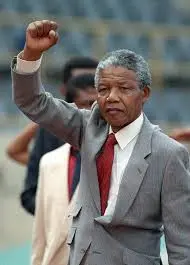
Mandela was released unconditionally on 11 February 1990. He was seventy-one years old. He had been in prison for twenty-seven years and six months. He walked out of Victor Verster Prison with his fist raised, and the watching world — the millions who had campaigned for his release for decades, who had worn "Free Mandela" t-shirts and signed petitions and marched — saw the man who had been the symbol of imprisoned resistance become, suddenly, a free person with a political future.
The negotiations that followed were long, difficult, and at times close to breakdown. The violence between ANC and IFP supporters in KwaZulu-Natal and on the Reef threatened to derail the transition. The assassination of Chris Hani in April 1993 nearly did. But Mandela's combination of strategic clarity, personal authority, and the kind of political magnanimity that comes from having already paid the ultimate personal price for one's convictions — twenty-seven years of imprisonment — kept the negotiation on track. The democratic constitution that emerged from the process was imperfect, as all negotiated documents are, but it was real, and it transferred genuine political power from the apartheid minority to the democratic majority.
The Presidency: The Single Term and the Symbolic Work
Nelson Mandela's presidency, from May 1994 to June 1999, was in one sense constitutionally normal — a democratic government administering a complex country with limited resources and enormous inherited problems — and in another sense entirely extraordinary, because the person at its head was a figure of global symbolic significance whose every public act carried meanings that extended beyond their immediate political content. The inauguration on 10 May 1994 in Pretoria — the administrative capital of the apartheid state, the city of the Union Buildings on whose steps the women had marched in 1956 — was the most visible expression of the transformation that the liberation movement had spent decades working toward.
His presidency was marked by the establishment of the Truth and Reconciliation Commission — Archbishop Desmond Tutu's commission that investigated the human rights violations of the apartheid era, heard testimony from perpetrators and survivors, and offered conditional amnesty for full disclosure — and by the adoption of the 1996 Constitution, which gave South Africa one of the most rights-protective constitutional frameworks in the world. The Reconstruction and Development Programme attempted to address the social backlash of apartheid in housing, health, and education, though its replacement by the Growth, Employment and Redistribution strategy in 1996 signalled a shift in economic direction that disappointed many in the liberation movement's left wing.
He served a single term, declining to stand for re-election despite the enormous political pressure — and the provision in the constitution that would have permitted a second term — to continue. The decision to serve one term and retire was itself a political act: a demonstration that the democratic institutions South Africa had built were more important than any individual, that the transition to democracy required the normalisation of democratic succession rather than the institutionalisation of any particular leader's indispensability.
Legacy: The Life That Became a Symbol
Nelson Mandela died on 5 December 2013, at the age of ninety-five, in Johannesburg. The mourning was global — a ten-day official period of mourning in South Africa, expressions of grief and tribute from governments and peoples across the world, a memorial service at the FNB Stadium in Soweto attended by more than ninety heads of state. The scale of the mourning reflected the scale of what his life had meant to people across the world — not only in South Africa, but to everyone who had followed the liberation struggle, who had campaigned for his release, who had taken from his example some inspiration for their own struggles against injustice.
The danger of global symbolic status is that it simplifies — that it reduces a complex human life with all its contradictions and difficulties to an icon, a symbol, a set of inspiring quotations detached from the historical context that gave them meaning. Mandela himself was aware of this danger and resisted it in his autobiography and in his public statements, insisting on the complexity of the struggle he had been part of and on the collective nature of the achievement that was attributed primarily to him.
The complete life — the Transkei chieftain's grandson, the Johannesburg lawyer, the Youth League firebrand, the underground operative, the Rivonia prisoner, the Robben Island prisoner-philosopher, the negotiator, the president, the elder statesman — is more interesting and more instructive than the icon. It is the life of a person who made choices, some of them difficult, some of them costly, and who maintained the central commitments of those choices through conditions that might have broken anyone. The commitment to non-racialism, the refusal to respond to racial oppression with racial hatred, the insistence on human dignity as a non-negotiable foundation of political life: these were not abstract principles for Mandela but lived convictions that he had paid twenty-seven years to maintain and that he demonstrated in every public act of his post-prison life.
South Africa's democratic constitution, its non-racial political culture, and the relatively peaceful transition from one of the most brutal racial systems in modern history to a constitutional democracy: these are the collective achievements of the liberation movement, and they are in part Nelson Mandela's achievement. The person and the symbol are, in the end, inseparable — because the person made themselves into the symbol through the choices they made and the costs they accepted, and the symbol is only meaningful because the person was real.