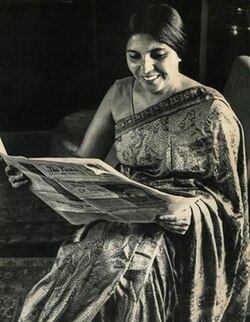
At a Glance
Durban, the Indian Congress Tradition, and an Intellectual Formation
Fatima Meer grew up in Durban in the specific intellectual and political milieu of the Natal Indian Congress's progressive wing — the wing that Gandhi's successors had pushed from the politics of Indian community interest toward the politics of non-racial liberation, and that by the 1940s was committed to the Congress Alliance's vision of a democratic South Africa belonging to all who lived in it. Her father Moosa Meer was a journalist whose work kept him connected to the politics of the Indian community and to the broader anti-colonial and anti-fascist currents of the war years, and growing up in this household gave Fatima both the political formation and the intellectual tools — the habit of analysis, the discipline of argument, the understanding that ideas mattered and had consequences — that would shape everything she subsequently did.
The University of Natal's non-European section — the segregated institution within the university that the apartheid system maintained for Black students — was both an insult and, paradoxically, a site of political formation. The insult was obvious: the existence of a "non-European section" was an assertion that Black students were not entitled to the same educational environment as white students, that they could be provided with inferior facilities and inferior resources while being told they were receiving the same education. The political formation was less obvious but equally real: by concentrating Black students in a single institution, by creating a space where they could meet and organise and discuss their conditions, the apartheid system had created exactly the kind of concentrated community of grievance and political consciousness that was the foundation of organised resistance.
Meer's encounter with sociology — the academic discipline that studies human social structures, institutions, and the conditions that maintain or transform them — gave her the theoretical framework for understanding what the apartheid system actually was: not a racial prejudice that could be addressed through individual attitude change, but a structural system of racial capitalism that was maintained by specific economic, legal, and political mechanisms and that required structural change rather than attitudinal reform. This analysis, developed through her academic work and deepened through her political engagement, shaped both her scholarship and her activism throughout her career.
Ismail Meer, the Mandela Connection, and the Durban Hub
Her marriage to Ismail Meer — a lawyer, ANC activist, and one of Mandela's closest friends from their student years together at the University of the Witwatersrand in the early 1940s — connected her directly to the ANC's national leadership in ways that her own NIC work had not. The friendship between Ismail Meer and Nelson Mandela dated from the period when the ANC Youth League was being formed and the Congress Alliance's non-racial character was being established, and it survived the decades of Mandela's imprisonment and exile to become one of the personal foundations of the relationship between the Meer household and the liberation movement's leadership.
The Meer household in Durban became a centre of the Natal liberation movement's intellectual and political life — a place where ANC leaders, NIC activists, SACP members, and the academics and professionals who supported the movement met, discussed, debated, and organised. The specific character of this household — its intellectual seriousness, its multi-racial character (Fatima and Ismail entertained across racial lines in ways that the Group Areas Act was designed to prevent), its connection to both the Indian Congress tradition and the broader ANC networks — made it a site of political formation for a generation of Natal activists who passed through it.
The connection to Mandela had specific consequences for Fatima's work. When she was approached about writing an authorised biography of the imprisoned leader in the mid-1980s — at a moment when the international campaign for his release was at its height and when a reliable, detailed account of his life was politically important — she had both the personal connections and the scholarly skills to do the work properly. She corresponded with Mandela in prison, interviewed family members and comrades, and drew on the network of relationships that the Meer household had built over decades to assemble the account that became Higher than Hope.
The Institute for Black Research and the Politics of Knowledge
The founding of the Institute for Black Research in 1973 was one of Meer's most significant contributions to the liberation movement — an institutional investment in the kind of scholarly knowledge that the movement needed to build effective programmes, to counter the apartheid state's ideological narratives with empirical evidence, and to document the conditions of Black South African life in ways that would sustain the international case against apartheid.
The Institute produced research on township conditions, on the social structure of Indian South African communities, on women's experiences under apartheid, on the economics of racial discrimination, and on the political organisation of the liberation movement. This research was not merely academic — it was deployed directly in the movement's political work, providing the factual foundation for the arguments that ANC representatives were making in international forums, giving the human rights organizations that supported the liberation movement the specific data they needed to make their case, and providing South African activists with the analysis that sustained their political work.
The politics of knowledge production in apartheid South Africa were not neutral. The apartheid state had its own research institutions, its own sociologists and economists who produced the intellectual justifications for the racial order — the ethnological studies that presented racial classification as natural rather than constructed, the economic analyses that presented the migrant labour system as mutually beneficial, the political science that presented Bantustan government as genuine self-determination. Meer's Institute was a counter to this apparatus — an institution committed to producing knowledge that served the liberation movement rather than the apartheid state, and that documented the reality of Black South African life rather than the ideological narrative the state preferred.
Four Bannings, the 1976 Detention, and the Price of Intellectual Activism
The apartheid government's response to Meer's work — four separate banning orders between 1952 and 1976 — was both a measure of the threat it perceived in her activities and a demonstration of the specific form of persecution that the apartheid state imposed on intellectuals and activists who were too prominent to simply imprison but too effective to leave unhindered. The banning orders restricted her movements, prohibited her from attending gatherings, prevented her from being quoted in the South African press, and limited her ability to conduct research and organise in the ways that her work required.
The 1976 detention — following the Soweto uprising in which students across South Africa rose up against the imposition of Afrikaans as a medium of instruction — came in the context of the most intense political crisis since Sharpeville. The security state was sweeping up activists across the country, and Meer was among those detained as the government moved against the networks of support for the student uprising. Her detention was relatively brief compared to those of some of her comrades, but it was experienced as part of the broader pattern of state violence against the communities and movements she had spent her life working with.
The response to each banning and each detention was characteristic of the woman: she continued working. The banning orders restricted the forms through which she could work but could not eliminate the work itself. She continued her research through the Institute, continued her writing, continued her political engagement through the networks and personal relationships that the banning orders could not entirely sever. The apartheid state's attempts to silence her produced a woman who became more rather than less determined to be heard.
Higher than Hope: Writing Mandela from Prison
The biography of Nelson Mandela that Meer wrote and published in 1988 — Higher than Hope: The Biography of Nelson Mandela — was not simply a literary achievement but a political act. Mandela had been imprisoned since 1964, and by the mid-1980s the international campaign for his release had made him the most recognisable symbol of the anti-apartheid struggle — a man whose face appeared on posters and walls across the world, whose imprisonment was the central demand of the global anti-apartheid movement, but whose actual life, ideas, and personality were known to most of the world only in outline.
Meer's biography filled this gap. Working through correspondence with Mandela in prison — conducted within the constraints and surveillance of the prison system, which monitored all of his communications — and through interviews with his family members, his comrades from the ANC Youth League, his Rivonia co-accused, and the broader network of the liberation movement, she assembled a detailed account of his life from his Transkei origins through the Rivonia Trial and into his imprisonment. The book was published internationally and translated into multiple languages, and its appearance at the height of the pre-release campaign gave it a political significance that went beyond its literary quality: it provided the international audience demanding Mandela's release with a full account of who they were demanding the release of, and why.
Mandela himself, in his acknowledgement of the biography, expressed the gratitude of a man who understood what the book had done for the campaign on his behalf. Meer's access to him and to the networks around him had been made possible by the specific relationships that her household and her political work had built over decades, and the biography was in a real sense the product of a lifetime of connection to the liberation movement rather than merely a journalistic commission.
Feminism, Triple Oppression, and the Unfinished Agenda
Meer's feminism was not a late addition to her political thinking but an integral dimension of her analysis from the beginning. She was one of the earliest and most persistent voices in the South African liberation movement arguing that the liberation struggle had to address the specific conditions of women — not after political democracy had been achieved, but as an integral part of what liberation meant. Her analysis of the triple oppression of Black women in South Africa — racial, class, and gender — was a consistent thread through her academic work, her political writing, and her community organising.
The Women's Cultural Group she founded in Durban in the 1950s was one of the early organisational expressions of this analysis — a space where Indian women could meet, discuss, and organise around their specific conditions as women rather than merely as members of the broader Indian community or the broader liberation movement. The group's activities ranged from cultural to political, reflecting Meer's understanding that the transformation of gender relations required both cultural change and political action, and that the two were inseparable.
Her insistence on the gender dimension of liberation made her a sometimes uncomfortable presence in the movement's mainstream, which tended to treat women's liberation as a secondary question. But her persistence eventually contributed to a shift in the ANC's own analysis — the Freedom Charter's commitment to equality for women, the ANC's subsequent adoption of gender quotas for its leadership structures, and the post-apartheid Constitution's strong protections for women's rights were all downstream from the kind of argument that Meer and her contemporaries had been making for decades.
Legacy
Fatima Meer's legacy operates across the multiple dimensions of her work: the scholarship of the Institute for Black Research, which produced the empirical foundation for understanding apartheid's structural conditions; the biography of Mandela, which sustained international awareness of the imprisoned leader during the most critical years of the campaign for his release; the feminist analysis that insisted on the triple oppression of Black women and contributed to the liberation movement's eventual incorporation of gender equality as a core commitment; and the personal example of a woman who was repeatedly banned, detained, and harassed by the apartheid state and who responded each time by continuing to work with increased determination.
She died in Durban in March 2010, in the city where she was born and where she had spent her life building the intellectual and political infrastructure of the liberation struggle. The democratic South Africa she helped to build has incorporated formal equality for women into its constitutional framework; the substantive equality that Meer spent her life arguing for — the transformation of the racial, class, and gender hierarchies that structure South African society — remains the unfinished agenda of the democratic project. The work of finishing it is the most important tribute to her legacy.