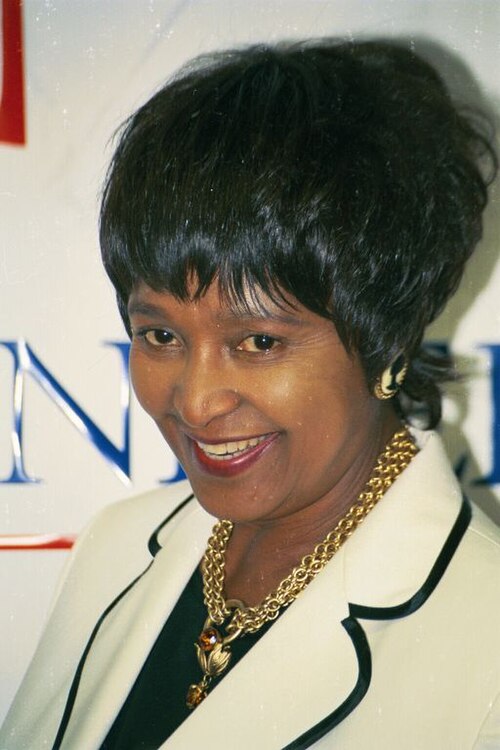
At a Glance
Pondoland, Johannesburg, and the Making of a Radical Social Worker
Winnie Madikizela grew up in Bizana in the Pondoland region of the Eastern Cape — a region with its own long history of resistance to colonialism and to the incorporation of African land and communities into the South African racial state. Her father was a school principal, a man of the educated African middle class that the mission school system had produced, and her upbringing gave her both the educational foundation and the political awareness that her subsequent career would demand. She came to Johannesburg as a young woman to train as a social worker at the Jan Hofmeyr School of Social Work, and she became the first Black professional social worker in South Africa — a distinction that reflects both her individual ability and the extraordinary narrowness of the professional doors that the apartheid system was prepared to open for Black South Africans.
Her work as a social worker at Baragwanath Hospital in Soweto brought her into direct contact with the poverty, ill-health, and social dislocation that apartheid produced in the lives of Black South Africans in the townships. If her political education had begun in her father's home and continued in the discussions and debates of Johannesburg's liberation movement networks — which she entered through her relationship with Nelson Mandela — her experience at Baragwanath Hospital gave it the concrete, material grounding that social work provides: the daily encounter with what structural inequality actually does to human bodies and human families.
She met Nelson Mandela through the ANC's Johannesburg networks, and they married in 1958. The marriage was, from its beginning, conducted in the shadow of the liberation movement's struggle with the apartheid state. Mandela was already a prominent ANC figure, already subject to banning orders and surveillance, already involved in the clandestine work of building the movement's capacity for resistance. Winnie entered this world with open eyes, and she became an activist in her own right — through the ANC Women's League, through the community networks of Soweto, through the personal relationships with other activists and their families that sustained the movement's social fabric.
The Years of Repression: Detention, Torture, and the Long Vigil
When Nelson Mandela was sentenced to life imprisonment in June 1964 after the Rivonia Trial, Winnie was twenty-seven years old. She had two young daughters. She had been under banning orders since 1962. She was now the wife of a life prisoner, which in the apartheid South Africa of 1964 — with no prospect of release, no negotiations on the horizon, no international pressure sufficient to force a change in the apartheid government's course — was effectively a form of permanent widowhood. She could not visit her husband freely, could not speak to him on the telephone, could not communicate with him except through the heavily censored letters that the prison authorities permitted.
The apartheid state's assessment was that by imprisoning Mandela and isolating Winnie, it had neutralised the Mandela factor in South African politics. This assessment was wrong. Winnie Mandela — precisely because she was the wife of the movement's imprisoned symbol, because the international media and the anti-apartheid movement fixed their attention on her as the human embodiment of the struggle's continuing presence inside South Africa — became one of the most politically significant figures in the country.
The detention of 1969 to 1970 was the most extreme of the apartheid state's attempts to break her. She was held for seventeen months in solitary confinement, subjected to interrogation around the clock, deprived of sleep, denied reading material, isolated from all human contact except the security police interrogators. It was a sustained attempt to destroy her psychological resilience and to extract information about the ANC's underground networks. The detention did not break her. She was released in 1970 without having provided the information her captors wanted, and she returned to her political work with an authority that her endurance of the detention had made unimpeachable.
Brandfort: Banishment and the Refusal to Be Silenced
The banishment to Brandfort in May 1977 was another attempt to neutralise her political effectiveness by removing her from the communities in which her political work had roots. Brandfort was a small, predominantly Afrikaner farming town in the Orange Free State — a world apart from Soweto, with no Black political community to speak of, no ANC networks, no connections to the liberation movement. The security police's calculation was that in this isolation she would lose her political relevance and her ability to maintain contact with the movement's networks.
The calculation was wrong again. Winnie Mandela built a political presence in Brandfort from nothing, working with the local Black community, providing social services, maintaining her connections with the liberation movement through correspondence and the visits of journalists, diplomats, and activists who made the journey to see her. The international attention that surrounded her meant that her banishment, rather than hiding her, made her more visible — every visit by a foreign journalist or anti-apartheid activist was a story, every official harassment was documented, and the image of the woman the apartheid state was so determined to silence became more powerful precisely because of the silencing attempts.
Her house in Brandfort was firebombed in 1985, and she returned to Soweto in defiance of the banishment order. The apartheid government, by this point deep in the crisis of the township uprisings, the State of Emergency, and the international sanctions campaign, did not prosecute her for the defiance. The banishment, in effect, was over.
The 1980s: At the Centre of the Storm
The 1980s were the decade in which Winnie Mandela's political standing reached its greatest height and in which the shadows that would complicate her legacy also emerged. She was the most prominent internal face of the ANC at a time when the UDF's mass resistance, the township uprisings, the State of Emergency, and the intensifying international pressure were bringing the apartheid system to its crisis. Her speeches at funerals and rallies — made in defiance of banning orders that she treated with contempt — reached the international media and the liberation movement's external networks with a force that no other figure inside South Africa could match.
The 1985 speech in which she declared that the liberation movement would "liberate this country" with "necklaces" — the horrific method of killing suspected informers and collaborators by placing a petrol-soaked tyre around their neck and setting it alight — was one of the most controversial moments of her career. She later said she had been misquoted or quoted out of context. The controversy over the statement reflects the larger difficulty of assessing her role in the violence of the 1980s: whether she was responding to the extreme violence of the apartheid state with rhetoric that mirrored its own brutality, or whether she was actively promoting vigilante violence in ways that the liberation movement's stated values did not sanction.
The Mandela United Football Club — the group of young men who attached themselves to her as bodyguards and enforcers in the late 1980s — became the source of the most serious allegations against her. The group was implicated in assaults, kidnappings, and the murder of Stompie Seipei, a fourteen-year-old activist whose death the TRC later found Winnie Mandela to have been connected to. The internal ANC leadership, including Oliver Tambo from exile, issued statements distancing the movement from the Football Club's activities. She was convicted of kidnapping and assault in 1991. The TRC's findings against her were some of the most damaging issued against any liberation movement figure.
A Contested Legacy: The Heroism and the Shadows
The difficulty of assessing Winnie Mandela's legacy is the difficulty of holding two genuinely contradictory truths simultaneously. The first truth is that she endured decades of repression — detention, torture, banishment, surveillance, the systematic destruction of her personal life — with extraordinary resilience, and that she maintained the liberation movement's presence inside South Africa through years when almost every other prominent internal leader had been imprisoned, killed, or forced into exile. This contribution was real, was significant, and was made at genuine personal cost.
The second truth is that the TRC's findings regarding the Mandela United Football Club's activities, and the evidence of her connection to those activities, represent a serious moral failure that cannot be explained away by the extreme conditions of the Emergency years or by the violence of the apartheid state. The liberation movement's own internal assessments were damning. Her supporters argued that the apartheid state's sustained campaign to destroy her — the detentions, the torture, the isolation, the banishment — had produced the psychological damage from which the Football Club's activities in part arose. This may be true, and it is relevant context. It does not resolve the moral questions about her direct responsibility for the harm done to people in her vicinity.
What the two truths together require is a more complex account of heroism than the liberation movement's hagiographic tradition typically provides — an account that can hold, in the same person, the genuine courage of endurance under extreme repression and the genuine failures of moral judgement that the Emergency years also produced. Very few liberation movement figures have demanded this complexity from their historians as insistently as Winnie Mandela.
Legacy
Winnie Madikizela-Mandela died on 2 April 2018, aged eighty-one. Her state funeral was attended by tens of thousands of people. The speeches praised her endurance, her courage, her role as the Mother of the Nation. The complications were acknowledged but not dwelt upon. This is how South Africa, still working through the meanings of the liberation struggle and the transition, chose to mark her passing.
Her legacy will be debated for as long as the history of the apartheid era is studied and argued over. It should be. The heroism was real. The failures were real. The context — of state violence, sustained repression, and the deliberate destruction of a human being's political and personal life by the apartheid apparatus — is real and relevant. The full accounting of what she was, what she did, and what was done to her remains unfinished work. That unfinished work is itself a form of tribute to someone who demands, above all, that she be taken seriously.