At a Glance
Ihithe, the Kikuyu Highlands, and a Childhood in a Landscape Being Lost
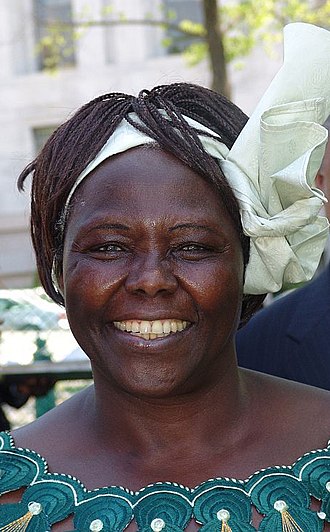
Wangari Maathai was born in 1940 in Ihithe village in Nyeri District — the highland country at the foot of Mount Kenya, whose combination of fertile volcanic soil, reliable rainfall, and dense forest cover had made it one of the most productive agricultural landscapes in East Africa and one of the most intensively settled areas of the Kikuyu highlands. The landscape of her childhood — the fig trees, the clear streams, the forest patches that were the source of medicine and timber and the regulation of the water cycle — was, even in 1940, already under pressure from the intersection of colonial land use patterns, European farming, and the population pressure that colonial land alienation had concentrated on the areas remaining in African hands.
Her scientific education — carried out partly in the United States on a scholarship through Tom Mboya's airlift programme and partly at the University of Nairobi, where she became in 1971 the first woman in East and Central Africa to earn a doctorate — gave her the analytical tools to understand what was happening to the landscape she had grown up in. The deforestation of the Kenyan highlands, the erosion of topsoil, the silting of rivers and the decline of water sources, the loss of the biodiversity that had sustained rural communities — these were not metaphorical descriptions of colonial damage but measurable, documentable, reversible physical processes that her scientific training equipped her to understand with precision. And her intimate knowledge of the Kikuyu highlands gave her the motivation to do something about them that purely academic knowledge could not have provided.
The connection between her scientific understanding and her personal landscape was the foundation of the Green Belt Movement — the insight that the environmental degradation she could document scientifically was the same degradation that rural Kenyan women were experiencing practically, in the drying up of the streams where they collected water, the disappearance of the firewood they needed for cooking, the erosion of the soil they were trying to farm. This connection — between scientific analysis and lived experience, between the laboratory and the shamba — was what made her environmental work simultaneously rigorous and grounded in the realities of rural women's lives.
The Green Belt Movement: Trees as Political Organising
The Green Belt Movement that Maathai founded in 1977 under the auspices of the National Council of Women of Kenya began with a deceptively simple premise: plant trees. The environmental logic was sound and straightforward. Kenya's forests had been dramatically reduced by colonial land clearance and subsequent agricultural expansion; the loss of forest cover had accelerated soil erosion, reduced water retention, depleted river systems, and diminished the biodiversity that rural communities depended on. Planting trees would reverse some of these processes, restoring watershed function, stabilising soils, providing firewood, and rebuilding the ecological complexity that monoculture farming had displaced.
But the genius of the Green Belt Movement was not in this environmental logic, which was correct but not in itself transformative. The genius was in how the movement organised around tree planting — in the institutional form it gave to the work and the political consciousness that form generated. Community tree nurseries required women to work together, to make collective decisions about which species to plant and where, to manage shared resources, to hold each other accountable for the care of the seedlings. The work was practical, visible, and immediately beneficial — women could see the trees growing, could see the soil stabilising, could see the stream banks holding. The practical effectiveness of the work demonstrated that collective action by rural women produced real results, and this demonstration of efficacy was itself a political education.
The movement paid women a small sum for each seedling that survived — a direct economic benefit that recognised women's labour and gave the work a financial dignity that voluntary activity alone could not have provided. It built networks of women organisers across Kenya's rural areas, trained community leaders, and created the institutional infrastructure of regular meetings, shared standards, and mutual accountability that a movement requires to sustain itself over decades rather than dissipating after the initial enthusiasm.
By the time the Moi government began to understand what it had permitted, the Green Belt Movement had planted millions of trees and built an organisational infrastructure that reached into rural communities across Kenya. It was, in retrospect, one of the most effective forms of grassroots political organising in the history of post-independence Africa — not despite being framed as an environmental project, but because being framed as an environmental project gave it the space to operate that an explicitly political organisation would have been denied from the beginning.
The Battle for Uhuru Park and the Confrontation with Moi
The confrontation between Wangari Maathai and the Moi government became fully explicit in 1989 when the government announced plans to build a sixty-storey skyscraper complex in Uhuru Park — Nairobi's central public green space, the equivalent of central park for a city that had very little public open space available to its rapidly growing population. The complex, proposed to include a headquarters for KANU, was to be funded by international investors and built on land that had been public parkland.
Maathai's opposition was total and public. She wrote to international funding institutions whose participation was required, alerting them to the environmental and public-interest dimensions of the proposal. She organised public campaigns. She refused the government's attempts to marginalise her opposition as the work of an ignorant woman who did not understand the requirements of development. Moi responded in terms that revealed the depth of his discomfort: he described her in a public speech as a woman who did not respect African tradition, who behaved like a man, and who had no African dignity. The attack was intended to discredit her by appealing to gender norms; it had the opposite effect internationally, drawing attention to the case that the government wanted quietly resolved.
The international funders withdrew. The skyscraper was not built. Uhuru Park remained public green space. It was one of the most significant environmental victories in the history of African civil society — and it was achieved by a woman with no institutional power, no government position, and no resource base beyond the networks of the Green Belt Movement and the clarity and persistence of her argument. The government's humiliation was complete enough to ensure that its response would be more directly violent. And it was: Maathai was beaten by police during subsequent protests at Uhuru Park, her car was vandalised, she received death threats, and the harassment that the government directed at her was sustained and systematic.
The Democracy Movement and the Mothers of Political Prisoners
As the democracy movement of the late 1980s and early 1990s gathered momentum — the same movement that Charles Rubia and Oginga Odinga launched with their 1990 call for multiparty elections — Maathai was among its most prominent and most courageous voices. Her involvement took a specifically maternal and environmental form that was characteristic of her political method: in February 1992 she led a group of mothers of political prisoners in a hunger strike at Uhuru Park, demanding the release of their sons from detention. The mothers camped in the park, refusing to leave; the police attacked the camp, beating the women — some of them elderly — with clubs; Maathai was beaten, lost consciousness, and was hospitalised. The hunger strike and the police response received extensive international coverage.
The symbolism of the action — mothers, elderly women, fasting in a public park, beaten by government police — was politically devastatingly effective because it was also entirely true. These were not staged protesters performing victimhood; they were women whose sons were actually imprisoned and whose willingness to be beaten in public for demanding their release communicated something that no political speech could have. The international press understood the image. The political prisoners were released. The mothers' encampment at Uhuru Park — subsequently named Freedom Corner — became a landmark of the Kenyan democracy movement's memory.
Throughout this period, Maathai was sustaining simultaneously the environmental work of the Green Belt Movement — now operating across Kenya and beginning to expand to other African countries — and the political work of the democracy movement. The dual focus was not accidental; it was the expression of her core argument that the two were inseparable. Forests were being logged by politically connected individuals who faced no accountability because the political system that should have held them accountable was captured by those same individuals. Water sources were being polluted by industries owned by people with government connections that insulated them from environmental regulation. The deforestation of Kenya was not an environmental problem that could be solved by planting trees alone; it was a political problem rooted in the absence of accountability that only democratic governance could address.
Nobel Peace Prize 2004 and the Argument It Validated
The Norwegian Nobel Committee's decision to award the 2004 Nobel Peace Prize to Wangari Maathai was a statement of intellectual position as much as a recognition of individual achievement. Peace prizes had gone to diplomats, arms-control negotiators, and human rights advocates; the award to an environmental activist who had built a tree-planting movement in rural Kenya was a deliberate argument that peace and security could not be separated from the environmental and political conditions that made them possible. The committee's citation stated this explicitly, connecting sustainable development, democratic governance, and respect for human rights as aspects of a single integrated project — precisely the connection that Maathai had been making for nearly three decades.
She was the first African woman to receive the Nobel Prize in any category — not just the Peace Prize but in science, literature, or economics. That distinction, achieved in 2004, said something about the barriers that African women had faced not just in Kenyan political life but in international recognition, and it said something about what those barriers had cost the world in the talent and contribution they had suppressed. Maathai herself was characteristically direct about this: she used the Nobel platform not to celebrate herself but to make the arguments about climate change, African governance, and women's rights that the platform gave her an unusually large audience to hear.
She was elected to parliament in 2002 — in the same elections that ended Moi's rule and brought Mwai Kibaki to the presidency in Kenya's first genuinely free transfer of power — and served as Assistant Minister for the Environment. The combination of parliamentary position and international platform gave her influence over Kenyan environmental policy that the Green Belt Movement's grassroots work had never directly achieved, and she used it to push for the forest conservation, watershed protection, and sustainable land management that her decades of environmental work had demonstrated were necessary.
The Argument That Trees and Democracy Are the Same Thing
Wangari Maathai's intellectual legacy — the argument that runs through everything she built and everything she wrote — is that the health of the natural environment and the health of democratic governance are not merely correlated but structurally connected, that you cannot have one in the long run without the other. Authoritarian governments degrade their environments because accountability is the mechanism through which environmental protection is enforced, and authoritarian governments destroy accountability because it threatens their power. Democratic communities protect their environments because they have the institutional means to do so — the right to be consulted about decisions affecting their land and water, the legal mechanisms to challenge those who degrade them, the political power to remove governments that ignore their interests.
The Green Belt Movement planted trees, but what it was actually building — the thing that made it politically threatening to the Moi government rather than simply a useful environmental project — was accountability: the accountability of women to their communities for the trees they tended, the accountability of community leaders to the women they organised, and by extension the accountability of governments to the citizens whose land and water and forests they were managing. Tree planting as a form of democratic education was the most subversive programme in Kenya in the 1980s, and the Moi government was correct to be worried about it even if the form of its worry — beating elderly women in Uhuru Park — was catastrophically counterproductive.
She died in September 2011, her memoir written, her prize received, her trees — more than 47 million of them across Kenya and beyond — in the ground. The Green Belt Movement continued. The forests were still under pressure. The democratic governance that alone could protect them was still incomplete. But the argument she had made — consistently, publicly, at personal cost across nearly four decades — was now part of the international consensus on what sustainable development required: not just technical environmental management but the political rights without which communities cannot defend the environments they live in. That argument, validated by the Nobel Committee in 2004, is Wangari Maathai's most enduring contribution to the world she spent her life trying to improve.