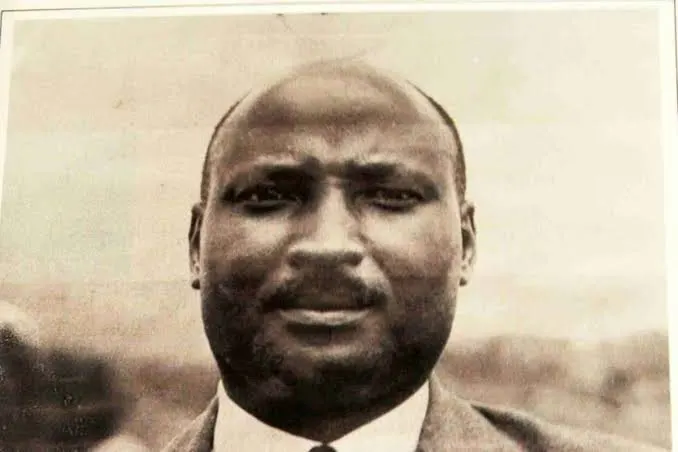
At a Glance
The Mission School World and the Making of a Constitutional Nationalist
Eliud Mathu was born in 1910 in Dagoretti, one of the areas of Kiambu District where the pressure of colonial land alienation was most immediately felt by Kikuyu communities. Dagoretti sits just south of Nairobi, and in the early decades of the twentieth century it was a landscape in transition — a place where Kikuyu agricultural land was being converted into European farms, where African families were being pushed into the squatter arrangements that defined rural landlessness, and where the expansion of Nairobi as a colonial capital was simultaneously creating new economic opportunities and new forms of social disruption. The mission churches and their associated schools were a significant presence in Kiambu, and Mathu's family's Christian faith placed him within reach of the educational infrastructure that the missions had built.
His education was exceptional by any measure. He progressed through missionary schools in Kenya to Fort Hare University College in the Eastern Cape of South Africa — an institution that the London Missionary Society had established in 1916 and that had become, by the 1930s, the most important institution of higher education for Africans anywhere in sub-Saharan Africa. Fort Hare educated an extraordinary concentration of the people who would shape African political life in the mid-twentieth century: Nelson Mandela attended in the early 1940s, as did Oliver Tambo; Robert Mugabe, Kenneth Kaunda, and many others from across the continent passed through its lecture rooms. The Fort Hare experience was important not just for the formal education it provided but for the networks it created and the political consciousness it nurtured — in an environment where educated Africans from across the continent encountered each other and compared notes on colonialism, its consequences, and the arguments for its end.
From Fort Hare, Mathu went to Balliol College, Oxford — an ascent into the very apex of British elite education. Balliol had trained British prime ministers, colonial administrators, and public intellectuals. To study there as a Black African in the early 1940s was to occupy an anomalous and illuminating position: to be immersed in the philosophical and political traditions through which the British justified their claim to govern, while simultaneously experiencing, as a colonial subject, the gap between those traditions' professed values and the actual practice of British power in Kenya and elsewhere. Mathu absorbed the Oxford education — his degree in philosophy, politics, and economics gave him the analytical tools to engage with political questions at the level of principle as well as practice — and returned to Kenya in 1944 with both the credentials and the arguments that his subsequent political career would require.
The Legislative Council: One Voice for Five Million People
The appointment of Eliud Mathu to the Kenya Legislative Council in October 1944 was a colonial political calculation disguised as a concession. Governor Sir Henry Moore, responding to African political pressure that had been building throughout the war years, appointed Mathu as the first African member of a legislature that had been designed from its inception to represent the interests of European settlers and, to a lesser degree, the Asian commercial community. There was no question of election — Mathu was appointed, not elected, and his mandate derived from the Governor's pleasure rather than from African popular consent. There was no question of genuine power — the Legislative Council was an advisory body subordinate to the Governor's executive authority, and even within that limited framework the settler-dominated unofficial members could be relied upon to oppose any measure that threatened European privilege. And there was no question of proportionality — Mathu represented approximately five million Africans; the European members represented fewer than thirty thousand settlers.
Despite these structural limitations, Mathu used his position with skill and determination. He raised in the Legislative Council the issues that mattered to the African population: land alienation and the squatter system; the differential wages that paid Africans a fraction of European wages for equivalent work; the pass laws and the kipande system that restricted African movement and maintained a labour force in permanent economic precariousness; the inadequacy of educational provision for Africans compared with the extensive and well-funded schools available to European children; the absence of any genuine political representation for a population that constituted the overwhelming majority of Kenya's inhabitants. He was procedurally competent — his Oxford training had given him the debating skills and the knowledge of legislative procedure that effective participation required — and he was politically astute enough to understand how to use the limited space available to him without triggering a reaction that would result in his removal.
His position was inherently contradictory, and the contradiction was one that any African politician working within a colonial representative system had to navigate. To participate in the Legislature was to accept, at least formally, the legitimacy of the colonial political framework — to agree to operate within its rules and to accept its procedural authority. To refuse participation was to leave the space entirely to those who would use it without any African voice at all. Mathu chose participation while making it unmistakably clear that his presence in the chamber was not an endorsement of the system but an attempt to use whatever leverage the system's own procedures offered to advance African interests. This was a difficult and sometimes uncomfortable position, and it exposed him to criticism from both directions: from settlers who resented any African voice in their legislature, and from more radical nationalists who saw constitutional participation as insufficient to the scale of the problem.
Co-Founding the Kenya African Study Union
The same year that he took his seat in the Legislative Council, 1944, Mathu was involved in the founding of the Kenya African Study Union — the organisation that would become the Kenya African Union (KAU) in 1946. The KASU/KAU represented the constitutional strand of African nationalism: an organisation that sought to advance African interests through political education, petitioning, lobbying, and eventually electoral representation, rather than through the confrontational methods that the radical wing of the movement would develop in the late 1940s and early 1950s.
The founding of the KAU brought together figures from different strands of Kikuyu and, increasingly, pan-Kenyan nationalism. Harry Thuku, who had been the first major Kenyan nationalist leader to suffer colonial imprisonment in 1922, was a founding member, though his politics had moderated considerably from the confrontational stance of his early career. James Gichuru, who would serve as the KAU's first president before handing the position to Kenyatta, was another central figure. Mathu's participation connected the organisation to the legislative process — his LegCo position gave the KAU a channel into the official political structures that no other African organisation had access to, and his ability to raise KAU concerns in the legislature gave the organisation a kind of visibility and leverage that purely extra-parliamentary organisation could not achieve.
When Jomo Kenyatta returned from Britain in 1946 and took over the KAU's presidency in 1947, the organisation's political centre of gravity shifted. Kenyatta was a more charismatic and authoritative figure than any of the other leaders, and his presence transformed the KAU into a mass movement rather than an elite pressure group. The tensions within the KAU between the constitutional moderates — of whom Mathu was representative — and the increasingly radicalised faction around figures like Bildad Kaggia and Fred Kubai intensified through the late 1940s and early 1950s. Mathu remained associated with the moderate wing, believing that African political advancement could be achieved through the existing constitutional processes if sufficient pressure was applied in the right way.
The State of Emergency and Its Aftermath
When the British declared the State of Emergency in October 1952 and began their mass arrests of nationalist leaders, Mathu was not among those detained. This was significant. His association with constitutional rather than military nationalism, his legislative role, and his reputation as a moderate voice meant that the colonial government did not regard him as a threat in the same way as Kenyatta, Kaggia, Kubai, and the others arrested in the initial sweep. He remained at large and continued to operate as a political figure during the Emergency period — a period in which the political space available to Africans contracted dramatically as the colonial government used its Emergency powers to suppress virtually all forms of organised African political activity.
His position during the Emergency was deeply uncomfortable. He was not implicated in the Mau Mau and had not been involved in the oath-taking and military organisation that defined the movement's underground activities. But he was also not prepared to publicly condemn the uprising in the terms that the colonial government demanded — to characterise the Mau Mau as nothing more than criminal savagery and to distance himself entirely from the aspirations that had driven men to the forests. He navigated this impossible middle ground with what might be described as careful ambiguity, continuing to advocate for African political rights through the legislative channels available to him while avoiding both the open endorsement of violence and the collaborationist condemnation that the colonial government sought from respectable African voices.
The Emergency demonstrated, more clearly than anything Mathu had experienced before, the limits of constitutional nationalism as a strategy in a colonial system that was prepared to use overwhelming force when its interests were threatened. Five years of guerrilla war and eight years of Emergency, with all their attendant suffering — the detention camps, the villagisation programmes, the executions — were required before Britain agreed to the political reforms that would lead to independence. Constitutional pressure had not been sufficient on its own; it had required the combination of military resistance and constitutional argument, the Mau Mau in the forests and the African politicians in the legislature and in London, to force the pace of change.
Education, Oxford, and the Intellectual Formation of Kenyan Nationalism
One dimension of Mathu's significance that deserves particular attention is the role he played in the intellectual formation of Kenyan nationalism — not through political organisation alone, but through the argument he embodied by his very existence and career. To have been a Fort Hare and Oxford graduate in Kenya in the 1940s was to be a living refutation of the colonial ideology that justified African subordination on grounds of intellectual and cultural inferiority. Mathu was, by any measure the British themselves would apply, as well-educated as any European member of the Legislative Council — better educated than most. He could debate constitutional theory, political philosophy, and economic policy in the language and analytical framework of the British liberal tradition, and he was doing so to argue that the British liberal tradition's own professed values required the end of colonial rule.
This intellectual dimension of the struggle is sometimes undervalued in accounts that focus primarily on the military and political history of the Mau Mau. But ideas matter in liberation movements, and the articulation of African political rights in terms that the colonisers could not dismiss as incomprehensible or barbarian was a genuine contribution to the process of ending colonial rule. Mathu made that contribution not in the forest with a gun but in the legislature with arguments — arguments that had been honed in the tutorials of Oxford's most distinguished college and that drew on the same philosophical traditions that British officials used to justify the empire. The implicit message — that those traditions, applied honestly, condemned the empire — was one that the colonial government could never quite find a comfortable answer to.
Independence and the Fading of a Pioneer's Legacy
When Kenya achieved independence in December 1963, Eliud Mathu was fifty-three years old and had been involved in the politics of African liberation for nearly two decades. Independence brought recognition of a sort — he was acknowledged as a pioneer, as the first African legislator, as one of the founders of the KAU — but the post-independence political environment was dominated by figures whose profiles were more dramatic and whose political bases were more solidly organised. The constitutional nationalists of his generation, the men who had worked within the legislative system during the colonial period, did not have the mass followings or the organisational machines of the independence movement's more populist figures.
Mathu withdrew gradually from active politics in the post-independence years, occupying himself with business and educational interests rather than with the rough competition of Kenya's emerging political landscape. He died in April 1976 at the age of sixty-five — a relatively young age for a man whose contribution to Kenyan political history had been so early and so significant. The recognition accorded to him at his death was respectful but not commensurate with the scale of what he had done: the man who had been the first African voice in Kenya's legislature, who had co-founded the organisation that became the vehicle of the independence movement, and who had argued for African political rights at Oxford-trained intellectual depth when such arguments were most necessary and most dangerous, received a quiet official acknowledgement and was thereafter largely absorbed into the footnotes of the country's independence narrative.
This relative neglect reflects a broader pattern in the memory of liberation movements: the military heroes and the mass agitators are remembered more vividly than the constitutional pioneers whose patient, procedural work helped create the political conditions in which the military resistance became effective. Dedan Kimathi in the forests and Bildad Kaggia in the detention camp generate more powerful narrative images than Eliud Mathu in the Legislative Council chamber. But the argument that Mathu made from 1944 onward — that Africans were entitled to genuine political representation, that the existing system was structurally unjust and needed to be changed — was the argument that the entire liberation movement was making, in different registers and by different methods. He was the first person to make it from inside the official institutions of colonial Kenya, and that distinction, however quiet the man who held it, was historically significant.