At a Glance
Rusinga Island, Mangu, and the Making of a Prodigy
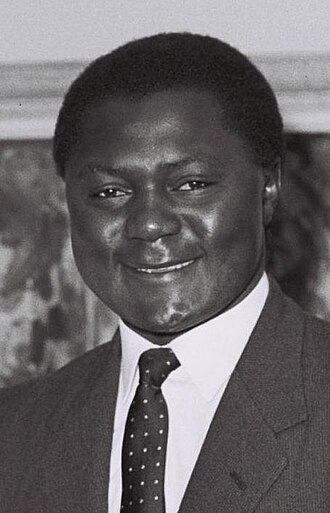
Tom Mboya was born in 1930 on Rusinga Island in Lake Victoria — a small, densely populated island off the Nyanza coast where the Luo fishing and farming communities lived in close proximity with the lake economy. His father worked on European-owned sisal estates, and the family's circumstances were modest. His trajectory from the island to Holy Ghost College at Mangu — a Catholic mission school in the Kiambu hills above Nairobi, one of the most academically demanding African secondary schools in colonial Kenya — was the result of exceptional academic ability recognised by mission teachers and supported by the kind of patronage that the colonial school system occasionally extended to students of unusual promise.
Mangu gave him a rigorous academic formation in an environment that, whatever its colonial limitations, took intellectual seriousness seriously. He was a student of exceptional ability — quick, analytically powerful, with a memory that retained what it absorbed and a mind that could deploy it effectively — and his time at Mangu prepared him for the subsequent career that would take him from the Nairobi docks to Oxford to Accra to Washington with a fluency of movement between worlds that most of his contemporaries could not match.
After Mangu, Mboya worked as a sanitary inspector for the Nairobi City Council — a position that gave him direct knowledge of the living conditions of Nairobi's African workers and of the indifference with which the colonial municipal authority managed those conditions. The sanitary inspection work was a form of practical education in the relationship between colonial economic exploitation and public health, and it confirmed what his Mangu formation had made intellectually clear: that the colonial system was not merely politically unjust but was producing material conditions of poverty, disease, and premature death among the African majority that any honest assessment condemned.
The Nairobi Docks, the Kenya Federation of Labour, and the Political Trade Union
Mboya's entry into trade union organising in 1952 — the same year that the State of Emergency was declared and the Mau Mau war began in the forests — was a choice to address colonial economic exploitation through the instrument that directly controlled the relationship between employer and worker. He was appointed general secretary of the Kenya Local Government Workers Union at twenty-two, an appointment that reflected both his personal ability and the urgency with which the labour movement needed leadership of his calibre. Within two years he had built the Kenya Federation of Labour — an umbrella organisation that coordinated Kenya's African trade unions and gave them a collective voice and bargaining capacity that individual unions could not achieve.
His trade unionism was from the beginning explicitly political as well as industrial. The liberation of African workers from colonial economic exploitation could not, in his analysis, be fully achieved through collective bargaining alone — it required the political liberation that independence would bring, because the colonial state's fundamental orientation toward maintaining cheap African labour made the playing field on which collective bargaining occurred permanently tilted against African workers. The connection between trade union organisation and the independence movement was therefore not a tactical alliance but a logical consequence of the analysis: the same colonial power that denied Africans political rights also denied them economic rights, and challenging one necessarily involved challenging the other.
His international connections gave the Kenya Federation of Labour a reach and a significance that was unusual for a colonial African trade union. He was elected to leadership positions in the International Confederation of Free Trade Unions — the Western-aligned international trade union body — and his relationships with American trade unions and with the American government and foundations that funded much of the international labour movement in the 1950s gave him access to resources and political networks that extended far beyond what Nairobi alone could have provided. These connections were double-edged: they brought resources and international attention but also associated him with the Western anti-communist politics of the Cold War in ways that complicated his relationships with the more explicitly socialist currents of African nationalism.
Accra 1958: The All-African Peoples' Conference
The All-African Peoples' Conference convened in Accra, Ghana, in December 1958 by Kwame Nkrumah was among the most important political gatherings in the history of African liberation — a meeting of representatives from across the continent at a moment when Ghana had achieved independence (1957) and when the wave of decolonisation that would transform Africa over the following decade was gathering momentum. Nkrumah's vision was of a unified Africa — a continental federation that would give African peoples the collective political and economic weight to resist neo-colonial domination — and the Accra conference was the first major attempt to build the political networks and the common programme that such a vision required.
Mboya's participation in Accra — and his performance there, which was widely remarked upon as among the most impressive of the conference — established him as one of the leading figures of the independence generation not just in Kenya but across the continent. He spoke with a clarity, a technical command, and a political intelligence that impressed African leaders who had been in the field for decades, and he returned from Accra with the kind of continental reputation that most Kenyan politicians of his generation were far from achieving. The relationships he built at Accra — with Nkrumah, with future leaders of Nigeria, Tanganyika, the Rhodesias, and the rest of the continent — gave his subsequent work a Pan-African dimension that went beyond the Kenyan or even the East African frame.
His relationship with Pan-Africanism was, however, more complex than his Accra performance suggested. Mboya was a pragmatist as well as a visionary, and his pragmatism led him to positions on the pace and form of African unity that were more cautious than Nkrumah's maximalist vision. He was supportive of continental solidarity while being sceptical of the institutional forms — particularly the Continental Union Government — that Nkrumah was advocating. This caution brought him into tension with the more radical Pan-Africanists, and his association with American foundations and the American trade union movement marked him, for some African socialist intellectuals, as too aligned with Western interests. These tensions were part of the broader debate within African nationalism about what economic and political model the independent states should pursue — a debate that Mboya's assassination in 1969 cut short before he had the opportunity to fully develop his own position.
The Kenya Airlifts: Education as Instrument of Liberation
Among the most consequential practical achievements of Tom Mboya's career were the Kenya Airlifts of 1959 to 1962 — the programme that brought approximately 800 Kenyan students to universities in the United States at a moment when the country was preparing for independence and needed urgently to build the educated professional class that would govern and develop the independent state. The programme was negotiated by Mboya with American foundations, with the Kennedy family, and eventually with the Kennedy administration — John F. Kennedy was personally supportive, and the relationship between Mboya and Kennedy was one of genuine political respect as well as practical collaboration.
The airlifts were significant at multiple levels. Most immediately, they gave hundreds of young Kenyans access to American higher education that the colonial system had not provided — producing lawyers, economists, engineers, doctors, and administrators whose skills the independent Kenyan state would need from its first days. Among those who came to America through the airlift programme was Barack Obama Sr., a Luo economist from Nyanza whose son would become the 44th President of the United States — a connection that gave the airlift programme a specific historical resonance that its original designers could not have anticipated.
Beyond the immediate educational output, the airlifts were a statement about Africa's ability to organise for its own development — to identify needs, build the political relationships to address them, negotiate the resources required, and implement the programme effectively. Mboya demonstrated through the airlifts that an African political leader could operate effectively on the international stage, building partnerships with the American government and private foundations on terms that served Kenya's interests rather than America's, and producing results that were tangible and lasting.
KANU, the Cabinet, and the Looming Succession
Mboya's co-founding of the Kenya African National Union in 1960 and his subsequent role as its Secretary-General through the independence period placed him at the organisational centre of the movement that negotiated Kenya's independence and governed the country from 1963. His relationship with Kenyatta was complex — deferential in public, politically supportive, and professionally effective, while privately sometimes strained by the tensions between Mboya's genuine national ambitions and the Kikuyu-centred character of the inner circle that Kenyatta was building around himself.
As Minister of Labour in the independence government, Mboya produced the most technically sophisticated ministerial work of any member of the Kenyatta Cabinet — building the labour law framework of the independent state, managing the Africanisation of the civil service, and using his ministry as a vehicle for the human capital development that he had always understood as central to genuine economic independence. His ministerial work was widely respected and demonstrated that his political talents extended to the practical business of governing as well as to the more visible arenas of oratory and political organisation.
By the late 1960s, the question of Kenyatta's succession was the dominant subtext of Kenyan politics. Kenyatta was old, his health was uncertain, and the competition for position in the post-Kenyatta political landscape was already shaping the alliances and the antagonisms that determined what was possible. Mboya's national legitimacy — his standing across ethnic lines, his international reputation, his demonstrated ministerial competence — made him the most credible alternative to the Kikuyu establishment figures who were competing for the succession. This made him threatening, and the nature and direction of that threat was understood clearly by those who most needed to prevent it from being realised.
The Assassination and Its Consequences
On 5 July 1969, Tom Mboya was shot outside Chhani's pharmacy on Government Road in central Nairobi. He had stopped to buy aspirin. A gunman approached him at close range and fired twice. Mboya was rushed to the Nairobi Hospital but died within an hour. He was thirty-eight years old.
A Kikuyu man, Nahashon Isaac Njenga Njoroge, was arrested, tried, and convicted of the murder. In the dock, he asked famously: "Why don't you go after the big man?" — a question that implicated but did not name those who had ordered the killing, and that has never been officially answered. No investigation has produced charges against anyone who ordered the assassination. The impunity, as with Pio Gama Pinto's murder four years earlier and JM Kariuki's killing six years later, was complete.
The political consequences were immediate and lasting. The conviction of a Kikuyu for the murder of the most prominent Luo politician in Kenya inflamed the Luo-Kikuyu tensions that were already present in the competition over the independence settlement and the succession question. Luo crowds responded to the conviction with fury; Kenyatta's visit to Kisumu in October 1969 — the same visit that ended in the Kisumu massacre and the banning of the KPU — was the direct political consequence of the atmosphere that Mboya's murder had created. The banning of the KPU and the detention of Oginga Odinga that followed removed the most prominent remaining voice of the political left and completed the consolidation of the one-party state that the Kenyatta government had been building since 1966.
More broadly, Mboya's death removed from Kenyan politics the figure who was most capable of building a genuinely trans-ethnic national political project — the leader whose legitimacy derived from demonstrated competence and national vision rather than from ethnic patronage. Whether he would actually have delivered the politics his reputation suggested remains a question that history cannot answer; the bullet that killed him on Government Road in July 1969 answered a different question instead, about what kind of politics Kenya's establishment was prepared to defend and what kind of leadership it was not prepared to allow.
The Man Who Might Have Been
Tom Mboya's assassination has been described many times as the greatest loss in Kenyan political history — the elimination of the figure who, of all those in the independence generation, came closest to combining the personal qualities, the political vision, the international standing, and the national legitimacy that genuine transformative leadership required. Whether this assessment is accurate is impossible to verify — counterfactual history is always speculative — but it reflects something real about the particular quality of what was lost when he was killed at thirty-eight.
He had organised the Nairobi docks at twenty-two. He had built one of Africa's most effective trade union federations by twenty-five. He had addressed the All-African Peoples' Conference at twenty-eight and been recognised there as one of the generation's outstanding voices. He had negotiated the airlifts that changed hundreds of Kenyan lives at twenty-nine. He had co-founded KANU at thirty. He had served as one of the most effective Cabinet ministers in the independence government through his thirties. At thirty-eight, with three decades of political life potentially ahead of him, the combination of what he had already achieved and what he might still have done is genuinely staggering. Kenya did not deserve the bullet that ended it. Neither did he.
He is buried on Rusinga Island, in the lake from which he came, and the island bears the marks of his presence: a museum, a mausoleum, the memory of a man whose origins were there and whose ambitions took him as far from those origins as political life in mid-twentieth-century Africa could reach. His son Raila Odinga — through Mboya's wife Pamela, and his subsequent marriage to Oginga Odinga's family — has carried the Luo political tradition into the next generation in a lineage that, however indirect, connects the liberation generation's aspirations to the ongoing project of realising them. Not yet, as Odinga said, and as Mboya's death made devastatingly clear.