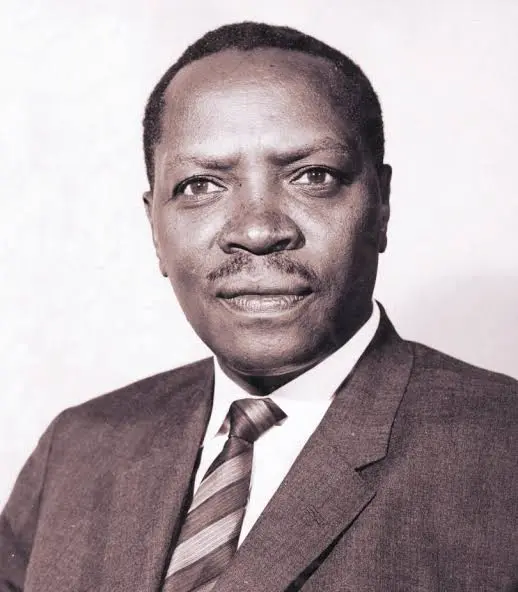
At a Glance
Kiambu, Teaching, and the Formation of a Political Mind
James Gichuru was born in 1914 in Kiambu District — one of the most politically charged areas of colonial Kenya, where the Kikuyu community's dispossession at the hands of European settlers was most concentrated and most visible. The land alienation that had converted African farmers into squatters and landless labourers in the highlands north of Nairobi was not an abstraction in Kiambu; it was the immediate daily reality of the landscape that Gichuru grew up in, the reason that families who had farmed particular tracts for generations were now subject to European landowners' terms and conditions, the source of the specific and personal grievance that drove Kikuyu political consciousness in a way that affected other communities less directly.
His education came through the mission school system, and he went on to train as a teacher — the professional path that was most consistently available to educated African men in colonial Kenya who wanted both professional standing and community engagement. The teaching profession in colonial Kenya was simultaneously underresourced, undervalued by the colonial administration relative to the education provided for European children, and of critical importance to the African communities it served. Teachers were among the most educated Africans in their communities, they were trusted with the formation of the next generation, and they were connected to the web of community life in ways that other professionals — government clerks, for instance — were not. They were, consistently, among the most politically active members of the African educated class.
Gichuru's teaching career in the Kiambu area built the community networks and the personal relationships that would support his subsequent political work. He was known as a thoughtful and principled man, someone whose judgment could be trusted and whose commitment to the broader African cause went beyond the personal political advancement that motivated some of his contemporaries. These qualities — integrity, measured judgment, the ability to earn and maintain trust — would prove essential to the specific role he played in the nationalist movement: building an organisation and maintaining it through difficult years, and then demonstrating the political wisdom to hand it to someone better positioned to lead it to its ultimate goal.
Founding the KAU: Building the Organisation Kenyatta Would Lead
The Kenya African Study Union that Gichuru co-founded in 1944 was established at a moment of political possibility and political uncertainty. The Second World War was entering its final phase; the Atlantic Charter's promise of self-determination was circulating widely among colonised peoples as an implicit commitment that applied to them as well as to the Europeans whose freedom it explicitly addressed; the Indian independence movement was approaching its climax; and the African political organisations that had been operating through the 1930s had built a constituency for change that was larger and more organised than at any previous point in Kenya's colonial history.
The KASU — renamed the Kenya African Union in 1946 — was designed to be a broader organisation than the ethnically-specific Kikuyu Central Association that had been the main vehicle of Kikuyu political work through the 1930s. Gichuru and his co-founders were reaching for a genuinely national Kenyan nationalism that could speak across ethnic lines — Kikuyu, Luo, Kamba, Luhya — and that could build a movement capable of pressing the colonial government for the constitutional reforms that the independence generation sought. This ambition distinguished the KAU from its predecessors and pointed towards the pan-ethnic nationalism that would eventually produce a genuinely national liberation movement.
As the KAU's founding president, Gichuru was responsible for building the organisation from scratch — recruiting members, establishing branch structures in different parts of the country, defining its political objectives and its organisational procedures, and maintaining its credibility and coherence in the face of colonial surveillance and the internal tensions that any political organisation experiences. He did this work for three years, from 1944 to 1947, and he did it well enough that when Kenyatta returned from Britain in 1946, he found an organisation that was functioning and that had established the political base from which a mass movement could be built.
The Decision to Step Aside: A Study in Political Selflessness
When Jomo Kenyatta returned to Kenya in September 1946 after fifteen years in Britain — years during which he had acquired an anthropology doctorate from the London School of Economics, had written Facing Mount Kenya, had been immersed in the Pan-African intellectual circles around George Padmore and Kwame Nkrumah, had attended the Fifth Pan-African Congress in Manchester in 1945, and had acquired an international reputation as one of Africa's foremost intellectual voices — the question of the KAU's leadership became immediately complex.
Gichuru was the incumbent president. He had founded the organisation, had built its structures, had given it three years of capable leadership. He had a legitimate claim to continue leading it. Kenyatta was returning as, in effect, an outsider who had been absent from Kenya for fifteen years — an extraordinary intellectual and political figure, certainly, but one who had not been present through the years of organisational work that Gichuru and his colleagues had done. In many political environments, the incumbent leadership defends its position against returning rivals, even distinguished ones, with considerable determination.
Gichuru chose differently. He assessed, with the political clarity that characterised his judgment throughout his career, that Kenyatta was the leader the KAU needed to become what it needed to become: a mass movement that could press the colonial government for independence rather than merely for incremental reform. Kenyatta's intellectual reputation, his Pan-African connections, his personal charisma, and the symbolic authority he carried as the man the colonial government had tried to keep out of Kenya for fifteen years — all of these made him a uniquely powerful figure, and Gichuru's ego was not large enough to prevent him from acknowledging this and acting on the acknowledgement. He stepped down from the KAU presidency in 1947 and supported Kenyatta's assumption of the role.
This act of political selflessness was consequential. A KAU led by Gichuru would have been a capable organisation — he was a good leader — but it would not have become the mass movement that Kenyatta's leadership produced. The KAU under Kenyatta became the political vehicle of a genuine national liberation movement, drawing hundreds of thousands of members across ethnic lines and generating the political pressure that forced the British to negotiate. Gichuru's willingness to set aside his own ambition to enable that transformation was a genuine contribution to Kenyan liberation, different in kind from the military courage of the forest fighters or the intellectual brilliance of Kenyatta's political writing, but no less important to the outcome.
Kenya's First Finance Minister: Building the Economic Architecture of Independence
When Kenya achieved independence on 12 December 1963, Gichuru was appointed to lead the Finance Ministry — the most technically demanding and in many ways the most consequential of the new government's cabinet positions. The independent Kenyan state needed, among much else, a national currency to replace the East African shilling that had been used across Kenya, Uganda, and Tanganyika; a central bank to manage monetary policy and the money supply; a fiscal framework that could raise government revenue through taxation and allocate it across the competing priorities of a newly independent state; and the institutional capacity to manage all of these functions competently and to maintain the confidence of international creditors, investors, and aid donors without whom the new state's development programme could not proceed.
The Central Bank of Kenya, established in 1966, was one of the most important institutions of the independence era, and its creation — along with the Kenya shilling that gave the country monetary sovereignty — was directly connected to Gichuru's Finance Ministry work. These were not glamorous achievements in the political sense; they did not generate the dramatic imagery of the independence celebrations or the Mau Mau commemoration ceremonies. But they were foundational to everything else: without a functioning monetary system and a fiscally coherent state, political independence was a very limited thing. The economic architecture of independent Kenya — however imperfect, however subsequently distorted by corruption and mismanagement — was built in large part by the Finance Ministry under Gichuru's direction in the years immediately after 1963.
He is also associated with the early fiscal policies that shaped Kenya's economic trajectory in the independence period — the choices about taxation, public investment, and the relationship between the public and private sectors that determined how the new state's resources would be allocated and who would benefit from independence's economic opportunities. These choices were not always the right ones, and the Kenya that emerged from the 1960s and 1970s was one in which economic inequality persisted and in which the political elite used their access to state resources in ways that replicated some of the inequalities of the colonial period. Gichuru was not the primary architect of these failures — they reflected broader political choices that went well beyond any individual Finance Minister — but he operated within the system that produced them and must be understood in that context.
The Loyal Deputy and the Questions of the Independence Settlement
Gichuru's consistent loyalty to Kenyatta — his willingness to serve as deputy rather than leader, to subordinate his own political judgment to Kenyatta's when the two differed, to defend the Kenyatta government's policies even when those policies were open to serious criticism — is both the most admirable and the most problematic dimension of his political career. The admirable dimension is straightforward: political loyalty of this kind is rare and valuable, and Gichuru's selflessness in stepping aside for Kenyatta in 1947 and in subsequently serving as his most reliable lieutenant was a form of political contribution that the nationalist movement genuinely needed.
The problematic dimension is equally clear: the Kenyatta government's failure to deliver land justice to the landless poor — documented with devastating clarity by Bildad Kaggia's life and writing — was a failure that Gichuru, as a senior member of the government, must be held partly responsible for. The land settlement policy that converted the liberation struggle's promise into a real estate transaction benefiting those already positioned to buy was a policy that the Finance Ministry helped design and fund. Gichuru's loyalty to the government that implemented this policy makes him complicit in its consequences, whatever the personal integrity he brought to his own affairs.
He died in February 1982, eighteen months after Kenyatta's death and before the worst excesses of the Moi years had fully revealed themselves. He left behind an independent Kenya whose economic institutions he had helped build and whose political trajectory he had helped shape — a mixed legacy that includes genuine achievements alongside participation in a settlement that the most principled voices of the independence generation, Kaggia above all, found deeply inadequate to what the liberation struggle had been fought for.