At a Glance
The Rift Valley, Alliance High School, and the Making of a Dissident
Josiah Mwangi Kariuki was born in 1929 in Bahati in Nakuru District — the Rift Valley highlands that European settlers had claimed as among the most productive agricultural land in East Africa and that had been the site of the most intensive land alienation in Kenya's colonial history. The Rift Valley Kikuyu were not the Central Province Kikuyu of Murang'a and Kiambu, rooted in their ancestral highlands; they were, disproportionately, the dispossessed — families who had been pushed off the Central Province land by the expansion of European farms, who had moved to the Rift Valley looking for new land and new opportunities, and who found themselves in a landscape of enormous European estates where their status was that of squatter labourers at the mercy of individual white farmers. The land grievance that animated the Mau Mau was, in the Rift Valley, not merely political abstraction; it was the family history of almost every Kikuyu family in the region.
Kariuki's admission to Alliance High School — the elite mission school in Kikuyu that had been educating Kenya's African professional class since the 1920s — was an exceptional achievement for a boy from his background. Alliance was the school that Oginga Odinga had attended, that produced doctors, lawyers, and politicians, that represented the apex of the educational opportunities the colonial system grudgingly made available to Africans. Kariuki was clearly a person of exceptional intelligence and social capacity, and Alliance gave him both the formal education and the networks that would shape his subsequent career.
But Alliance also gave him something more uncomfortable: the experience of inhabiting an educational institution that trained its students for a world in which merit and ability would determine advancement, while the world outside the school gates operated on entirely different principles — principles of race and colonial hierarchy that made the promise of meritocracy a lie available only to the handful of Africans educated enough to see the contradiction clearly. Kariuki saw it clearly, and the tension between what he had been educated to expect and what the colonial system actually delivered formed the emotional foundation of his subsequent political life.
The Oath, the Forest, and Nine Years in the Camps
Kariuki was drawn into the Mau Mau movement in the early 1950s as the oath-taking network spread through Kikuyu communities in the Central Province and the Rift Valley. He was young — in his early twenties when the State of Emergency was declared in October 1952 — and his political formation had given him both the ideological framework to understand what the Mau Mau was fighting for and the personal connections to the Kikuyu communities whose land grievances drove the movement. He was arrested by the colonial authorities and subjected to the detention without trial that the Emergency regulations permitted.
The detention experience that followed — nine years in the colonial detention camp system — was the crucible in which Kariuki's political personality was definitively formed. The camps, which at their peak held over 150,000 Kenyans in a vast network of facilities ranging from relatively open work camps to the closed, brutal processing camps where systematic torture and forced confessions were employed, were one of the colonial government's central instruments for suppressing the Mau Mau movement. The British called the process of extracting confessions and oaths of loyalty from detainees the Pipeline — a system of progressive movement through camps of increasing severity until the detainee either confessed and was released or died in the process. The violence employed in the Pipeline — beatings, castration, forced labour under inhumane conditions, the deliberate killing of detainees who resisted — was of a scale and systematic character that constituted, by any reasonable standard, a crime against humanity.
Kariuki survived nine years of this system. His memoir, Mau Mau Detainee, published in 1963 immediately after Kenya's independence, documented the detention experience with a directness and specificity that made it one of the most important texts to emerge from the Mau Mau era. He described the physical conditions of the camps, the violence of the interrogations, the deaths of fellow detainees, and the psychological dimensions of a system designed to break the political will of those it held. He also described the forms of resistance that detainees maintained — the refusal to confess, the sustaining of political solidarity within the camps, the determination to survive and return to the struggle. The book was not primarily a polemic; it was testimony, and its power came from the specificity and credibility of what it described.
Independence, Wealth, and the Contradictions of JM Kariuki
When Kariuki was released from detention as Kenya moved towards independence, he emerged into a political landscape that was both transformed and disappointingly familiar. The colonial government was going; an African government was coming. But the economic structures that colonialism had built — the land ownership patterns, the business licensing arrangements, the patterns of investment and accumulation — were not being fundamentally restructured. The independence settlement, as Bildad Kaggia had been arguing with increasing bitterness, was a transfer of political power without the economic transformation that the Mau Mau fighters had actually been fighting for.
Kariuki's own trajectory in the independence years was in some respects a small-scale reproduction of the pattern he would later condemn at the national level. His political connections — the networks he had built through the detention camps, through the nationalist movement, and through the post-independence political establishment — gave him access to business opportunities and government-adjacent activities that translated into personal wealth. By the early 1970s he was a millionaire, with farms, business interests, and the material comfort that independence had indeed delivered to those with the right political positioning.
This personal wealth was the most difficult dimension of his political persona, and it was used against him by those who wanted to characterise his criticism of inequality as hypocritical. His response to this criticism was direct: he acknowledged his wealth, argued that what mattered was his political positions and what he did with the wealth rather than that he possessed it, and pointed to his practice of distributing considerable amounts of money to his constituents, paying school fees for children from poor families, and using his parliamentary position to advocate for policies that would genuinely benefit the landless poor. The argument had some force. A politician who is personally comfortable but who consistently advocates for the redistribution of wealth and power toward those who have neither is more useful than a personally poor politician who does nothing of the sort.
Parliament and the Politics of the Poor
Kariuki's parliamentary career in the late 1960s and early 1970s established him as the most prominent voice for the interests of ordinary Kenyans in a legislature that was increasingly dominated by the wealthy and the well-connected. He represented Nyandarua North constituency — Aberdare country, the forest region where Dedan Kimathi had fought and died — and he took the specific history of sacrifice in that landscape seriously, using it as the moral foundation for his demands that the independence government honour what the liberation struggle had promised.
His constituency work was as important as his parliamentary speeches. He received — and attempted to respond to — enormous volumes of correspondence from ordinary Kenyans seeking help with the practical problems that the independent state's indifference and inefficiency created for those without political connections: lost land cases, children excluded from schools by fees they could not afford, medical bills that were beyond family resources, bureaucratic entanglements that trapped the poor in systems designed not to serve them. He employed a secretary to manage the correspondence and he used his own resources to help in cases where help was possible. This was not merely a political strategy; by all contemporary accounts it reflected a genuine concern for the people who wrote to him that went beyond the calculations of electoral advantage.
In parliament, Kariuki was willing to say things that the chamber's culture of deference to the executive and to Kenyatta's personal authority made dangerous to say. He challenged the land policy directly, arguing that the settlement scheme that had converted the freedom struggle's promise into a purchase programme accessible only to those with capital was a betrayal of the Mau Mau generation. He challenged the patterns of business licensing and economic opportunity that concentrated wealth among those with political connections while excluding the majority. He challenged the corruption that was becoming increasingly visible in the management of public resources. And he did all of this while remaining technically within KANU — the ruling party — which made him simultaneously harder to silence and more threatening to those who wanted him silenced.
Ten Millionaires and Ten Million Beggars
The phrase that Kariuki became associated with — that Kenya had become a country of ten millionaires and ten million beggars — was both a political slogan and an analytical claim, and it was effective because it was accurate. The independent Kenya of the early 1970s had produced, through the combined mechanisms of land allocation, business licensing, government contracting, and political patronage, a small class of very wealthy Africans — predominantly Kikuyu, predominantly from the political networks around Kenyatta — whose fortunes had been built on the opportunities that political connection provided. Simultaneously, the rural and urban poor — the landless families of the Rift Valley, the squatter communities of Nairobi, the smallholder farmers of the Central Province who had received inadequate land allocations or none at all — remained in poverty that the independence decade had not meaningfully improved.
The gap between these two Kenyas was visible, measurable, and politically potent. Kariuki did not invent it; he named it. And naming it with sufficient clarity, in a political environment in which the official narrative celebrated independence as an unqualified success, was an act of considerable political courage. Kenyatta's government did not tolerate criticism of this kind from within the political establishment — the banning of the Kenya People's Union in 1969 and the detention of Oginga Odinga had demonstrated this — and Kariuki's growing prominence as a critic of inequality made him an increasingly uncomfortable presence for those around the President.
His ambition was also a factor. By the early 1970s, Kariuki was widely discussed as a potential successor to Kenyatta — a man whose popularity among the mass of ordinary Kenyans was beyond dispute and who, unlike the figures jockeying for position within the inner circle of the Kenyatta establishment, had a genuine political base rooted in something other than ethnic arithmetic and patronage networks. This combination — popular legitimacy, radical economic critique, and credible ambitions for national leadership — made him existentially threatening to those who wanted to control the succession to Kenyatta without interference from a genuinely popular alternative.
The Murder and Its Aftermath
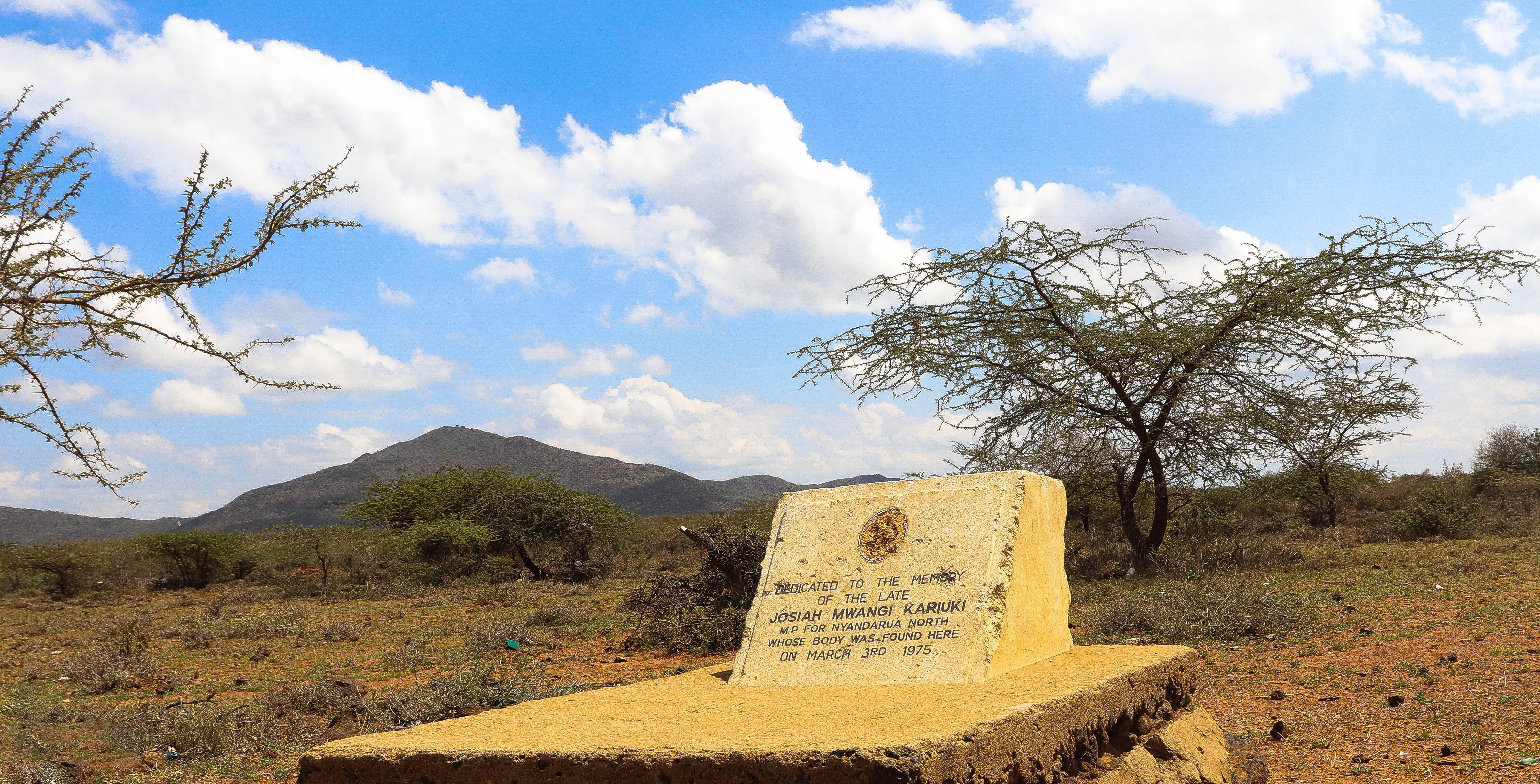
On or around 2 March 1975, Josiah Mwangi Kariuki was abducted in Nairobi. His body was found at the Ngong Hills — the range of forested hills southwest of the capital that Kenyans had always known as a place of beauty and that now acquired a different association — on 2 March 1975. He had been tortured. He had been shot. His body had been mutilated in ways that communicated the contempt and fear of those who had ordered the killing. He was forty-five years old.
The parliamentary select committee that investigated the murder — in itself a remarkable act of legislative independence in the context of Kenyatta's Kenya — produced a report that named members of the General Service Unit as responsible and implicated figures close to the President. The committee's chairman, Elijah Mwangale, and its members showed considerable courage in conducting the investigation and presenting findings that the government clearly did not want presented. The government's response was equally clear: Kenyatta dismissed the report, the committee members faced harassment and career consequences, and no prosecutions were ever brought. The murder had served its intended purpose — the removal of a voice the establishment found dangerous — and the impunity with which it was carried out sent an unmistakable message to anyone who contemplated following Kariuki's example.
The assassination of JM Kariuki was not an isolated event in the history of Kenyan political violence; it was part of a pattern that included the murder of Tom Mboya in 1969 and would continue under Moi with further political killings and disappearances. But it occupied a particular place in that pattern because of who Kariuki was and what he represented. Mboya had been a brilliant organiser and Pan-Africanist whose murder had ethnic as well as political dimensions. Kariuki was the poor people's champion — the politician who had spoken most directly and most persistently for the ten million beggars against the ten millionaires — and his murder communicated that in Kenya, that kind of speaking had lethal consequences.
The Memory That Survived the Murder
JM Kariuki's death did not silence the argument he had been making. His phrase about ten millionaires and ten million beggars entered the permanent vocabulary of Kenyan political discourse — a formulation so accurate and so memorable that it could not be unspoken. His memoir Mau Mau Detainee remained in print and in circulation, a first-hand account of the colonial detention system that no official history could replace. His parliamentary speeches were preserved in Hansard. And the conditions he had been describing — the inequality, the land injustice, the concentration of wealth among the politically connected — remained as visible and as politically relevant after his death as before it.
The democratic reform movement of the late 1980s and early 1990s — the movement that Charles Rubia and Oginga Odinga initiated with their 1990 call for multiparty democracy — drew on the same reservoir of popular anger at inequality and exclusion that Kariuki had channelled in the early 1970s. The specific arguments had evolved, the specific personalities had changed, but the fundamental political reality — that the independence settlement had failed to deliver economic justice to the majority — remained the same. Kariuki had been among the most effective articulators of that failure, and the violence with which the state had responded to his articulation was itself evidence of how accurate and how threatening the articulation was.
He remains one of the most significant and most mourned figures in Kenyan political history — a man who had survived nine years of colonial detention only to be murdered by the government that those detained alongside him had helped bring to power. The tragedy of his life and death is inseparable from the broader tragedy of the independence settlement: the sacrifice of the Mau Mau generation produced a liberation that benefited a narrow class while leaving the majority in the poverty that the liberation struggle had promised to end. JM Kariuki named that tragedy clearly, paid for the naming with his life, and left behind a phrase that Kenya has not been able to forget.