At a Glance
Krugersdorp, Aligarh, Edinburgh: The Making of a Revolutionary Doctor
Yusuf Dadoo's formation as a political thinker occurred across three continents and through three distinct intellectual and political environments that each contributed something essential to the synthesis that defined his mature political thought. His Krugersdorp childhood gave him the direct experience of racial discrimination and communal subordination that was the foundation of his political motivation — the daily reality of anti-Indian legislation, of being a member of a community that was simultaneously economically established and politically excluded, that was told it did not fully belong in the country where it had lived for generations. His years at Aligarh Muslim University in India gave him exposure to the Indian independence movement, to the Congress's nationalist politics, and to the broader anti-colonial tradition that was reshaping the political possibilities of the non-European world in the 1930s. And his years at Edinburgh, where he qualified as a doctor, gave him access to the British and European socialist and communist traditions — to the theoretical frameworks of Marxism and its analysis of capitalism, class, and imperialism that would provide the analytical structure for his understanding of South African racial domination.
He returned to South Africa in 1936 already committed to a political programme that integrated anti-racism, anti-imperialism, and class analysis in a synthesis that the Communist Party of South Africa's theoretical tradition had been developing since the 1920s. The CPSA — which would later be dissolved and reconstituted as the South African Communist Party — had developed, through the theoretical work of figures like Moses Kotane and others, the analysis of South Africa as a "colonialism of a special type": a society in which racial oppression and capitalist exploitation were so deeply intertwined that neither could be fully addressed without addressing the other, and in which the liberation of the Black majority from racial domination was simultaneously a step toward the transformation of the capitalist economic system that racial domination served. This analysis shaped Dadoo's political programme and distinguished it from a narrower anti-racism that might have settled for formal political equality without addressing the economic structures that made racial inequality possible.
The South African Indian Congress and the 1946 Passive Resistance Campaign
The South African Indian Congress had been founded in 1923 as the successor to earlier organisations representing the Indian community's political interests, and by the 1940s it was the primary vehicle for Indian South African political organisation. Dadoo's rise within the SAIC — he became president of the Transvaal Indian Congress, which was the SAIC's most significant regional body, in 1945 — was part of a broader transformation of the Congress from a moderate, merchant-dominated body focused on protecting the economic interests of the established Indian business community into a more assertive, mass-based organisation committed to the full equality of all South Africans regardless of racial or communal background.
The 1946 Asiatic Land Tenure and Indian Representation Act was the immediate occasion for the passive resistance campaign that made Dadoo's name nationally and internationally. The Act restricted Indian South Africans' right to own property in areas where they had previously been permitted to do so, and offered them a form of political representation through a communal council that was explicitly designed to provide the appearance of representation without its reality. Both provisions were deeply objectionable: the property restrictions were a direct attack on the economic position of a community that had built its stability in South Africa over generations through property ownership, and the communal representation was a trap — accepting it would have meant accepting the legitimacy of a system that categorised South Africans by race and assigned their political rights on communal rather than individual grounds.
Dadoo and Monty Naicker — who led the Natal Indian Congress, the SAIC's other major constituent body — organised the passive resistance campaign that followed: a two-year programme of non-violent civil disobedience in which Indian South Africans entered land they were legally prohibited from owning and invited arrest. The campaign drew directly on Gandhi's earlier South African campaigns and on the simultaneous Indian independence struggle, and it attracted substantial international attention at a moment — immediately after the Second World War, in the founding years of the United Nations — when the language of racial equality and human rights was acquiring a new international currency that the apartheid state found increasingly difficult to resist. The campaign was eventually suppressed, but it established the SAIC as a mass political organisation, confirmed Dadoo's leadership, and built the inter-racial relationships with the ANC that the Doctors' Pact of 1947 would formalise.
The Doctors' Pact, the Congress Alliance, and the Freedom Charter
The Doctors' Pact of March 1947 — signed by Dadoo and Naicker on behalf of the Indian congresses and by A. B. Xuma on behalf of the ANC — was one of the foundational documents of South African non-racial liberation politics. Its significance lay not in its specific provisions, which were relatively modest, but in what it represented: a formal commitment by the African and Indian political organisations to work together against racial discrimination rather than pursuing separate communal strategies. This was not inevitable; there were significant forces within both communities that preferred communal organisation — that believed the Indian community's specific interests were best protected by an Indian organisation focused on Indian issues, or that the ANC should concentrate on African interests without the complications of multi-racial alliance. Dadoo was the most important figure on the Indian side in arguing against this position and for the non-racial alliance politics that the Pact established.
The Congress Alliance that grew from the Doctors' Pact — incorporating the ANC, the SAIC, the Congress of Democrats (which organised white South Africans sympathetic to the liberation movement), and the Coloured People's Congress — was the organisational framework within which the Freedom Charter was produced at the Congress of the People at Kliptown on 25–26 June 1955. The Freedom Charter — "The people shall govern! All national groups shall have equal rights! The people shall share in the country's wealth!" — was the liberation movement's most important programmatic statement, the document that articulated most fully what the liberation movement was fighting for and how it envisioned the society it wanted to build. Dadoo's role in building the Congress Alliance that made the Charter possible was one of his most lasting contributions to the liberation struggle.
The Freedom Charter's economic programme — its insistence that the mineral wealth beneath the soil, the banks, and the monopoly industries belonged to the people, that the land should be shared among those who worked it — reflected the SACP's influence on the Alliance's political programme, and Dadoo was one of the most important conduits of that influence. The tension between the Charter's economic radicalism and the more moderate political positions of some in the ANC's leadership was one of the recurring fault lines of liberation movement politics, and Dadoo consistently argued for the more radical reading — for understanding the Freedom Charter not merely as a programme for political democracy but as a commitment to economic transformation as well.
The SACP Underground, Exile, and Three Decades in London
The Sharpeville massacre of March 1960 and the subsequent banning of the ANC and SACP transformed the conditions of the liberation movement's work. The banning of the SACP — which had already reconstituted itself underground following its first dissolution in 1950 — forced it deeper into clandestinity, and Dadoo's departure from South Africa in 1960 was part of the broader reorganisation of the movement's structures in response to the new repressive environment. He settled in London, which became the base for three decades of exile political work that was, in its own way, as significant as the underground work he had done inside South Africa.
From London, Dadoo worked alongside Oliver Tambo in the ANC's external mission — the two men forming one of the most important partnerships in the history of the exile liberation movement. Tambo was the ANC's external face, the person who maintained the movement's political relationships with governments, international organisations, and solidarity movements across the world; Dadoo was the SACP's senior representative, the person responsible for maintaining the communist party's analytical and organisational contribution to the movement and its relationships with communist parties internationally, particularly with the Soviet Union and the Eastern European states whose material support was crucial to the liberation movement's survival.
His chairmanship of the SACP, which he assumed in 1972, gave him formal authority over an organisation that was simultaneously underground, in exile, and attempting to maintain its presence inside South Africa through carefully managed clandestine networks. The SACP's role in the liberation movement was contested — within the ANC there were always voices that believed the communist party's influence was excessive, that it distorted the ANC's non-racial nationalism in a Marxist direction that was inappropriate to South African conditions, and that the ANC's relationship with Moscow through the SACP compromised the movement's independence. Dadoo's response to these criticisms was consistent and principled: the SACP's analysis of South Africa as a colonialism of a special type, its understanding of the relationship between racial and class oppression, and its organisational discipline and cadre training were essential contributions to a movement that needed all the analytical and organisational resources it could find.
The Question of Non-Racialism: Dadoo's Most Important Legacy
Yusuf Dadoo's most important legacy is not any specific campaign or organisational achievement but the political choice he made at the beginning of his career and maintained consistently until his death: the choice to build a non-racial liberation politics rather than a communal Indian politics, to align the Indian South African community's political organisation with the African majority's liberation movement rather than attempting to protect communal interests through separate negotiation with the white state.
This choice was not obvious or inevitable. The South African Indian community in the 1940s faced a genuine strategic question about how best to protect its interests in a society that was increasingly hostile to its presence. One answer — the communal answer — was to negotiate with the white state for specific protections of Indian rights, accepting the racial categorisation that the state imposed as the framework for political representation. Another answer — Dadoo's answer — was to reject the racial categorisation entirely, to align with the ANC's programme of non-racial liberation, and to work toward a South Africa in which racial categories would no longer determine political rights or life chances. The first answer offered possible short-term protection at the cost of accepting and reinforcing the racial system; the second offered the possibility of genuine equality at the cost of accepting that the Indian community's specific interests would be subordinated to the broader programme of the liberation movement.
Dadoo chose the second answer and spent four decades arguing for it, organising for it, and paying the personal cost of exile for it. The Freedom Charter's clause that "South Africa belongs to all who live in it, black and white" — the clause that most clearly expressed the non-racial vision at the heart of the Congress Alliance — is in significant part his intellectual and political achievement. The multi-racial South Africa that the 1994 elections produced, imperfect and contested as it has been, is closer to what Dadoo fought for than to what his communalist opponents within the Indian community were offering. That his name is less well known than those of the liberation movement's African figures is a function of the historiography's tendency to follow the dominant political narratives; his significance in the making of those narratives was as great as most of the people whose names are better remembered.
Death in Exile and the Recognition That Came Too Late
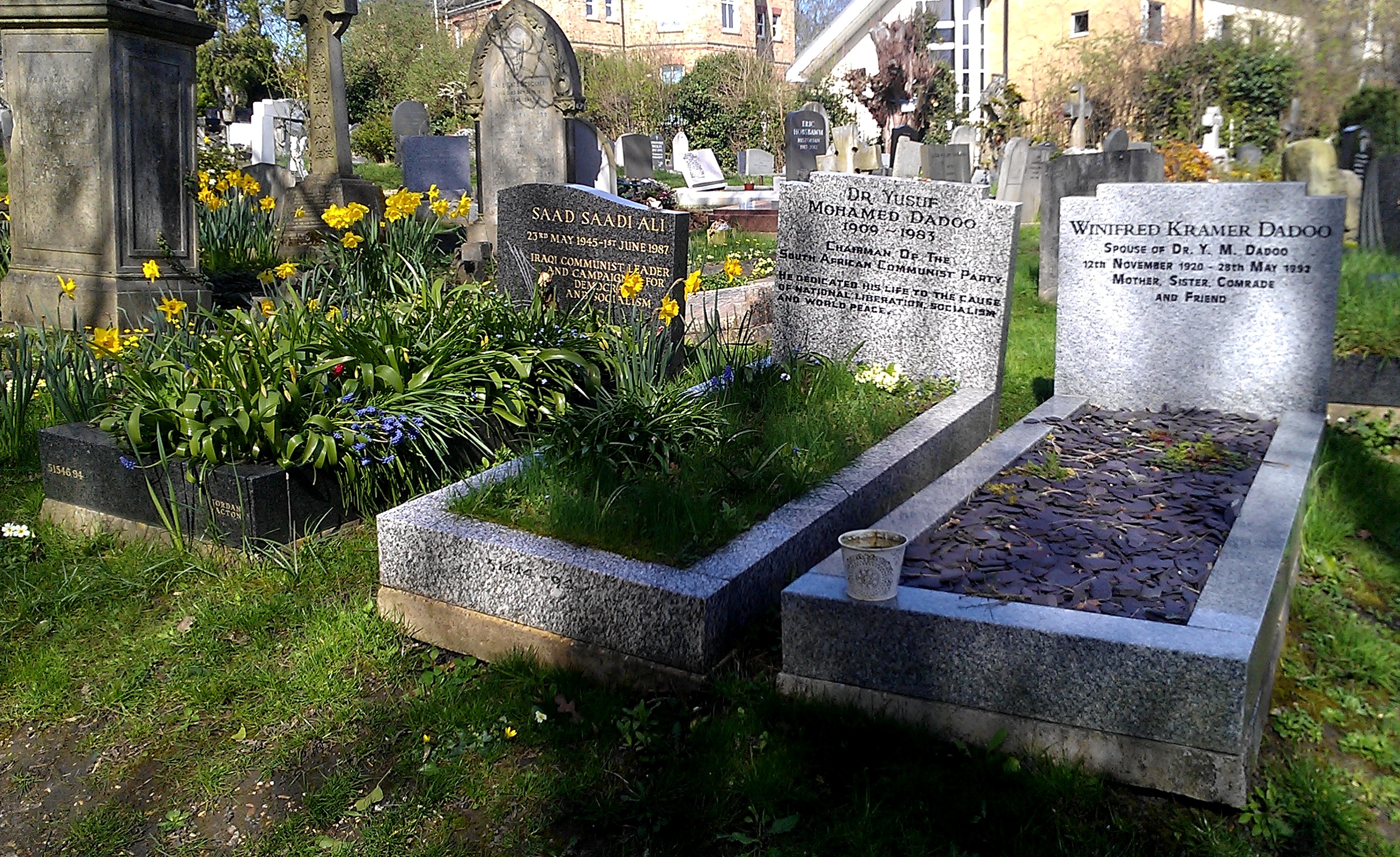
Yusuf Dadoo died in London on 19 September 1983 — eleven years before the democratic South Africa he had given his life to create came into existence. He died in exile, separated from the country of his birth by more than two decades of enforced absence, and he died without seeing the liberation movement's victory. He was seventy-four years old. Oliver Tambo, who had worked alongside him in London for more than two decades, delivered the eulogy at his memorial service. The ANC and SACP mourned him as one of their most important figures; the wider world largely failed to notice.
In democratic South Africa, Dadoo has received some of the posthumous recognition his contribution warranted: streets have been named after him, he has been the subject of commemorative events, and his role in the Congress Alliance and the Freedom Charter process has been acknowledged in the historical record. But he remains less celebrated than many figures of lesser significance in the liberation movement's history, partly because his work was primarily organisational and theoretical rather than dramatic and symbolic, and partly because the liberation movement's historiography has not always been as attentive to the contributions of Indian South Africans as it has been to those of its African figures.
His legacy deserves better than this. Dadoo was one of the architects of the non-racial South Africa that the constitution of 1996 attempted to describe and that the liberation movement at its best aspired to build. That the aspiration has been only partially realised does not diminish the importance of the aspiration or of the people who gave their lives to it. He was one of those people — a man who chose principle over communal interest, solidarity over safety, and the long view over the immediate accommodation — and the South Africa that exists, with all its failures and all its achievements, owes something to that choice.