At a Glance
Cofimvaba, Fort Hare, and the Formation of a Revolutionary
Chris Hani was born in 1942 in Cofimvaba, a small town in the Transkei whose name was recognisable to most South Africans only as a place on a map of the reserves — one of the many small towns in the rural homelands that the apartheid economy had stripped of economic activity and that the migrant labour system had depleted of their most productive men, who left for the mines and factories and returned, if they returned at all, as older and often broken versions of themselves. His father was one of these migrants — a man whose labour sustained an urban economy that provided him with almost nothing in return and whose absence was both an economic necessity and an unacknowledged social catastrophe for the families left behind.
Hani was educated at Catholic mission schools — St. John's College in Umtata was the most significant of these — and received the kind of solid intellectual foundation that the mission schools provided at their best: rigorous, demanding, and at the same time infused with the implicit message that the students' potential was real and that the colonial and apartheid system's denial of that potential was an injustice rather than a fact of nature. He was academically gifted and was admitted to Fort Hare University — the institution that had educated Mandela and Tambo and Govan Mbeki and that remained, despite the apartheid government's attempts to reduce it to a Bantustan institution, a place where the liberation movement's intellectual and political traditions were transmitted to each new generation.
At Fort Hare he joined the ANC Youth League and then the SACP. The combination was natural in the political environment of the early 1960s: the ANC's banning, the formation of MK, and the Rivonia arrests were either imminent or occurring, and the young men at Fort Hare who were serious about the liberation struggle understood that the time for moderate politics was over. Hani's subsequent career — the military training, the guerrilla campaign, the exile decades — was set in motion by choices made at Fort Hare in the years immediately before and after the banning of the ANC.
Exile, the Wankie Campaign, and the Making of a Military Commander
Hani went into exile in 1963, traveling through the network of ANC and SACP contacts that moved young men out of South Africa and into the training camps that the organisation was establishing in Tanzania, Angola, and elsewhere. He underwent military training in the Soviet Union — one of the primary providers of military education to MK's cadres — and emerged as a trained guerrilla operative with both the technical skills and the political formation that MK's military wing required.
The Wankie Campaign of 1967 and 1968 was the operation that established his military reputation. The ANC and ZAPU — the Zimbabwe African People's Union, which was fighting its own liberation struggle against Rhodesian white minority rule — agreed to a joint military operation that would infiltrate guerrillas through the Wankie Game Reserve in Rhodesia, with the dual purpose of supporting ZAPU's operations inside Rhodesia and establishing a route through which MK guerrillas could eventually infiltrate South Africa itself. The Luthuli Detachment, which Hani commanded alongside other MK officers, crossed into Rhodesia and encountered Rhodesian security forces and South African police units that had been deployed to assist them.
The campaign was, militarily, a disaster: the Rhodesian forces were better equipped, better informed, and operating in terrain they knew far more intimately than the infiltrating guerrillas. Most of the Luthuli Detachment were killed or captured. Hani survived — through a combination of tactical skill, physical endurance, and what he himself described as fortune — and made his way out of Rhodesia with a small group of survivors. The campaign's military failure was matched by its political significance: it demonstrated that the ANC was capable of attempting direct military action against the apartheid-aligned white minority regimes, that its cadres were willing to fight and die for the liberation struggle, and that the movement had not been destroyed by the Rivonia arrests and the post-1964 repression.
Hani's reputation within MK was transformed by Wankie. He had gone in as a trained operative; he emerged as a commander with combat experience, the respect of his surviving comrades, and the political authority that comes from having been tested and not having failed. His subsequent rise through MK's ranks — to Chief of Staff, to the position of the movement's most credible military figure — was built on this foundation of direct experience rather than bureaucratic seniority.
The Return, the SACP, and the Voice of the Poor
The unbanning of the ANC in February 1990 and the beginning of the transition process required the ANC and its allied organisations to transform themselves from liberation movement structures to political parties capable of functioning in a democratic system — a transformation that required not only organisational change but political repositioning. The ANC's moderate leadership — led by Mandela, Thabo Mbeki, and the team that had been conducting secret negotiations with the National Party government — was committed to a constitutional transition that would prioritise political democracy and national reconciliation, and that was prepared to accept constraints on the pace and extent of economic transformation in order to secure the white minority's acceptance of the transition.
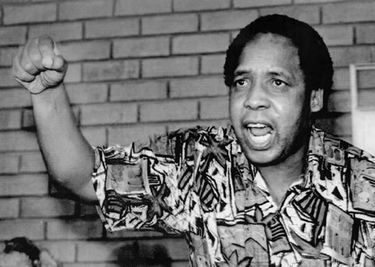
Hani's return to South Africa brought back a figure who represented a different political tendency within the ANC Alliance — one that was committed to the same constitutional democracy but that insisted the economic transformation question could not be deferred indefinitely, that the liberation struggle's promise to the poor could not be discharged by political rights alone. He was elected SACP General Secretary in 1991, succeeding Joe Slovo, and used that platform to articulate a programme of nationalisation, land redistribution, and economic restructuring that went significantly beyond what the ANC's economic negotiating team was proposing.
His popularity among township youth was both his greatest political asset and a source of political tension within the ANC Alliance. Opinion polls in the early 1990s consistently showed him as the most popular leader among young Black South Africans — ahead of Mandela in some surveys, not because he was more respected than Mandela but because his working-class origins, his military record, his uncompromising rhetoric about economic transformation, and his direct, unambiguous engagement with the conditions of township life spoke to constituencies that found the ANC's carefully managed negotiating positions insufficiently radical. He was the person the youth would follow if the transition process broke down; he was also the person most capable of holding the youth in the process if he chose to do so.
Easter Saturday: The Assassination and Its Aftermath
On the morning of 10 April 1993 — Easter Saturday — Janusz Waluś drove to the Dawn Park neighbourhood of Boksburg, where Hani had recently purchased a modest house, and shot him four times in his driveway as he returned from buying a newspaper. Hani died at the scene. Waluś drove away. Retha Harmse, a white neighbour, saw the car, noted the registration number, and called the police. Waluś was arrested within hours. Clive Derby-Lewis, a Conservative Party MP who had compiled a list of ANC and SACP leaders for assassination and whose wife had typed Hani's address onto the list, was arrested shortly afterward. Both were convicted of murder and sentenced to death. Their sentences were later commuted to life imprisonment, and both eventually applied for parole — applications that were opposed by Hani's widow Limpho and by the SACP.
The assassination was the single most dangerous moment of the transition period. Hani was not merely a political leader; he was the person who embodied the liberation movement's credibility with the most volatile constituency in South African politics — the township youth who had been fighting in the streets since 1976 and who were prepared to abandon the negotiation process if they concluded it was betraying them. His death removed the leader who could have held them in the process, and it threatened to release the violence that the assassins' political backers — elements of the far right who wanted to derail the transition and restore white minority rule — had intended it to release.
What prevented the collapse was primarily Mandela's address to the nation that evening — one of the most consequential political speeches in South African history, in which he called for calm while acknowledging grief, praised the white neighbour whose observation had caught the killer, and insisted that the transition process must continue. The speech worked not because it suppressed the anger — it acknowledged the anger explicitly — but because it gave the anger a direction: toward the political system that was being constructed, toward the elections that would give Black South Africans the power to honour Hani's memory by building the society he had fought for.
What Was Lost
The question of what South Africa lost when Chris Hani was killed is not simply a question about an individual life, though the loss of the individual was itself immense. It is a question about the political direction of the transition and of the democratic order that followed. Hani was the SACP's most credible voice for the programme of economic transformation — nationalisation, land redistribution, structural economic change — that the party had championed throughout the liberation struggle and that the ANC's negotiating team was progressively setting aside in favour of the market-friendly economic policies that the post-apartheid government eventually adopted.
Whether Hani, had he lived, would have been able to shift the ANC Alliance's economic programme in a more redistributive direction, or whether the structural pressures of the transition — the need to maintain investor confidence, the constraints of the global economic environment, the requirements of political stability — would have prevailed regardless of his advocacy, is a question that cannot be answered. What can be said is that his death removed the most powerful voice for a different direction from the political conversations that shaped the post-apartheid order, and that the South Africa that emerged from those conversations — politically democratic, economically unequal, with structural inequality largely intact — was not the South Africa he had spent his life working to create.
Legacy
Chris Hani's legacy is complex because his life was cut off before it was complete — before he had the opportunity to either realise or fail to realise the political programme he championed. He is remembered primarily through the assassination and through the political crisis it created, which risks reducing him to a symbol of what was lost rather than an understanding of what he actually was: a man of genuine intellectual force, military courage, and political commitment who had earned his leadership through decades of struggle rather than through administrative advancement or political connection.
The SACP and the ANC Alliance continue to invoke his name in debates about economic policy — as a marker of the radical economic tradition that the transition settlement marginalised. This invocation is sometimes deployed cynically by politicians who claim his legacy while pursuing policies he would have opposed. But the genuine political tradition he represented — the insistence that political democracy without economic transformation is insufficient, that the liberation struggle's promise to the poor has not been discharged by the right to vote — remains alive in South African politics, contested and unresolved, as he left it.