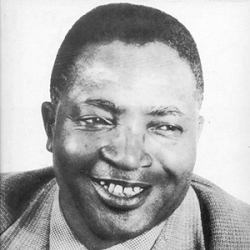
At a Glance
Rustenburg and the World That Made Him
Moses Kotane was born on 9 August 1905 — a date that the post-apartheid South Africa would designate as National Women's Day in honour of the 1956 Women's March — in Wentworth, a small community near Rustenburg in the western Transvaal. He was born into the world of the African peasantry of the Transvaal: a world in which the land laws of the colonial and early Union period had severely restricted African land ownership, in which the male members of rural families were increasingly drawn into the migrant labour system of the mines and the farms, and in which formal education was available only through mission schools whose resources were a fraction of those provided to white children.
Kotane's formal education went as far as mission schooling could take him, and then he educated himself — through reading, through the political discussions and debates of the labour movement and the Communist Party, through the theoretical training of the Lenin School in Moscow, and through decades of engagement with the Marxist tradition in the context of the specific conditions of South African society. His self-education was not a handicap or a limitation; it was a formation, a process that gave him both the intellectual tools he needed and a knowledge of their application to conditions he had lived rather than merely observed.
He came to the Communist Party in the 1920s, when the party was still developing its understanding of the relationship between class politics and race politics in South Africa, still working out what Marxism meant in conditions that differed significantly from the European industrial capitalism in which the tradition had been developed. He brought to that process of working out a perspective that was unavailable to most of the Party's leadership: the perspective of a Black South African worker whose experience of the racial economy was not theoretical but lived, whose knowledge of what the system did to people was not derived from observation of others but from personal history.
The Lenin School and the Development of an Independent Communist
Kotane's selection for training at the International Lenin School in Moscow in the late 1920s was both an honour and a formation. The Lenin School was the Comintern's principal instrument for developing communist leaders from its affiliated parties — a place where selected cadres received intensive theoretical training in Marxism-Leninism, developed relationships with communists from other national parties, and were exposed to the institutional culture of the international communist movement at the height of Stalin's consolidation of power in the Soviet Union.
The paradox of Kotane's time at the Lenin School is that the institution designed to produce disciplined communist cadres loyal to the Soviet line produced instead a man of formidable intellectual independence who would spend the rest of his career applying his own judgment to political questions rather than deferring to Moscow's authority. This was not ingratitude or disloyalty; it was the result of a genuinely serious engagement with Marxist theory that led Kotane to the conclusion that the theory had to be applied to specific conditions rather than imported as a template, and that the specific conditions of South Africa required approaches that differed from those appropriate to European communist parties or to the Soviet experience.
He returned from Moscow with both the theoretical formation he had received and the independent judgment that his own character had preserved. The combination made him, over the following decades, one of the most effective and one of the most intellectually serious communist leaders in the African continent.
The Kotane Letter: The Most Important Internal Critique
In 1934, serving as Party secretary in the Western Cape, Moses Kotane wrote the document that became known as the Kotane Letter — one of the most important internal documents in the history of the South African Communist Party, and one of the most prescient pieces of political analysis produced by any figure in the South African liberation movement in the 1930s.
The letter addressed a problem that Kotane had observed in the Party's operation: the CPSA was overwhelmingly led by white and Indian members, primarily from the educated professional and petit bourgeois strata, whose social distance from the African working class they claimed to represent was both an organisational weakness and a political contradiction. The Party claimed to be the party of the working class, but the African workers who constituted the overwhelming majority of South Africa's working class found the Party's leadership, its language, and its political culture alien to their experience. The result was a Party that had an excellent theoretical framework and a very limited relationship with the mass constituency its programme addressed.
Kotane's argument was that this had to change — that the Party needed to develop African leadership at every level, to conduct its work in African languages and in the cultural idioms of African communities, to engage with the specific political and social conditions of African life rather than imposing a European communist model on conditions for which it was not designed. He argued that the Africanisation of the Party was not a concession to racial thinking but a recognition that communist politics needed to be rooted in the actual conditions of the people it sought to organise.
The letter was received with hostility by significant elements of the Party leadership who saw it as a challenge to the international communist tradition's rejection of racial categories. But Kotane persisted, and the argument he made in 1934 was gradually vindicated over the following decades as the SACP became increasingly African in its composition and leadership and as the Africanisation he had advocated proved essential to the Party's effectiveness in the liberation movement.
General Secretary and the Architecture of the Alliance
Moses Kotane's election as general secretary of the CPSA in 1939 gave him the institutional position from which his most important work would be done. As general secretary through the 1940s, 1950s, and into the 1960s — through the banning of the CPSA, through the formation of the underground SACP, through the development of the Congress Alliance and the Defiance Campaign and the Freedom Charter — he was the most important single figure in the management of the relationship between the Communist Party and the ANC.
His dual membership — general secretary of the SACP and member of the ANC's National Executive Committee and its treasurer — gave him a unique vantage point on the relationship between the two organisations and a unique ability to manage the tensions that inevitably arose between them. The Communist Party and the ANC were distinct organisations with distinct memberships, distinct programmes, and at times distinct political emphases. The Congress Alliance that linked them was not a merger but a partnership, and partnerships between distinct organisations require active management to remain functional. Kotane was the principal manager of this relationship for two decades, and the Alliance's coherence through those decades was in significant part his achievement.
He was a pragmatist as well as a principled thinker — someone who understood that political effectiveness required the maintenance of workable relationships even with people and organisations with whom one had significant disagreements. The ANC's more conservative elements were sometimes suspicious of the communist influence that Kotane represented, and the SACP's theoretical commitments sometimes sat uneasily with the ANC's broader nationalist orientation. Kotane navigated these tensions with the patience and the strategic intelligence of a man who had been managing difficult political relationships for decades and who understood that the alternative to managing them was their breakdown, which would serve no one's interests.
Resisting Moscow: The Independence of the South African Line
One of the most significant but least celebrated aspects of Moses Kotane's political career was his willingness to resist Moscow's directives when he believed they were wrong for South African conditions. This was not a trivial matter in the context of the international communist movement of the Stalinist era — the Comintern's authority over affiliated parties was substantial, and resistance to its line could have serious consequences for a Party leader's standing within the international movement.
The most significant instance of Kotane's resistance was his opposition to the dissolution of the Communist Party of South Africa under the Suppression of Communism Act of 1950. The Comintern-influenced international communist movement had decided that communist parties in countries where they faced legal banning should dissolve themselves rather than continue underground — a position that reflected the particular conditions of the postwar Western European context but that Kotane believed was wrong for South Africa. He resisted the dissolution decision as long as he could, arguing that the South African Party could and should continue as an underground organisation rather than simply ceasing to exist in response to the apartheid government's demands.
He was eventually overruled, and the CPSA was formally dissolved in 1950. But it reconstituted itself almost immediately as the underground SACP, and Kotane continued as its general secretary in the new form. His resistance had delayed but not prevented the dissolution, and the underground reconstitution that followed vindicated his argument that the Party could continue in the changed conditions. The episode illustrated both the limits of his ability to defy the international movement's decisions and the depth of the political independence that led him to try.
The Stroke, Moscow, and the Final Irony
In 1963, Moses Kotane suffered a severe stroke that left him substantially incapacitated. He was fifty-eight years old. The stroke effectively ended his active political career, though he retained his formal positions in the SACP and the ANC for years afterward. He was taken to Moscow for medical treatment — the Soviet Union's provision of medical care for senior liberation movement figures was one of the most concrete forms of material support it offered — and he remained in Moscow for the rest of his life.
He died in Moscow on 19 May 1978, at the age of seventy-two. He had spent the last fifteen years of his life in the Soviet Union — the country whose political directives he had sometimes resisted, whose institutional culture he had sometimes argued against, and whose support for the South African liberation movement he had also depended on and valued. The irony of his death in Moscow was not lost on those who had known him and his political history.
He died in Moscow, far from Rustenburg where he had been born, far from the South Africa for which he had given his political life. In this he joined JB Marks, who had died in Moscow six years earlier, and anticipated Yusuf Dadoo, who would die in London five years later. The generation that had built the Congress Alliance and developed the theoretical and organisational framework of the South African communist tradition died in exile, without seeing the democratic South Africa they had devoted their lives to creating.
Legacy: The Man Who Held Two Movements Together
Moses Kotane's legacy is both organisational and intellectual. Organisationally, he was the general secretary of the SACP for nearly a quarter century — the person most responsible for maintaining the Party's coherence through its banning, its underground reconstitution, and its development as the ANC's most important ally in the liberation struggle. He was simultaneously the ANC's treasurer and NEC member — the living embodiment of the Congress Alliance relationship and its most important single maintainer. The Alliance that made the liberation movement what it was existed through the decades of Kotane's dual commitment in part because of his patient, skilled work in holding it together.
Intellectually, his most important contribution was the Kotane Letter and the argument for the Africanisation of the SACP — the insistence that communist politics in South Africa needed to be rooted in the conditions and the culture of the African working class rather than imposed as a template from European or Soviet experience. This argument, resisted when it was first made, was gradually vindicated as the Party's development confirmed Kotane's analysis. The SACP that emerged from the transition period — increasingly African in its leadership and its political orientation — was in significant part the product of the direction he had pointed to in 1934.
He was self-educated, brilliant, independent, and devoted — a man who had risen from the peasant world of the western Transvaal to the leadership of the most intellectually serious organisation in the South African liberation movement, who had maintained that leadership through some of the most difficult decades in the history of the international communist movement, and who had done so with an independence of judgment that was both his most distinctive quality and his most important contribution. South Africa's liberation was, in part, his work.