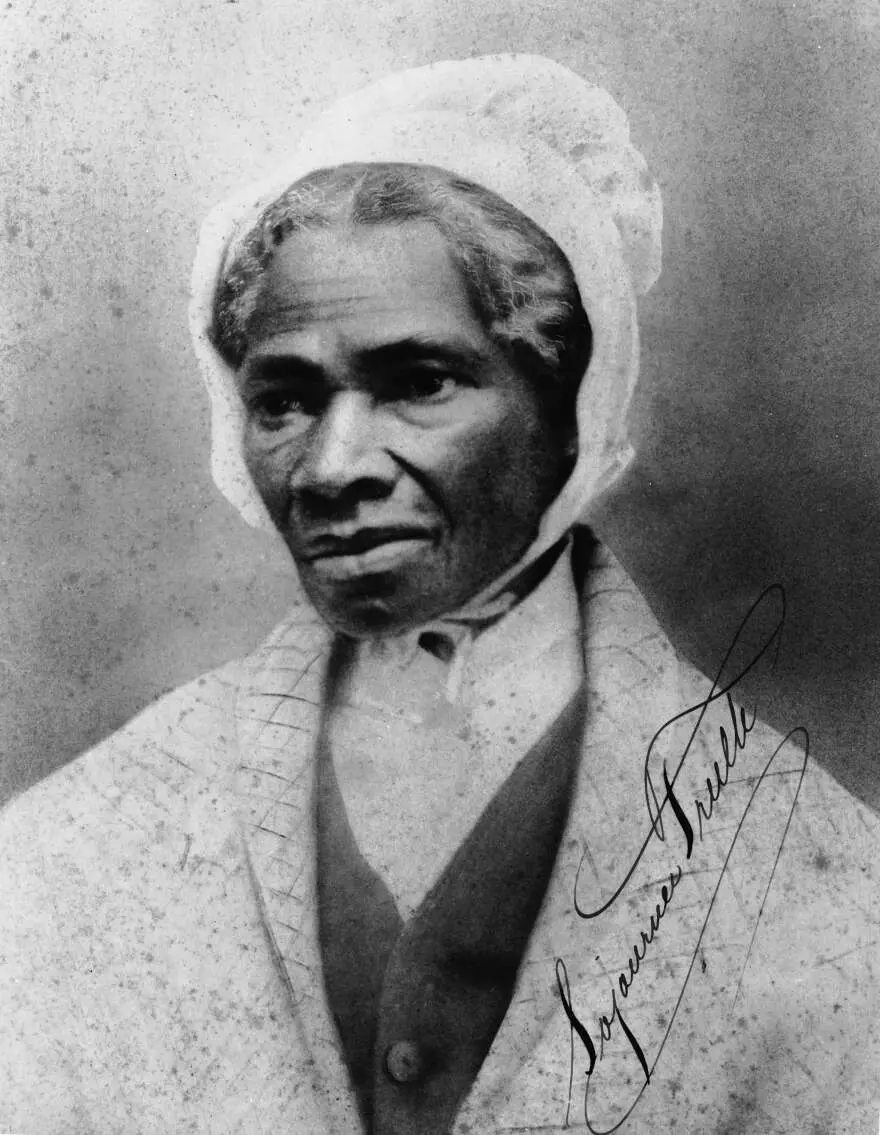
Sojourner Truth, escaped slave and abolitionist orator who delivered the Ain't I a Woman speech in Akron in 1851 and worked for the Union cause during the Civil War.
United States · Civil Rights Movement

Sojourner Truth

Isabella Baumfree was born around 1797 — the exact date unknown, as enslaved people were not given birth records — in Swartekill, Ulster County, New York, to enslaved parents named James and Elizabeth, known as Betsey, who were owned by Colonel Johannes Hardenbergh. She grew up speaking Dutch as her first language, was sold away from her parents as a child, was sold again multiple times, was beaten and sexually abused by her enslavers, married a fellow enslaved person named Thomas with whom she had five children, and escaped from slavery in 1826 — one year before New York's gradual emancipation law would have freed her — carrying her infant daughter Sophia with her to the home of Isaac and Maria Van Wagenen, who gave her shelter and paid her enslaver the agreed value for her remaining service. She had left behind her son Peter, who had been illegally sold to a planter in Alabama; she pursued legal action and, in one of the first successful legal actions by a Black woman in American history, obtained her son's return in 1828. She moved to New York City, worked as a domestic, became involved in the Methodist church's evangelical community, experienced a religious transformation in 1843 that she understood as a divine call to travel and to speak — a call that led her to rename herself Sojourner Truth, choosing a name that described both her mode of life (she would sojourn, travel from place to place) and her purpose (she would speak the truth) — and began the itinerant preaching and lecturing career that would define the remaining forty years of her life. She delivered the speech that has come to be known as "Ain't I a Woman?" at the Women's Rights Convention in Akron, Ohio, in 1851 — a speech that challenged the white women's suffrage movement's claims about womanhood by pointing to her own experience as a woman who had worked like a man, who had never been helped into carriages or over puddles, who had borne and lost children into slavery, and who was asking whether any of this diminished her womanhood and what had Christ to do with it in any case. The specific argument she was making — that womanhood had been defined in ways that excluded the experience of Black women, and that any definition of women's rights that did not include Black women's rights was not a definition of women's rights at all — anticipated by a century and a half the intersectionality framework that Kimberlé Crenshaw would develop to name what Truth had perceived and practised. She worked for the Union cause during the Civil War, met President Lincoln at the White House in 1864, attempted to desegregate Washington D.C.'s streetcars by riding them regardless of the drivers' objections, and continued to travel and speak on abolitionism and women's rights until her health declined in the 1870s. She died on November 26, 1883, in Battle Creek, Michigan, at the age of approximately eighty-six.

United States Abolitionism Ain't I a Woman Women's Suffrage Civil War Escaped Slave

Born: c. 1797, Swartekill, New York, USA  |  Died: 26 November 1883, Battle Creek, Michigan, USA — aged approximately eighty-six

At a Glance

Full NameBorn Isabella Baumfree; renamed herself Sojourner Truth in 1843 after experiencing what she understood as a divine call to travel and preach; born approximately 1797, Swartekill, Ulster County, New York; enslaved from birth; escaped from slavery in 1826 carrying her infant daughter; obtained legal return of her son Peter from Alabama in 1828 — one of the first successful legal actions by a Black woman in American history; moved to New York City; religious transformation 1843; began itinerant preaching; delivered "Ain't I a Woman?" at Akron Women's Rights Convention 1851; met President Lincoln at White House 1864; attempted to desegregate D.C. streetcars; continued speaking until health declined in 1870s; died 26 November 1883, Battle Creek, Michigan, aged approximately eighty-six
BornApproximately 1797, Swartekill, Ulster County, New York; enslaved from birth to parents James and Elizabeth (Betsey) Baumfree, owned by Colonel Johannes Hardenbergh; grew up speaking Dutch as her first language, which she spoke with an accent throughout her life; was sold away from her parents as a child; was beaten and sexually abused by her enslavers; had five children with an enslaved man named Thomas; escaped in 1826, one year before New York's gradual emancipation would have freed her
Died26 November 1883, Battle Creek, Michigan; died at the age of approximately eighty-six; had been living in Battle Creek since the 1850s, where the Adventist community had provided a home base for her itinerant preaching career; her death was mourned by the abolitionist and women's suffrage communities; Frederick Douglass delivered a tribute to her; she was buried in Battle Creek where she remains
The Legal Action for PeterAfter escaping slavery, discovered that her son Peter had been illegally sold by her enslaver to a plantation owner in Alabama — a violation of New York's law, which prohibited the sale of enslaved people out of state; pursued legal action through the Dumont family's connections and eventually won her son's return from Alabama; the case was one of the first successful legal actions by a Black woman in American history and demonstrated, at the very beginning of her free life, the combination of determination and strategic intelligence that would characterise everything she subsequently did
The 1843 Transformation and the New NameIn 1843 experienced what she described as a divine call to travel and to speak — a religious transformation that led her to leave New York City and begin the itinerant preaching and lecturing career that defined the remaining forty years of her life; chose the name Sojourner Truth to describe both her mode of life and her purpose; the name was a statement of vocation and of self-definition by someone who had had her identity defined by others since birth and who was now, at approximately forty-six years old, choosing who she was and what she was for
The Akron Speech, 1851Delivered what has come to be known as "Ain't I a Woman?" at the Women's Rights Convention in Akron, Ohio, in 1851; the speech challenged the white women's suffrage movement's definitions of womanhood by pointing to her own experience: she had ploughed and reaped and husked and chopped and mowed alongside any man, had borne thirteen children and seen most of them sold into slavery, and she was asking whether any of this excluded her from womanhood; the speech's core argument — that the women's rights movement's definition of women excluded Black women — was the first major articulation in American public life of what is now called intersectionality
Civil War and LincolnWorked for the Union cause during the Civil War, helping to recruit Black soldiers for the Union Army and collecting food and supplies for Black troops; met President Lincoln at the White House in October 1864, a meeting she described with characteristic directness in her correspondence; attempted to desegregate Washington D.C.'s streetcars by riding them regardless of drivers' attempts to prevent her from boarding — an act of direct action fifteen years before the first organised sit-in movements; continued to travel and speak on abolitionism and women's rights through the 1870s

Swartekill, Dutch-Speaking Slavery, and the Earliest Losses

Sojourner Truth's earliest life was shaped by the specific conditions of New York State slavery — a slavery that differed from the cotton plantation slavery of the Deep South in its scale and its specific organisation but that was no less comprehensive in its dehumanisation. She grew up in Ulster County's Dutch-speaking farm communities, enslaved to Dutch-descended families who spoke Dutch as their primary language, and Dutch was her first and primary language throughout her life. This linguistic formation distinguished her from most of her subsequent movement colleagues and gave her public speaking a distinctive accent that she retained as a feature of her public identity rather than a deficit to be overcome.

She was sold away from her parents as a child — the standard practice of the slave system's destruction of family bonds — and sold again, and again, experiencing with each sale the specific violation of being treated as property whose disposition was determined by market forces rather than by her own choices or the relationships she had formed. She was beaten by enslavers who found her work inadequate or her manner insufficiently deferential. She was sexually abused. She had five children with an enslaved man named Thomas, watching each birth with the knowledge that the child she bore would also be enslaved and would be subject to being sold away from her at any point.

Her escape in 1826 — carrying her infant daughter Sophia, leaving behind her other children who were not yet free, walking to the home of Isaac and Maria Van Wagenen who gave her shelter and paid her enslaver — was the act that began her free life, but it was immediately complicated by the discovery that her son Peter had been sold illegally to an Alabama planter. Her pursuit of Peter's legal return — through the courts, through the legal assistance of the Quaker and Methodist communities she was becoming part of — was the first demonstration of the specific determination and strategic intelligence that would characterise her entire subsequent career.

The 1843 Call and the Self-Naming

The religious transformation that Truth experienced in 1843 — the divine call she understood as directing her to travel and to speak — was the beginning of her public career and the occasion for the act of self-naming that was itself one of the most significant acts of her life. She had been called Isabella Baumfree, inheriting the surname of one of her enslavers in the way that enslaved people were given surnames, and she now chose a name that described what she was going to do rather than who she had been owned by. Sojourner, because she would travel; Truth, because she would speak it.

The choice of this name at approximately forty-six years old was an act of self-definition by someone who had had her identity defined by others since birth. It was the assertion of an autonomous self that enslavement had tried to prevent and that freedom had made possible. It was also strategically effective: the name Sojourner Truth was unforgettable, communicated her purpose, and gave her public persona a quality of moral clarity that "Isabella Baumfree" could not have provided. She had named herself, and the name she chose was exactly right.

Her itinerant preaching career took her across the northeast and midwest, speaking at camp meetings, anti-slavery gatherings, women's rights conventions, and any other venue that would have her. She was illiterate — she never learned to read or write — and dictated her autobiography to Olive Gilbert, which was published as "The Narrative of Sojourner Truth" in 1850. The narrative's publication gave her story a national circulation and provided the specific documentation of her experience that made her speeches more powerful: audiences knew who she was before she spoke.

Akron 1851: The Speech That Named Intersectionality Before Its Name Existed

The Women's Rights Convention in Akron, Ohio, in 1851 was attended by ministers and other men who were arguing that women should not be granted rights because women were too delicate, too dependent, too in need of male assistance to be trusted with political authority. The arguments were being directed at white women who were present and who were, in important respects, representative of the genteel ideal of womanhood the arguments invoked. Truth was also present, and she was not representative of that ideal.

The speech she delivered — standing up after a minister had argued that woman's frailty and dependence demonstrated her need for male protection — made one of the most devastating arguments in the history of American political discourse. She pointed to herself: she had ploughed and reaped and husked and chopped and mowed; no man had helped her into carriages or over puddles; she had borne children and seen most of them sold into slavery; she had as much muscle as any man in the room. Was she not a woman? Had all of this happened to someone who was not a woman? And what did any of it have to do with Jesus, who had come of a woman with no man involved, making the claim that women's authority depended on male sanction theologically incoherent?

The argument she was making — that the women's movement's definition of womanhood excluded the experience of Black women, and that any definition of women's rights that did not include Black women's rights was not a definition of women's rights at all — was the first major articulation in American public life of what Kimberlé Crenshaw would name "intersectionality" a century and a half later. Truth had perceived and practised what Crenshaw would theorise: that the experience of Black women was not the experience of Black people plus the experience of white women, but a specific experience that neither category adequately captured, and that any movement addressing either racial injustice or gender injustice without addressing their intersection was addressing something less than the full reality of the people most affected by both.

The Civil War, Lincoln, and the Streetcar

Truth's work during the Civil War extended her direct action tradition into a new context: she helped recruit Black soldiers for the Union Army, collected food and supplies for Black troops, and worked with the National Freedman's Relief Association in Washington D.C. Her meeting with President Lincoln in October 1864 — which she described in her correspondence with the same directness she brought to everything else — was characteristically direct: she told him she had heard of him before he was president, he signed her "Book of Life" (an autograph book she carried), and she told him he was the best president the country had ever had, receiving the response that she was the first Black woman who had said so to him.

Her attempts to desegregate Washington D.C.'s streetcars in 1865 were among the earliest recorded examples of direct action desegregation of public transportation — fifteen years before the first organised sit-in movements and ninety years before Rosa Parks's Montgomery refusal. She simply boarded streetcars that were not supposed to carry Black passengers, stood her ground when challenged, and used the legal protections available to her to address the cases where drivers physically blocked or ejected her. She won at least one case, obtaining a judicial acknowledgment that she had been wrongfully treated.

She continued to travel and speak through the 1870s, her health gradually declining, until she settled more permanently in Battle Creek, Michigan, where the Adventist community provided a home base. She died in November 1883, at approximately eighty-six years old, having spent forty years after her 1843 transformation speaking truth to power in the most literal sense — telling audiences, including presidents, exactly what she thought, in a voice whose distinctive Dutch-accented English was as unmistakable as the argument it was making.

Other Civil Rights Movement Profiles

USA · Civil Rights Frederick Douglass The nineteenth century's dominant Black freedom voice whose oratorical tradition paralleled Truth's — different in register, equal in importance USA · Civil Rights Harriet Tubman Fellow escaped slave and abolitionist whose direct action tradition complemented Truth's public speaking tradition USA · Civil Rights Mary Church Terrell Who carried Truth's tradition of Black women's civic leadership and anti-racism into the twentieth century USA · Civil Rights Ida B. Wells Whose anti-lynching journalism extended Truth's tradition of bearing direct witness to racial violence into the post-Reconstruction era USA · Civil Rights Pauli Murray Who coined 'Jane Crow' to name what Truth had practised at Akron — the specific intersection of racial and gender oppression that neither movement alone addressed USA · Civil Rights Rosa Parks Whose 1955 Montgomery bus refusal carried forward the direct action tradition Truth had begun with Washington D.C.'s streetcars in 1865 USA · Civil Rights Ella Baker The twentieth century's most important Black woman organiser who carried forward the tradition of principled insistence on full inclusion that Truth had established USA · Civil Rights Fannie Lou Hamer The Mississippi sharecropper whose 'I'm sick and tired of being sick and tired' captured the same exhausted determination that animated Truth's entire career USA · Civil Rights Shirley Chisholm Who ran 'unbought and unbossed' — the same refusal to accept the terms of political normalcy that Truth had embodied at every Women's Rights Convention she attended USA · Civil Rights Septima Clark The educator who taught generations of Black women to claim their civic rights — extending Truth's tradition of practical empowerment into the mid-twentieth century
Share X Facebook WhatsApp LinkedIn