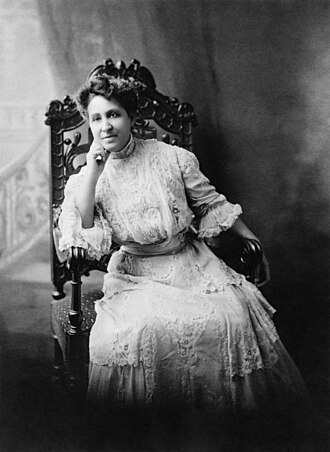
Mary Church Terrell, co-founder of the NAACP, first president of the National Association of Colored Women, and the woman who led the campaign that desegregated Washington D.C.'s restaurants when she was eighty-nine years old.
United States · Civil Rights Movement

Mary Church Terrell

Mary Eliza Church was born on September 23, 1863, in Memphis, Tennessee, the daughter of Robert Reed Church Sr. — who would become one of the wealthiest Black men in the South — and Louisa Ayers, and she was born in the year of the Emancipation Proclamation, in a city where that proclamation's promises were already being constrained by the racial order that would spend the next ninety years reassembling itself in modified forms. Her privileged background — her father's wealth was exceptional by any standard, Black or white, in postbellum Memphis — gave her educational opportunities that were available to virtually no other Black woman of her generation: she attended the Model School affiliated with Antioch College, was sent north for her secondary education, and graduated from Oberlin College in Ohio in 1884, one of the first Black women to graduate from a major American university and one of very few of either race to take the Classical Course rather than the Ladies Course. She earned her master's degree from Oberlin in 1888, studied abroad in Europe for two years, and was offered a position at Oberlin but turned it down to return to the South. She taught at Wilberforce University in Ohio and at the M Street High School in Washington D.C. — the premier Black secondary school in the country — and married Robert Heberton Terrell, a lawyer and eventually a municipal court judge, in 1891. She was appointed to the District of Columbia Board of Education in 1895, becoming the first Black woman to serve on a school board in the United States. She founded and served as the first president of the National Association of Colored Women in 1896 — the organisation that coordinated Black women's clubs across the country and that became one of the most important institutions of Black civic life in the late nineteenth and early twentieth centuries. She was one of the co-founders of the NAACP in 1909, signing "The Call" alongside W.E.B. Du Bois, Ida B. Wells, and others. She wrote and lectured continuously for sixty years — in English, in German, and in French, all of which she spoke fluently — on civil rights, women's suffrage, lynching, and the full range of racial and gender justice issues that her long life encompassed. She spoke before the International Congress of Women in Berlin in 1904 in German, the first Black woman to address an international audience in a language other than English, and she continued speaking and writing until the final years of her life. At the age of eighty-six she joined the campaign to desegregate Washington D.C.'s restaurants and public accommodations, filing suit under the Reconstruction-era laws of 1872 and 1873 that had prohibited racial discrimination in D.C. public places and that had gone unenforced for decades. She sat in at restaurants and was denied service alongside younger activists. In 1953, at the age of eighty-nine, she was present when the Supreme Court ruled in District of Columbia v. John R. Thompson Co. that the old Reconstruction-era laws were valid and enforceable — effectively desegregating the capital city's public accommodations. She died on July 24, 1954, at the age of ninety, two months after the Supreme Court's Brown v. Board of Education decision — having lived from the Emancipation Proclamation to the decision that formally rejected its long betrayal, a span of American history whose entire arc of promise and failure and partial redemption she had experienced, resisted, and helped to transform.

United States NACW NAACP Oberlin College Washington D.C. Reconstruction Era

Born: 23 September 1863, Memphis, Tennessee, USA  |  Died: 24 July 1954, Annapolis, Maryland, USA — aged ninety

At a Glance

Full NameMary Eliza Church Terrell; born 23 September 1863, Memphis, Tennessee; daughter of Robert Reed Church Sr., one of the wealthiest Black men in the South; graduated from Oberlin College 1884 (Classical Course) and earned her MA from Oberlin 1888; taught at Wilberforce University and at M Street High School in Washington D.C.; married Robert Heberton Terrell 1891; appointed to D.C. Board of Education 1895 (first Black woman on a U.S. school board); founded and led the National Association of Colored Women 1896; NAACP co-founder 1909; led D.C. restaurant desegregation campaign 1949-1953; died 24 July 1954, Annapolis, Maryland, aged ninety
Born23 September 1863, Memphis, Tennessee; born in the year of the Emancipation Proclamation; her father Robert Reed Church Sr. had been born enslaved but accumulated substantial wealth in postbellum Memphis real estate; her privileged background gave her educational opportunities unavailable to virtually any other Black woman of her generation; was sent north for her education at the insistence of her father who understood that a southern education would limit her; graduated from Oberlin in 1884, one of the first Black women to graduate from a major American university
Died24 July 1954, Annapolis, Maryland; died at the age of ninety; died less than three months after the Supreme Court's Brown v. Board of Education decision; she had been born before the Civil War was over and died having witnessed and participated in the entire arc of Black civil rights struggle from Reconstruction through the modern movement's first major Supreme Court victory; her death at ninety placed her among the very few people whose lived experience spanned this entire arc
Oberlin and the Formation of an IntellectualAttended Oberlin College's Classical Course — choosing the academically rigorous programme designed for students who intended scholarly or professional careers over the Ladies Course designed for women — graduating in 1884; earned her MA from Oberlin in 1888; studied abroad in Europe for two years, becoming fluent in French and German; was offered a faculty position at Oberlin but returned to the South to teach at Wilberforce and then at M Street High School in Washington D.C.; her linguistic abilities — she delivered speeches in German and French as well as English — were a direct product of her European studies
National Association of Colored WomenFounded and served as the first president of the National Association of Colored Women in 1896, coordinating the Black women's club movement that had developed across the country in the late nineteenth century; the NACW was one of the most important institutions of Black civic life in the Progressive Era, providing a network through which Black women organised for civil rights, education, health, and community welfare in the absence of adequate public provision; her leadership of the NACW established her as the most prominent Black woman civic leader in America in the early twentieth century
NAACP Co-Founder, 1909Was among the signatories of "The Call" that established the NAACP in 1909, alongside W.E.B. Du Bois, Ida B. Wells, and others; her connection to the NAACP placed her at the founding of the most important Black civil rights legal organisation of the twentieth century and gave her a continuing platform for her advocacy; her relationship with the NAACP was sustained through the subsequent decades of her advocacy
The D.C. Desegregation Campaign at Eighty-SixJoined the Coordinating Committee for the Enforcement of the D.C. Anti-Discrimination Laws at the age of eighty-six in 1949 and became the face of the campaign to enforce the Reconstruction-era laws of 1872 and 1873 that had prohibited racial discrimination in D.C. public places; she and other activists sat in at restaurants and were denied service; the campaign's legal case, District of Columbia v. John R. Thompson Co., reached the Supreme Court and was decided in 1953 when Terrell was eighty-nine; the Court ruled the Reconstruction-era laws valid and enforceable, effectively desegregating the capital's public accommodations

Memphis 1863, Oberlin 1884, and the Education That Made Everything Possible

Mary Church Terrell's life spanned so much of American history — from the Emancipation Proclamation to Brown v. Board of Education, from the Civil War's end to the modern civil rights movement's first great Supreme Court victory — that the temptation is to reduce it to its historical bookends and miss what actually happened in between. What happened in between was nine decades of sustained, serious, intellectually rigorous civil rights advocacy by someone whose formation in Black intellectual life's most demanding institutions had given her the tools to sustain it.

Her father Robert Church's wealth — accumulated through real estate and business in postbellum Memphis, making him one of the wealthiest Black men in the South — was the material foundation of her extraordinary educational opportunities. He understood, as wealthy Black Southerners of his generation sometimes did, that the South's educational system was going to limit his daughter's development and that the only adequate response was to send her north where Oberlin College was admitting Black students and taking seriously the education it offered them. Terrell's decision to take the Classical Course at Oberlin — the programme designed for students intending scholarly or professional careers, rather than the Ladies Course designed for women — was a statement about her own intentions that Oberlin's willingness to admit her to the programme confirmed.

Her European sojourn — two years of study and travel in France, Germany, and Switzerland — produced the linguistic fluency in French and German that would allow her, in 1904, to deliver an address to the International Congress of Women in Berlin in German: an act whose significance was not merely linguistic but political. The first Black woman to address an international audience in a language other than English was making a claim about the intellectual citizenship of Black women in the world's intellectual life that was, in 1904, genuinely radical.

The NACW, the NAACP, and Six Decades of Advocacy

The National Association of Colored Women that Terrell founded and led beginning in 1896 was the institutional expression of the Black women's club movement — the network of local clubs that Black women had been building across the country since Reconstruction as vehicles for community organisation, mutual aid, and civic advocacy in the absence of adequate public institutions and in the face of a white women's club movement that largely excluded them. The NACW coordinated this network nationally, provided it with a public voice, and made Terrell its first national president — a role in which she demonstrated the organisational and rhetorical gifts that would characterise her public work for the next half century.

Her co-founding of the NAACP in 1909 — signing "The Call" alongside Du Bois, Ida B. Wells, and the white progressives whose participation the founding required — placed her at the intersection of the Black women's organisational tradition she had built and the biracial civil rights legal organisation that would become the twentieth century's most important institutional vehicle for racial justice. Her relationship with both the NACW and the NAACP was sustained through the subsequent decades, giving her an institutional presence in the movement's organisational life that complemented her public advocacy.

She wrote and lectured continuously — in English, French, and German — for sixty years after the NACW's founding. Her speeches and essays addressed the full range of racial and gender justice issues, making arguments about the intersection of racism and sexism that anticipated by decades the frameworks that subsequent scholarship would develop to analyse these intersections. She was a suffragist as well as a civil rights advocate, understanding that the disenfranchisement of women and the disenfranchisement of Black people were related expressions of the same set of hierarchical assumptions about whose voices deserved to be heard in a democracy.

The Restaurant Campaign at Eighty-Six: The Last Great Act

The most extraordinary fact of Terrell's extraordinary life is that her most directly consequential single act of civil rights advocacy came when she was eighty-six years old — when she joined the Coordinating Committee for the Enforcement of the D.C. Anti-Discrimination Laws and became the face of the campaign to enforce the Reconstruction-era laws of 1872 and 1873 that had prohibited racial discrimination in Washington D.C.'s public accommodations. These laws had existed for eighty years; they had never been adequately enforced; and the city's restaurants, hotels, and public facilities remained comprehensively segregated as the twentieth century's midpoint approached.

Terrell and the other campaigners' strategy was to use the old laws as the legal basis for a direct challenge to D.C.'s segregation — filing suit against restaurants that denied service, organising sit-ins, and keeping the campaign in public view long enough to produce a legal ruling that would force enforcement. She was the campaign's most visible figure: an eighty-six-year-old woman who had been born in the year of the Emancipation Proclamation, who had spent her entire adult life advocating for civil rights, who was now sitting at restaurant counters and being refused service in the capital city of the country she had spent her life demanding live up to its promises.

The Supreme Court's 1953 ruling in District of Columbia v. John R. Thompson Co. — holding that the Reconstruction-era laws were valid and enforceable and that D.C. restaurants could not legally refuse service on the basis of race — came when Terrell was eighty-nine years old. She had lived to see the legal desegregation of Washington D.C.'s public accommodations — a victory produced in part by her own direct participation in the campaign at an age when most people would regard the work as complete and the rest as for younger people. She died the following year, aged ninety, having done the work her entire life and having refused to stop doing it even when the world had given her every acceptable reason to.

Other Civil Rights Movement Profiles

USA · Civil Rights Ida B. Wells Fellow NAACP co-founder whose anti-lynching journalism paralleled Terrell's advocacy — both Black women at the founding of the movement's central institution USA · Civil Rights W.E.B. Du Bois NAACP co-founder alongside Terrell whose intellectual partnership shaped the organisation's early direction USA · Civil Rights Sojourner Truth The earlier generation's most powerful Black woman voice — the tradition Terrell inherited and extended USA · Civil Rights Frederick Douglass The nineteenth century's dominant Black civil rights voice who Terrell knew personally and whose tradition she carried into the twentieth century USA · Civil Rights Dorothy Height NCNW leader who carried Terrell's tradition of Black women's civic leadership into the civil rights era USA · Civil Rights Rosa Parks Whose 1955 Montgomery arrest came the year after Terrell's death — the movement Terrell had helped found entering its most visible phase USA · Civil Rights Harriet Tubman Fellow nineteenth century Black woman whose courage and determination in the face of enormous obstacles paralleled Terrell's in very different domains USA · Civil Rights Septima Clark Citizenship education pioneer who worked in the same tradition of Black women's civic leadership that Terrell had established USA · Civil Rights Fannie Lou Hamer The grassroots Mississippi voice whose movement activism built on the institutional foundation Terrell and the NACW generation had laid USA · Civil Rights Ella Baker Whose SNCC founding mentorship stood in the same tradition of Black women's organisational leadership that Terrell had pioneered
Share X Facebook WhatsApp LinkedIn