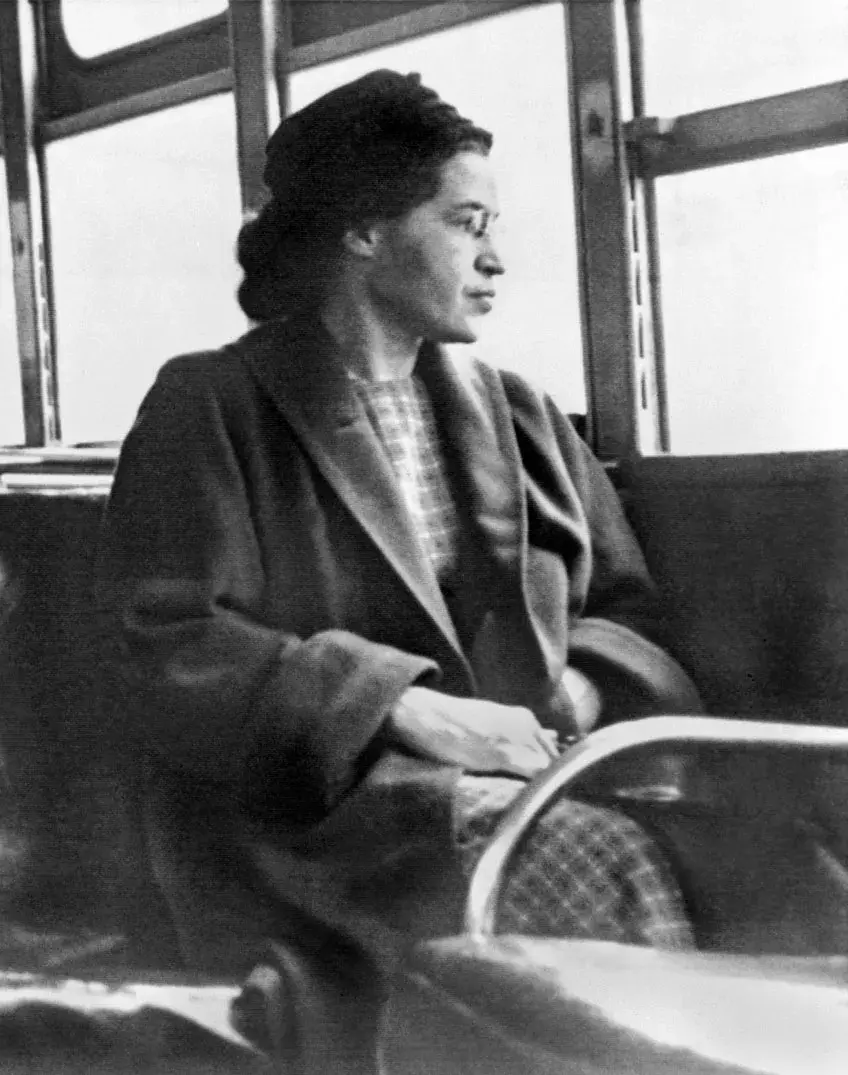
Rosa Parks, NAACP secretary and seamstress, photographed being fingerprinted after her December 1, 1955 arrest in Montgomery, Alabama — the arrest that launched the Montgomery Bus Boycott.
United States · Civil Rights Movement

Rosa Parks

Rosa Louise McCauley was born on February 4, 1913, in Tuskegee, Alabama, the daughter of James McCauley, a carpenter, and Leona Edwards McCauley, a teacher, and grew up in the specific conditions of rural Alabama's racial order before moving with her family to Montgomery where she attended the Alabama State Teachers College and where she met and married Raymond Parks, a barber and NAACP member, in 1932. She joined the NAACP in the late 1930s, became the Montgomery branch's secretary — working directly under E.D. Nixon — and spent the following thirteen years doing the unglamorous, patient work of civil rights organising that the standard narrative of the Montgomery Bus Boycott obscures in favour of the single dramatic moment of her arrest: she investigated rape cases involving Black women and white perpetrators for the NAACP, organized voter registration drives, connected Montgomery's Black community to the broader national civil rights network, and maintained the organisational relationships that made the movement possible. In the summer of 1955, she attended the Highlander Folk School in Monteagle, Tennessee — the interracial civil rights training institute run by Myles Horton where Septima Clark also worked — where she received formal training in civil rights organising and where she encountered, for perhaps the first time in her life, a fully integrated social environment. She returned to Montgomery in the fall of 1955. On December 1, 1955, she boarded the Cleveland Avenue bus after a day's work as a seamstress at Montgomery Fair department store. The bus filled, and the driver asked the Black passengers in the first row of the Black section to move back to make room for a white passenger. Rosa Parks did not move. She was arrested, taken to jail, and charged with violating Montgomery's bus segregation ordinance. She called E.D. Nixon from jail. Nixon arranged bail through lawyer Clifford Durr and his wife Virginia. Nixon called Parks at home and asked whether she was willing for her case to be used as the legal and political foundation for a direct challenge to bus segregation. She said yes. Nixon called the ministers and organised the meeting that produced the Montgomery Improvement Association and selected Martin Luther King Jr. to lead it. The next morning the buses ran nearly empty. The boycott lasted 381 days. The Supreme Court's ruling in Browder v. Gayle desegregated the buses. Rosa Parks was not the first Black woman to refuse to give up her seat on a Montgomery bus — Claudette Colvin had done so nine months earlier — but she was the person whose case the movement chose to make its test case because she was, in E.D. Nixon's assessment and in the assessment of everyone who knew her work, exactly the right person: a woman of irreproachable dignity, deep organisational commitment, and the specific quality of quiet determination that communicated itself most powerfully to the audiences the movement needed to reach. She moved to Detroit in 1957, worked for Congressman John Conyers for twenty years, continued to be a civil rights activist and advocate throughout her life, and died on October 24, 2005, in Detroit, at the age of ninety-two. She lay in honour at the United States Capitol Rotunda — the first woman to do so.

United States Montgomery Boycott NAACP Highlander Folk School Civil Rights Icon Detroit

Born: 4 February 1913, Tuskegee, Alabama, USA  |  Died: 24 October 2005, Detroit, Michigan, USA — aged ninety-two

At a Glance

Full NameRosa Louise McCauley Parks; born 4 February 1913, Tuskegee, Alabama; married Raymond Parks 1932; joined NAACP late 1930s; became Montgomery NAACP branch secretary under E.D. Nixon; attended Highlander Folk School summer 1955; arrested December 1, 1955; her case used as foundation for Montgomery Bus Boycott; moved to Detroit 1957; worked for Congressman John Conyers 1965-1988; received Presidential Medal of Freedom 1996; received Congressional Gold Medal 1999; died 24 October 2005, Detroit, Michigan, aged ninety-two; lay in honour in the U.S. Capitol Rotunda
Born4 February 1913, Tuskegee, Alabama; parents James McCauley and Leona Edwards McCauley; grew up in rural Alabama; moved to Montgomery; attended Alabama State Teachers College; married Raymond Parks, a barber and NAACP member, in 1932; their marriage was a civil rights partnership as well as a personal one — Raymond Parks was involved in the defence of the Scottsboro Boys at the time they married and Rosa was supporting his organising work before she became involved formally herself
Died24 October 2005, Detroit, Michigan; died of natural causes at the age of ninety-two; had been in declining health for several years; her death was mourned nationally and internationally as the passing of one of the civil rights movement's most enduring symbols; she lay in honour in the U.S. Capitol Rotunda for two days — the first woman and second Black American to receive this honour; her funeral in Detroit was attended by thousands
Thirteen Years as NAACP SecretaryServed as secretary of the Montgomery NAACP branch from the early 1940s until the boycott, working under E.D. Nixon; her work included investigating rape cases involving Black women and white perpetrators — cases that the Alabama legal system routinely dismissed but that the NAACP documented and publicised as part of the broader campaign against racial injustice; organised voter registration drives; managed the branch's records and correspondence; maintained the community relationships that the Montgomery movement drew on when the boycott began
Highlander Folk School, Summer 1955Attended the Highlander Folk School in Monteagle, Tennessee in the summer of 1955, approximately five months before her arrest; Highlander was an interracial civil rights training institute where Myles Horton and Septima Clark trained civil rights organisers; Parks's attendance at Highlander gave her formal organising training and exposed her to a fully integrated social environment; she returned to Montgomery in the fall of 1955 with a reinforced commitment to the civil rights work she had been doing for more than a decade
The December 1 ArrestOn December 1, 1955, boarded the Cleveland Avenue bus after work at Montgomery Fair; the bus filled; driver James Blake asked the Black passengers in the first row of the Black section to move back; Parks did not move; Blake called the police; Parks was arrested and charged; she has described her decision as not a result of tired feet but of being tired of giving in — a statement about the political meaning of the act rather than its physical occasion; she was calm, composed, and clear about what she was doing
The Choice to Use Her CaseE.D. Nixon's decision to use Parks's case as the foundation for the boycott was not automatic — Claudette Colvin had refused to give up her seat nine months earlier, and Nixon had declined to use her case as the test case partly because of specific aspects of her personal situation; Nixon's assessment of Parks — her irreproachable personal reputation, her years of NAACP work, her dignity and composure, her freedom from the specific vulnerabilities that he had identified in Colvin's situation — made her the right choice for the political and legal challenge that the movement had been preparing for and that her arrest now made possible

Tuskegee, Montgomery, and the Thirteen Years Before the Arrest

The standard narrative of Rosa Parks's December 1, 1955 refusal presents it as a spontaneous act — the tired seamstress who simply didn't feel like giving up her seat — in a way that is both false to the facts and disrespectful to the person it claims to honour. Parks was not a spontaneous actor; she was a trained civil rights organiser with thirteen years of NAACP work behind her, a woman who had attended the Highlander Folk School's civil rights training programme five months before her arrest, and a person who had been involved in exactly the kind of long-term preparation for a legal challenge to bus segregation that her arrest made possible. The spontaneous seamstress narrative strips her of her actual agency — the agency of someone who was doing something she had prepared for and believed in — and substitutes for it a passive response to personal discomfort that has nothing to do with who she actually was.

She grew up in rural Alabama, came to Montgomery, attended Alabama State Teachers College, and married Raymond Parks — already an NAACP activist engaged in the defence of the Scottsboro Boys — in 1932. The NAACP membership that she eventually formalised was the natural expression of a household where civil rights activism was already part of the texture of daily life. Her work as the Montgomery branch secretary under E.D. Nixon, beginning in the early 1940s, included among its most difficult and most important work the investigation of rape cases — Black women raped by white men, cases that the Alabama legal system reliably dismissed but that the NAACP documented and publicised. This work required courage, discretion, and the ability to maintain relationships of trust with victims who had every reason to believe that speaking publicly would make their situations worse.

Her attendance at the Highlander Folk School in the summer of 1955 — where she met Septima Clark, where she encountered the integrated social environment that Highlander maintained deliberately and that was genuinely rare in 1955 — reinforced a commitment that was already deep and gave her formal training in the organising methods she had been practising for years. She returned to Montgomery five months before her arrest with a clearer sense of what the movement was building toward and a reinforced personal commitment to being part of building it.

December 1, 1955: What She Did and Why It Worked

Parks has described her decision on December 1, 1955, in terms that make clear it was not primarily a physical decision about her feet or her exhaustion: she was tired of giving in. The tiredness she was describing was not physical but political — the accumulated exhaustion of a person who had spent thirteen years documenting the racial order's injustices, who had been refused service, who had been required to navigate the specific humiliations of Montgomery's bus system throughout that time, and who on that particular evening decided that she was not going to navigate them any further. The decision was personal and it was also political; it was individual and it was also the expression of everything the movement had been building toward.

Her composure during and after the arrest was characteristic of who she was and was strategically important. She did not argue with the arresting officers; she did not create a scene; she was quiet, dignified, and clear. She called E.D. Nixon from jail. Nixon arranged bail through lawyer Clifford Durr and his wife Virginia Foster Durr, who were among the small number of white Montgomerians actively supporting the civil rights movement. Nixon called Parks at home, explained that her case could be used as the foundation for the legal and political challenge to bus segregation, and asked whether she was willing. She consulted her husband and her mother and called Nixon back to say yes. The boycott began the next morning.

The decision to use her case rather than Claudette Colvin's earlier refusal was Nixon's, and it was a strategic assessment of which case would be most defensible in the specific political and legal context the movement was operating in. Parks's personal reputation — her years of NAACP work, her standing in the community, her irreproachable personal conduct — made her the test case that the movement needed. She had, without calculating for it, become exactly the right person to be in exactly the right seat at exactly the right moment.

Detroit, Congress, and the Life After Montgomery

Parks and her husband Raymond left Montgomery in 1957, driven partly by the economic harassment that had made it impossible for either of them to find or maintain employment in the city where her refusal had launched the boycott. They moved to Detroit, where her brother Sylvester McCauley already lived, and where Parks eventually found work and community in the city's substantial Black population. The economic consequences of her act — the loss of her seamstress job, Raymond's loss of his barbershop work, the impossibility of employment in Montgomery — were costs that the standard narrative of the boycott rarely emphasises but that were real and sustained.

Her work for Congressman John Conyers, which began in 1965 and continued until 1988, was her most sustained post-Montgomery employment — an administrative and constituent services role that kept her connected to political life without placing her in the movement's formal leadership. She continued to be a civil rights activist and advocate throughout these years, speaking, attending events, lending her presence to causes that the movement she had helped to launch was still pursuing. She was not retired from the movement; she was participating in it in the form that the post-legislative era made appropriate.

She received the Presidential Medal of Freedom in 1996 and the Congressional Gold Medal in 1999 — two of the highest civilian honours the United States government bestows — and she died in October 2005 at the age of ninety-two, having outlasted almost everyone who had been part of the movement she helped to launch. She lay in honour in the Capitol Rotunda for two days, the first woman to receive this distinction. The honour was appropriate, even if the narrative that accompanied it — the spontaneous seamstress, the tired feet — was not. She was not spontaneous. She was prepared. The preparation was what made the spontaneous moment possible, and the preparation was the product of thirteen years of civil rights work that the icon narrative has always been more comfortable forgetting.

Other Civil Rights Movement Profiles

USA · Civil Rights E.D. Nixon Montgomery NAACP leader who had recruited Parks as branch secretary, bailed her out, and made the decision to use her case as the boycott's foundation USA · Civil Rights Claudette Colvin Refused her Montgomery bus seat nine months before Parks — the earlier refusal that Nixon decided not to use as the test case USA · Civil Rights Martin Luther King Jr. The young minister selected to lead the MIA whose leadership Parks's refusal made necessary and whose career her refusal launched USA · Civil Rights Fred Gray Montgomery attorney who represented Parks at her trial and who filed the Browder v. Gayle case that legally desegregated the buses USA · Civil Rights Septima Clark Citizenship education pioneer at Highlander Folk School where Parks received her 1955 civil rights training USA · Civil Rights Jo Ann Robinson Women's Political Council leader who produced the boycott leaflets through the night of December 1 alongside E.D. Nixon's organising USA · Civil Rights Fannie Lou Hamer Mississippi voter registration activist who was thinking of Emmett Till when Parks refused — who embodied the same tradition of quiet, determined refusal USA · Civil Rights Harriet Tubman The nineteenth century's most celebrated example of a Black woman whose courage changed history — the tradition Parks inherited USA · Civil Rights Sojourner Truth Escaped slave who refused to accept the terms of racial subjugation — the earlier tradition of refusal that Parks continued USA · Civil Rights Emmett Till Was thinking of when she refused to move — the murder three months before her arrest that was in the consciousness of every Black person who resisted in December 1955
Share X Facebook WhatsApp LinkedIn