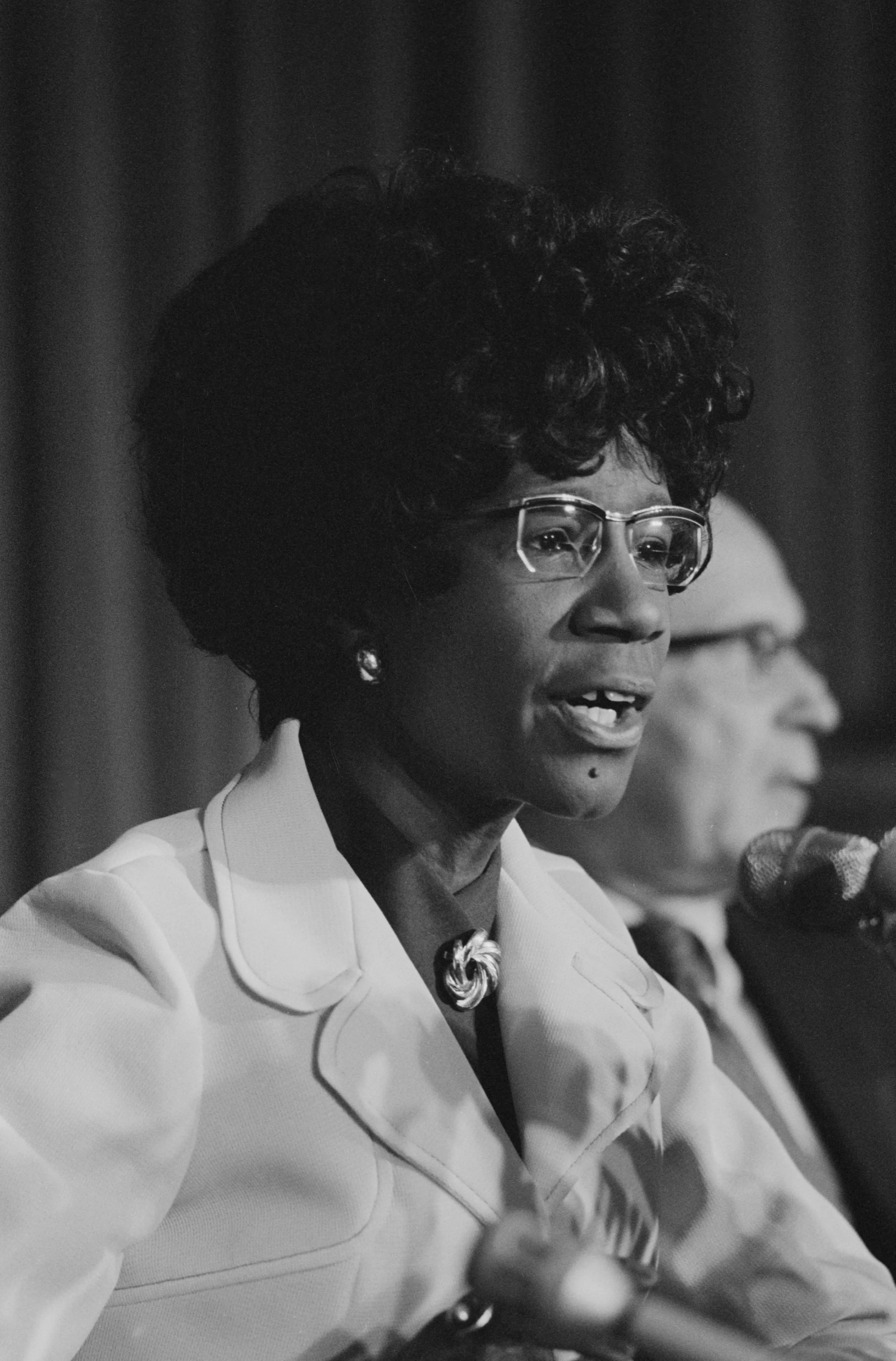
Shirley Chisholm, first Black woman elected to Congress and first Black major-party presidential candidate, who ran in 1972 'unbought and unbossed' and whose campaign opened the door that Barack Obama and Kamala Harris later walked through.
United States · Civil Rights Movement

Shirley Chisholm

Shirley Anita St. Hill was born on November 30, 1924, in Brooklyn, New York, the daughter of Charles St. Hill, an unskilled factory worker from British Guiana, and Ruby Seale St. Hill, a seamstress from Barbados, and grew up spending several years of her childhood with her maternal grandmother in Barbados — an experience she later credited with giving her the strong sense of personal identity and the West Indian directness that distinguished her from American-born politicians who had been shaped by the specific expectations of the American racial order. She attended Brooklyn College, earning her degree in sociology in 1946, and Columbia University, earning her master's degree in early childhood education in 1952, and built her early career as an educator and community organiser in Brooklyn's Bedford-Stuyvesant neighbourhood — the largest Black urban community in the northeastern United States and one of the most politically underrepresented. She served in the New York State Assembly from 1964 to 1968 before becoming the first Black woman elected to the United States Congress in 1968, winning New York's 12th congressional district seat on the slogan "Unbought and Unbossed" — a phrase that captured both her independence from the political machines that had controlled Black political participation in New York and her independence from the gender expectations that had shaped every political campaign before hers. She served in Congress for seven terms, from 1969 to 1983, serving on the House Education and Labor Committee and the Rules Committee, co-founding the Congressional Black Caucus in 1971, and consistently advocating for the most underrepresented constituencies — the poor, women, children, and people of colour — in terms that made clear that she regarded their interests as the same cause. In 1972 she ran for the Democratic presidential nomination — the first Black major-party presidential candidate in American history and the first woman to seek a major-party presidential nomination through the actual primary and caucus process rather than as a symbolic gesture. She won 151.95 delegate votes at the convention, more than most people expected and far fewer than she deserved. She faced opposition from the political establishment, from white women's groups who preferred other candidates, and from parts of the Black political establishment who regarded her candidacy as premature or impractical. She ran anyway, in the specific way she ran everything: directly, without apology, in the conviction that the barriers she was challenging needed to be challenged whether or not the challenge was immediately successful, because the challenge itself was part of how barriers fall. She retired from Congress in 1983, taught at Mount Holyoke College, and died on January 1, 2005, in Ormond Beach, Florida, at the age of eighty. President Obama posthumously awarded her the Presidential Medal of Freedom in 2015.

United States First Black Congresswoman 1972 Presidential Campaign Congressional Black Caucus Bedford-Stuyvesant Unbought and Unbossed

Born: 30 November 1924, Brooklyn, New York, USA  |  Died: 1 January 2005, Ormond Beach, Florida, USA — aged eighty

At a Glance

Full NameShirley Anita St. Hill Chisholm; born 30 November 1924, Brooklyn, New York; parents Charles St. Hill (from British Guiana) and Ruby Seale St. Hill (from Barbados); spent childhood years in Barbados with maternal grandmother; BA from Brooklyn College 1946; MA in early childhood education from Columbia University 1952; married Conrad Chisholm 1949; New York State Assembly 1964-1968; elected to U.S. House of Representatives 1968 (first Black woman elected to Congress); served seven terms 1969-1983; ran for Democratic presidential nomination 1972; co-founded Congressional Black Caucus 1971; taught at Mount Holyoke College; married Arthur Hardwick 1977; died 1 January 2005, Ormond Beach, Florida, aged eighty
Born30 November 1924, Brooklyn, New York; grew up partly in Barbados with her maternal grandmother, an experience she credited with giving her the strong sense of personal identity and West Indian directness that distinguished her from American-born politicians; her Caribbean formation gave her a perspective on American racial politics that was simultaneously inside and outside it — she understood it with the clarity of someone who had also seen what life looked like without its specific constraints
Died1 January 2005, Ormond Beach, Florida; died of complications from multiple strokes at the age of eighty; had been in declining health since a series of strokes in 2001; was posthumously awarded the Presidential Medal of Freedom by President Obama in 2015; her 1972 presidential campaign was the subject of renewed historical attention after the 2008 and 2020 elections made clear the specific doors she had opened
First Black Congresswoman, 1968Won election to New York's 12th congressional district in 1968, defeating the Republican candidate James Farmer (the CORE founder) to become the first Black woman elected to the United States Congress; her campaign slogan "Unbought and Unbossed" communicated her independence from the Brooklyn Democratic machine that had traditionally controlled Black political participation in the borough and her refusal to accept the gender constraints that had shaped every political campaign before hers; the slogan became the title of her 1970 autobiography
The 1972 Presidential CampaignAnnounced her candidacy for the Democratic presidential nomination on January 25, 1972 — the first Black major-party presidential candidate and the first woman to seek a major-party presidential nomination through the actual primary process; campaigned in twelve states and won delegates in several; received 151.95 delegate votes at the Democratic National Convention in Miami Beach; faced opposition from the political establishment, from white women's groups who preferred other candidates, from George Wallace supporters who were managing their candidate's delegates, and from parts of the Black political establishment who regarded her candidacy as premature; won fewer votes than she deserved and more than most predicted
Congressional Black CaucusCo-founded the Congressional Black Caucus in 1971 alongside Charles Rangel, Ron Dellums, and other Black members of Congress; the CBC's founding was a recognition that Black members of Congress needed a formal organisational structure to coordinate their advocacy and to present their constituency's interests collectively rather than individually; Chisholm's founding role reflected her understanding that individual Black political success required collective Black political infrastructure
Seven Terms in CongressServed in the House of Representatives from 1969 to 1983, on the House Education and Labor Committee and later the Rules Committee; consistently advocated for poor people, women, children, and people of colour; was one of the founding members of the National Women's Political Caucus; opposed the Vietnam War; advocated for childcare legislation; supported the Equal Rights Amendment; brought to her legislative work the same directness and independence that her campaign slogan had advertised and that her seven terms in Washington demonstrated was not a campaign posture but a genuine characterological trait

Brooklyn, Barbados, and the Formation of an Independent Mind

Shirley Chisholm's formation was shaped by the specific experience of a Caribbean immigrant family in Brooklyn — a formation that gave her a double perspective on American racial politics that purely American-born politicians rarely possessed. Her parents Charles and Ruby St. Hill had come from British Guiana and Barbados respectively, bringing with them the specific cultures of British Caribbean societies where race and class intersected differently than in the American South, where Black people occupied a wider range of economic and social positions, and where the specific psychological formation of Jim Crow had not operated in quite the same totalising way.

Her years in Barbados with her maternal grandmother — sent there partly for the better educational opportunities and partly for the stability that her grandmother's household provided while her parents worked to establish themselves in Brooklyn — gave her what she later described as a strong sense of personal identity and the directness that West Indian culture encouraged. She returned to Brooklyn as a teenager with a clearer sense of who she was than many of her peers who had grown up entirely within the American racial order's specific demands, and this self-possession was one of the qualities that would eventually make her political career possible.

Brooklyn College and Columbia University gave her the academic formation that her subsequent career in education and then in politics required, and the specific context of Brooklyn's Bedford-Stuyvesant neighbourhood — the largest Black urban community in the Northeast, politically underrepresented despite its size, commercially underserved despite its economic potential — was the specific political environment in which she built the community organising experience and the political relationships that eventually produced her Assembly seat and then her congressional seat.

Unbought and Unbossed: The Phrase That Named a Career

"Unbought and Unbossed" was not merely a campaign slogan but an accurate description of the political position that Chisholm occupied throughout her career. The Brooklyn Democratic machine had been the primary instrument of Black political inclusion in the borough — but inclusion on the machine's terms, which meant Black political figures who were reliable participants in the machine's networks of patronage and loyalty rather than independent advocates for their constituents' interests. Chisholm's refusal to operate on these terms — her insistence on representing the people who elected her rather than the political forces that controlled access to office — was the substance behind the slogan, and it cost her the support that machine politicians received and gave her the independence that made her useful to the people she was supposed to serve.

Her defeat of James Farmer in the 1968 congressional race was itself a demonstration of this independence: Farmer was a nationally known civil rights figure, the founder of CORE and one of the movement's Big Six, and he was the Republican candidate; her willingness to compete against him on the basis of who would better serve the district's residents — rather than on the basis of who was more famous or who had better national civil rights credentials — was characteristic of how she understood her mandate.

Her seven terms in Congress were equally characteristic: she was not a legislator who accumulated power through strategic deference to leadership or through the kind of long-term relationship building with colleagues that produced committee chairmanships and floor influence. She was a legislator who said what she thought, advocated for what she believed, and accepted the institutional costs of that independence without apparent regret. The Rules Committee seat she eventually achieved was evidence that the independence had not prevented some accumulation of institutional influence; but the independence was always the primary trait, and the influence was secondary.

The 1972 Campaign: Opening the Door That Others Walked Through

Chisholm's 1972 presidential campaign was the most consequential act of her career, not because it came close to winning — it did not — but because of what it demonstrated and what it made possible. It demonstrated that a Black woman could mount a credible national campaign for a major party's presidential nomination, compete in primaries across multiple states, win delegates, and address a national convention as a candidate rather than as a surrogate. It made possible the campaigns that followed: Jesse Jackson's 1984 and 1988 campaigns, which explicitly built on the precedent she had set; Barack Obama's 2008 campaign, which was the first to convert Black presidential candidacy into an actual major-party nomination; and Kamala Harris's 2020 vice-presidential campaign, which was the first to convert it into a national office.

The opposition she faced was multiple and sometimes came from unexpected directions. The white women's movement, which might have been expected to support the first woman to seek a major-party presidential nomination through the actual primary process, largely preferred other candidates — George McGovern or Hubert Humphrey — who were less threatening to the alliances those movements had built with the Democratic establishment. Parts of the Black political establishment regarded her candidacy as premature, impractical, and a potential drain on the political capital that Black politicians needed to build rather than spend on symbolic gestures. She encountered both forms of this opposition directly and continued anyway.

Her campaign's 151.95 delegate votes at the Miami Beach convention were more than most people had predicted and fewer than the significance of her candidacy warranted. She gave a speech to the convention that was, by most accounts, one of the most important speeches delivered at any major-party convention in the twentieth century — a statement of what the Democratic Party owed to the constituencies it had been asking for votes without adequately serving, delivered by someone who had earned the right to make the demand by having actually competed in the process rather than merely commenting on it from outside.

Legacy: The Door She Opened and the Recognition She Received Late

Chisholm retired from Congress in 1983, taught political science at Mount Holyoke College in Massachusetts, and spent her later years in declining health. The strokes she suffered in 2001 affected her cognitive capacity and prevented her from fully engaging with the renewed historical attention that her 1972 campaign received as subsequent Black and women candidates built on its precedent. She died on January 1, 2005, before Barack Obama had announced his presidential candidacy and years before Kamala Harris became the first Black woman vice president of the United States.

President Obama's posthumous award of the Presidential Medal of Freedom to Chisholm in 2015 was an acknowledgment from the person whose career most directly demonstrated what her candidacy had made possible. The specific form of the acknowledgment — a Black president honouring the Black woman who had run for president decades before he did — was the kind of historical symmetry that made the belated recognition feel like something more than consolation. She had opened the door; others had walked through it; the people who walked through it eventually acknowledged what she had done.

Other Civil Rights Movement Profiles

USA · Civil Rights Jesse Jackson Who built his 1984 and 1988 presidential campaigns explicitly on the precedent Chisholm's 1972 campaign had established USA · Civil Rights Fannie Lou Hamer Mississippi Freedom Democrat who ran for Congress in 1964 — the grassroots electoral tradition Chisholm brought into national mainstream politics USA · Civil Rights Ella Baker Whose group-centred leadership philosophy stood in contrast to Chisholm's charismatic individual candidacy — both necessary, both underappreciated USA · Civil Rights Dorothy Height NCNW leader whose institutional approach to advancing Black women's interests paralleled Chisholm's electoral approach USA · Civil Rights Pauli Murray Who co-founded NOW and whose Jane Crow analysis named the double discrimination that Chisholm's candidacy challenged simultaneously USA · Civil Rights Julian Bond Who was nominated for vice president at the 1968 DNC — the earlier nomination-that-couldn't-happen that preceded Chisholm's 1972 campaign USA · Civil Rights James Farmer CORE founder who Chisholm defeated in the 1968 congressional race — whose defeat demonstrated that civil rights credentials could not substitute for community representation USA · Civil Rights A. Philip Randolph Fellow Caribbean-American who built Black political power through labour organising — the parallel tradition to Chisholm's electoral approach USA · Civil Rights Martin Luther King Jr. The movement's moral authority that Chisholm's political career was translating into institutional power — different domains, same project USA · Civil Rights Rosa Parks Whose refusal to be displaced made a political opening — and who, like Chisholm, was claimed by everyone who came after her and remembered as less strategically conscious than she actually was
Share X Facebook WhatsApp LinkedIn